
Up close and personal with a whole lot of trees — and fruit.
One of the things that has been keeping me very busy — at least lately — this summer is my work as a cherry drying pilot.
What It’s All About
In brief: During the last three or so weeks that cherries are on the trees, if they get wet, they can become damaged — usually splitting or developing mold. Growers who don’t want to lose their crop hire helicopter pilots to stand by during cherry season. After a rain, they call us out to hover over trees. The downwash from our rotor blades shakes the branches, thus shaking off accumulated water.
There’s a lot more I can say about this, but I don’t think it’s necessary. As I mentioned here, the work can be dangerous and requires good flying skills. (There was an accident in an orchard just the other day that was likely caused by a failure to respect density altitude in a heavy helicopter. Both occupants survived uninjured; the helicopter didn’t.) It’s not for low-time pilots. And it’s a crappy way to build time — I was here 6 weeks before I was called out to fly at all and, now seven weeks in, I’ve only flown about 9 hours.
Oh, and did I mention how incredibly tedious the work is?
Some Snapshots
Anyway, yesterday I was called out twice to dry. There was a 15-acre orchard that I had to dry twice and a 40-acre orchard that I dried just once. Add that acreage together and you get 70 acres of cherry trees.
For my second call out, I mounted my GoPro “nosecam” on the helicopter. I actually have video from that viewpoint of both orchards I dried on that call. It’s not very exciting stuff. As I type this, I’m debating on whether to throw a few minutes’ worth into a video to share. I wouldn’t want to put anyone to sleep.
I did, however, pull out a few still images as photos to share here.
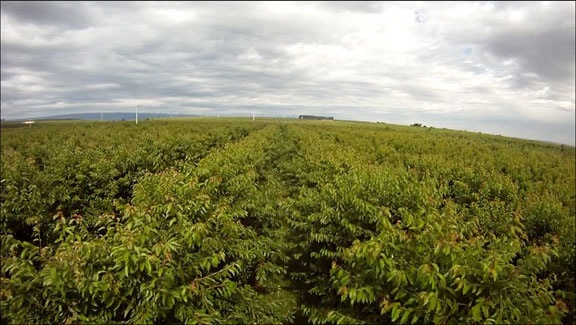
This is a typical view down an aisle of cherry trees. I fly very low.
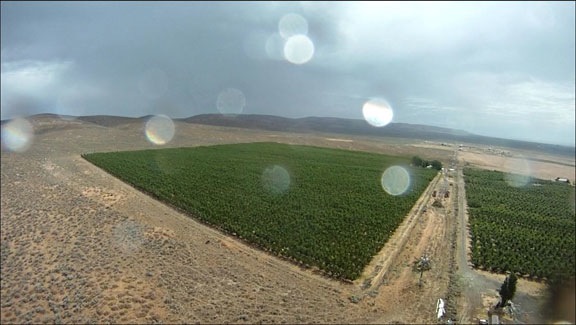
Here’s a shot as I approached the 40-acre orchard block. You’re looking at hundreds, if not thousands, of trees. It was still raining lightly as I flew up. I took the opportunity to land near the orchard and pull my door off. When the sun comes out, it gets very hot in the cockpit — especially when you’re wearing a Nomex flight suit and helmet.
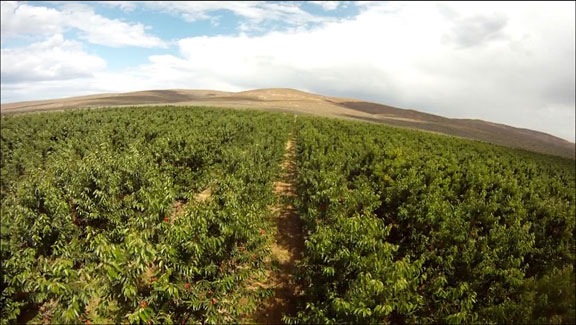
Here’s another drying shot. These trees are younger than the ones in the smaller orchard and were heavy with fruit, which you may be able to see in this shot. The sun was out for much of this dry, so time was of the essence.
Serious Business
Cherry drying is serious business. My client is paying me good money to sit around and wait for the rain. When the rain comes, it’s my job to quickly and effectively dry his trees. If I fail to do my job, my client can lose his entire crop. That could be hundreds of thousands of dollars worth of fruit, the difference between a profitable year and a year living on credit.
It’s a huge responsibility that I take very seriously.
The next time you eat fresh US-grown cherries, think about the folks in the production chain that put those cherries on your plate. I might be one of them.
Discover more from An Eclectic Mind
Subscribe to get the latest posts sent to your email.
I work at a Berkeley restaurant. I read your earlier reports a couple of years ago, and I do think of you and the cherry growers when I prepare cherries for desserts. (I should specify that I think well of you and the growers and pickers, and the truckers, even while pitting pounds and pounds of cherries.)
Local markets get Wenatchee-labeled cherries, perhaps some that you’ve dried. (I haven’t seen Washington cherries yet this year.) I appreciate the fruit, and any food, all the more for understanding the collective effort in getting it to my table.
Thanks for the info and the pictures!
The Washington cherry season is VERY late this year. They just finished picking Mattawa about a week ago and are now picking close to Wenatchee. Some of my Quincy area growers won’t pick until July month end or even August! A lot of the cherries go to Asia, if you can believe that.
For another look at the world of cherry production, you might want to check out a video I made last year, Cherries: From Tree to Truck. It covers the picking process at one of the orchards I work for. It’s only five minutes and isn’t bad for a first serious effort, if I do say so myself.
Hello,
I came across your blog when…. hmmmm …. actually, I’m not entirely sure how it happened now, but I suspect through a photography link of some kind. I don’t have anything specific to say about this particular item, other than that this use of helicopters is not one I’d ever heard of before, and I can see that it may partially explain why cherries are not the least expensive of all available fruit! Very educational.
What I’d really like to do is just thank you for a thoroughly entertaining and well-written collection of posts. I’ve been working my way through many of the blog-writing articles, as well as several of those about helicopters. Given that I have no specific interest in helicopters, this is clearly a testament to your excellent writing style.
I shall continue to read!
Best wishes,
Mike
Thanks very much for taking the time to comment. These days, I really do need comments to help motivate me to blog. Feeling kind of burned out lately and that I’ve run out of things to say. Your comment gave me a little boost. Hope to get back to writing more regularly here. Thanks!
Update: I was curious to know exactly how many trees are in the 40-acre orchard that appears in the second photo, so I asked the orchardist. He did some quick math and came up with over 17,000 trees. Whoa.
Fascinating post and I also ready your post about your first day flying drying runs. Well written. Question my curiosity begs me to ask: why does density altitude go up with temperature? Gay-Lussac’s pressure temperature law suggests air pressure would go up, not down, with temperature, though humidity likely would too. Is it that the change in air pressureis small compared to increased humidity (and therefore density altitude) or is it something else? I am not yet a pilot, and have only just learned of density altitude from you, here. ✈
You can learn more about density altitude as it applies to flying here: http://flightmonkeys.com/?p=1732
Or try this: http://lmgtfy.com/?q=density+altitude+explained
Thank you!
After over 10000 hours hands on I must agree with the esteemed lady pilot. A 500 hour guy is only just capable of safely doing low level low speed manoevers.
Esteemed. You’re making me blush.
I think one of the biggest problems is that there’s sometimes so much going on. You’re hovering low-level over the trees. The wind might be blowing. There might be rain on the windscreen or there might be sun in your eyes when flying in certain directions — or there might be both. There are wind machines and wires and buildings and tall trees and wind blocks. There might be hills and gullies. There’s chatter on the radio or maybe even incoming phone calls from dispatchers or clients. There’s a lot of stuff going on. What 300-hour pilot with maybe just 30 to 50 hours in an R44 — which is considerably larger than the R22 he probably trained in — is going to be able to handle all that?
Long time since I made a lady blush ! Seriously, you are so right. There is a lot going on flying low slow and careful,but PHONE CALLS ? My passengers do it all the time, me never. Maybe thats why I am still warm.(and friendly,cuddly etc.) Mind the wires. John R
Unfortunately, that’s how I communicate with my clients. I have a Bluetooth setup that’s hands free and all I have to do is push a button to answer I don’t even hang up; the call drops when the caller does. I don’t answer calls unless they’re mission-related. The calls I take are usually short, less than 15 seconds.
I wish I could use the radio for this, but I can’t. Too many clients, too spread out. Even if they all had hand-held aviation radios, I’d never pick up their signals everywhere. But I deal with it, sometimes climbing up out of an orchard or even landing to take a call. It’s just part of my normal workflow now.
Bluetooth is something we got after eating black cherry pies as kids. Just kidding. Thought flying choppers was the ultimate in multitasking when I was training, but I learnt that this was just the beginning. Night combat ops in bad weather with a sick helicopter,3 radios on the go, etc, soon sorted the men from the boys! Safe flying Maria.