Archive

Posts Tagged ‘writing’

The Trouble with Tech Editors

August 30th, 2010 by Maria Langer

Not usually the problem.

From about August 10 until just the other day, I was working on a book revision. It’s my third pass at this software manual that’s now distributed in ebook form. I’m not sure if I’m allowed to mention what it’s for, so I won’t. It doesn’t really matter, does it?

This book was unusual in that for the first time, it was the technical editors that gave me headaches. (Usually, it’s heavy-handed copyeditors.) My publisher waited until the last minute to contract me and everyone else who worked on the book and, because of that, they had trouble getting a good technical editor. They wound up with two people who apparently have nothing better to do than hang out in the support forums for the software and quite possibly hang on every word posted there. The first one worked on Chapters 2-14 before going on vacation. The other one worked on the rest of the 23-chapter book.

The problem I had centered around their apparent misunderstanding of what their job was. The first one kept commenting to tell me to add every known technique for performing each task. I’d decided early on to stick to menu commands and shortcut keys whenever possible, but she kept telling me to add this toolbar button or that hidden dialog option. It got on my nerves until we told her to stop. The other thing she did was introduce obscure problems that people in the forums have, apparently expecting the book to cover them all.

The other tech editor also drew upon his forum experience, this time expecting me to include marketing material that would clarify information about the features so forum participants would have less to complain about. The book’s a straight how-to — technically, it’s the software manual — so addressing the issues of a handful of forum whiners (the worse kind) isn’t part of the program. But what really got me mad was that this second editor was apparently unable to follow the instructions as written and kept telling me that things didn’t work. I’d have to go back and follow the instructions to see where I’d screwed up. But every single time, the instructions worked exactly as I’d written them. This was a huge time suck.

To be fair, they each did have a few comments that were actually worth acting on. I made a handful of changes that improved the book. That’s what their job was — to help me improve the book. But they didn’t seem to understand what would make the book better. All they seemed to know was what would make the book longer.

What neither understood is that I had about 15 days to revise a 600-page book. That’s not enough time to rewrite the book. All I had to do was add or change material for new or changed features. There weren’t many changes. The book, which was originally written by the software developer’s staff, had very few tech edit comments in the two previous editions I worked on. So I couldn’t figure out why these two editors kept coming up with comments that no one else had.

It’s the damn forums, I guess.

The Writing Life , , , ,

Did you enjoy this post? If so, please comment on it or share a little link love:
Add to Del.icio.us Add to Del.icio.us    Technorati This Technorati This    Digg This Digg This    Stumble It Stumble it!    Twit This Tweet This

What Do You Do When the RIGHT Word is a BAD Word?

August 21st, 2010 by Maria Langer

Use the bad word?

I’m trying to write a blog post about a problem I’ve seen that makes the people with this problem seem….well, like assholes.

I can list a bunch of equally “bad” words here, but since I know some of my clients read this, I thought I’d keep it as close to PG rated as I could.

And that’s the problem. I want a word that isn’t one of those “bad” words. I want a word that’s perfectly acceptable in polite company.

Restrained by Niceties

The closest almost polite word I can come up with is jerk, and even that has connotations that are questionable. Besides, it’s not strong enough. These people are beyond jerks. They’re…well, what?

It’s unfortunate that certain words, on their own, should be considered so objectionable that we simply don’t utter them in polite company. George Carlin riffed on this in his famous “The Seven Words” routine. (If you have never seen this routine or haven’t seen it in a while, watch this video. It’s more than just a list of bad words. Carlin was a genius when it came to language.) The reluctance to use “bad” words just makes it difficult for people to express themselves accurately. The word I want is asshole, but I don’t think it’s right to use it because it might offend someone. So I scratch around for the right word and only come up with more of the same.

The Meaning I Want to Convey

Asshole, DefinedThe Thesaurus in my Mac, which I don’t use very often, was no help. It didn’t even include asshole (although the Dictionary did, as shown here).

When I looked up jerk, the synonyms were just as mild as jerk is. Ass was only included because it referred to an animal as well, but it also included the secondary meaning with these wimpy synonyms:

idiot, dolt, simpleton, imbecile; dimwit, halfwit, dummy, dum-dum, loon, jackass, cretin, jerk, fathead, blockhead, jughead, boob, bozo, buffoon, numbskull, numbnuts, lummox, dunce, moron, meatball, doofus, ninny, nincompoop, dipstick, lamebrain, chump, peabrain, thickhead, dumb-ass, wooden-head, pinhead, airhead, birdbrain; nitwit, twit, turkey, goofball, putz; dated tomfool, muttonhead

The word I want doesn’t mean stupid because of some kind of mental deficiency, as these words suggest. It means stupid and offensive because of a mean streak and/or complete lack of regard for other people. That’s what an asshole is, isn’t it?

How about Dick?

Phil Plait used the word dick recently in a speech he gave to a mixed crowd at a skeptics event in Las Vegas this summer. (Highly recommended folks; it’ll help you understand how to be more convincing when trying to make a point.) It might be the least offensive of the words I’ve been able to come up with. But like sucks, I have difficulty using it — partially because I’ve had friends named Dick. (Poor guys.)

What do you, dear reader, think? Is dick okay? Not quite as strong as I want, but the meaning is pretty much there.

Any suggestions? I can’t write the blog post until I have the right word and I do want to get it written. What do you think?

The Writing Life ,

Did you enjoy this post? If so, please comment on it or share a little link love:
Add to Del.icio.us Add to Del.icio.us    Technorati This Technorati This    Digg This Digg This    Stumble It Stumble it!    Twit This Tweet This

Interesting Links, August 19, 2010

August 19th, 2010 by Maria Langer

Here are links I found interesting on August 19, 2010:

This just in... , , , , , , , , , , , , , , , , , , ,

Did you enjoy this post? If so, please comment on it or share a little link love:
Add to Del.icio.us Add to Del.icio.us    Technorati This Technorati This    Digg This Digg This    Stumble It Stumble it!    Twit This Tweet This

Guest Blogger FAIL

August 7th, 2010 by Maria Langer

Another oddity from my inbox.

Here’s today’s message, with the subject “We would like to write an article for your site,” edited to remove identifying information:

Hey there,

We have been reading the articles on your website and are very impressed with the quality of your information.

We have a team of copywriters who specialize in writing articles on various topics and would like to write an original article for you to use on your website – this article will not be used anywhere else on the Internet.

In exchange all we ask is that we can have one or two links within the body of the article back to one of our sites. You can view a sample of the quality of our articles at [redacted].

If you are interested in having us write an article for your website please just let me know and we would be more than happy to have one written for you within two weeks.

Kind regards,
[redacted]

If they’re so impressed with the quality of my information, what makes them think I need a post written by someone else? Isn’t it clear that I can write my own blog posts?

And if it’s my personal blog, what makes them think I’d welcome posts from others? Did they find any posts by others on my blog?

And yes, I do realize that they likely never even looked at my blog. That this is just a form of spam that’s likely to sent out to every blogger they can find contact info for.

The question I take away from this is: Are bloggers so desperate for content that they’ll let strangers do guest posts in exchange for a couple of links?

Needless to say, I’m not interested so I don’t think a response is necessary. No need to put my e-mail address in their spam list. (They had to use a contact form to contact me.)

In a way, they did write a blog post for me. This one.

On Blogging , ,

Did you enjoy this post? If so, please comment on it or share a little link love:
Add to Del.icio.us Add to Del.icio.us    Technorati This Technorati This    Digg This Digg This    Stumble It Stumble it!    Twit This Tweet This

Is Writing a Book Like Riding a Bicycle?

August 6th, 2010 by Maria Langer

Is it possible to forget how?

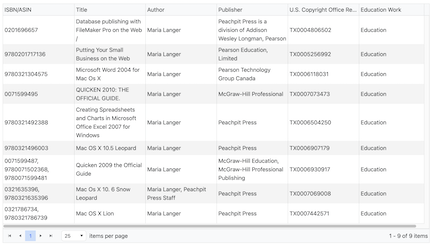
Despite all my blogging about Flying and helicopters, I still earn the bulk of my income as a writer. I’ve been writing computer how-to books since 1991 (depending on which book you consider my first) and have authored or co-authored more than 70 titles since then.

You’d think that by now I could write a book in my sleep. In a way, I can. Or at least I thought I could.

This past week, I began discussions with a publisher I’d never worked with before about two new titles. I you might expect — I certainly did — I was asked to submit an outline for each proposed book. I sat down with Microsoft Word’s outline feature on one laptop and the software I was going to be writing about running on a laptop beside it. And, for longer than I’d like to admit, I felt overwhelmed.

Writing a Book ≠ Revising a Book

Creating Spreadsheets and ChartsYou see, although I’ve got 70+ books under my belt, the vast majority of those titles are revisions. Two of them have been revised at least 10 times. In fact, on consulting my list of books, I realized that the last time I wrote a book from scratch was in 2004 (Creating Spreadsheet and Charts with Microsoft Excel: Visual QuickProject Guide for Peachpit Press), although I did co-author one (with Miraz Jordan) from scratch in 2006 (WordPress 2: Visual QuickStart Guide for Peachpit Press).

And revising a book is not like writing one from scratch.

When I revise a book, I start with the book and its text. There’s no need for a new outline. If the book will need major changes, I might take the existing book’s table of contents, bring it into Word’s outline feature, and modify it to fit the changes into appropriate places. But if the changes are minor — and believe me, quite a few revisions were like that — I didn’t even bother printing the table of contents. Either way, I go through each chapter and read the text, making changes as necessary. I re-shoot all the screen shots — even in books that have hundreds of them. I add sections and remove sections. Occasionally, I’ll move sections around or expand on sections to make them clearer. More and more often these days, I’m asked to remove sections simply to reduce page count. Then I’m done.

But when I write a book from scratch, I’m starting with nothing more than the subject — usually a software program or online service — and a blank outline page. I need to build the outline from scratch, knowing just a few things:

  • The audience. This is usually beginner to intermediate users; I don’t write for advanced users or programmers very often. Knowing the audience is important; it enables me to make assumptions about their experience and goals. My audience has changed in the 20 or so years I’ve been doing this. In the old days, I often had to begin with basics like how to point and click and close windows. Now I can assume my readers know all that and get on with topic-specific content.
  • The series. Most of my books are part of a book series. In the past, I’ve authored the first book in a series, but that’s not common. I like writing series books. They give me an idea of the style and format my editors want. I can visualize the final pages as I write. Heck, for some books — Peachpit’s Visual QuickStart Guide series, for example — I actually lay out the pages as I write.
  • The software or service. That’s my subject matter. I need to know the software or service very well to know what I’m going to write about. Often, I’m working with beta software that’s not quite ready for prime time or, worse yet, changes as I write. I have to explore menus and palettes and dialogs. I have to try things to see what happens. I have to learn so I can teach.
Don’t Torture Yourself
I always write with the software or service I’m writing about running on a second computer. Anyone who tries to write a book without being able to reference the subject matter while writing is putting himself through a lot of unnecessary torture.

The trick is to build an outline from the ground up, knowing where to start and where to end and how to get from one point to the next. Each chapter should have a logical flow, starting with the basics and moving on to more complex topics. I can’t explain how to perform one task until I’ve already explained how to perform the subtasks that are part of it. For example, I can’t write about formatting text until I’ve explained how to select the text to format and why selecting that text is important.

Have I Lost My Touch?

It’s this logical flow of things that had me stalled this week as I struggled with the two outlines. I seemed to have lost my touch. I couldn’t focus on the software and approach it as a new user might.

What made matters worse was that the editor I was working with gave me outlines to start with. I wasn’t sure whether he wanted me to follow those outlines or build my own. The outline for one of the books was very good. I wouldn’t have had any problem using it as a basis for my book. But I felt weird about using someone else’s outline — even if I had permission to do so. It was almost as if I were copying someone else’s work. I didn’t like that idea at all.

That meant I had to come up with an entirely different approach.

And that’s what stalled me. My mind went blank and I simply couldn’t think of another way to do it.

I’ve Still Got It

Putting the other outline aside and concentrating on the software is what saved me. I was eventually able to focus on the software. I started writing Part names, Chapter names, and A-Head names, following the style used in the series. I shuffled heads around. One thing led to another, just like it always had.

When I was halfway finished and clearly comfortable with my own approach, I consulted that other outline to make sure I covered all the applicable topics that it did. Since the other book was about the Windows version of the software (for the same publisher), only about 80% of the topics applied my Mac version book. My outline presented them in a completely different order, building skills along a different path.

Looking back on it, I realize that my outline is more like one of my outlines and wonder what I’d liked about the other outline in the first place.

Back on the Bicycle

I find it more difficult to write an outline than a book. That might sound strange, but it’s true. Getting the organization settled is the hardest part for me. Once I have that blueprint, I can start building pages.

With the initial period of uncertainty mostly behind me — at least on one of the two projects — I’m looking forward to writing a new book and working with new people. I’m hoping I get some good feedback from my editor on the outline and that we can work together to fine-tune it to meet the publisher’s needs. The contract comes next and then the writing. It’s all part of a workflow I’m quite familiar with.

Now if only I could knock out that second outline…

The Writing Life , , ,

Did you enjoy this post? If so, please comment on it or share a little link love:
Add to Del.icio.us Add to Del.icio.us    Technorati This Technorati This    Digg This Digg This    Stumble It Stumble it!    Twit This Tweet This