The Long Drive with the Long Trailer

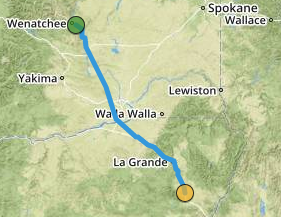
I move my mobile mansion from Wenatchee to Lake Powell.

I’ve been traveling for the past week or so, starting in Wenatchee Heights, WA and ending in Phoenix, AZ.

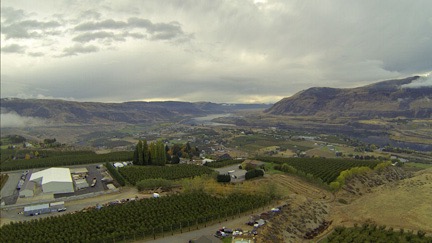
Day 1I left Wenatchee Heights with my 5th wheel RV hooked up behind my husband’s Chevy pickup. The first day’s drive was relatively short: from Wenatchee Heights to Walla Walla, a distance of only 190 miles. Only a small portion of the drive was on a freeway (I-90); the rest was on back roads through farmland.

It rained for part of the drive, but never enough to make the road slick. I took my time. The trailer weighs in at 15,000 pounds and although it tows well, I can never really forget that it’s back there.

At Walla WallaIn Walla Walla, I stayed at the Blue Valley RV Park. It was a relatively pleasant place, with average sized RV spots, full hookups, picnic tables and grass. The trees were too young to give shade, but I bet they’ll be nice in about 5 years. The main building had a pool table, laundry room, and restrooms. Everything was clean and the place was quiet. I got some laundry done, wrote an article for AircraftOwner Online, and relaxed.

I had dinner at two excellent local restaurants: T. Maccarone’s and Saffron Mediterranean Kitchen. It was nice to have a change of scenery. I was there for four nights. The wine with my dinner at T.Maccarone’s is what sent me to Dusted Valley Winery for a tasting, where I bought four bottles of wine.

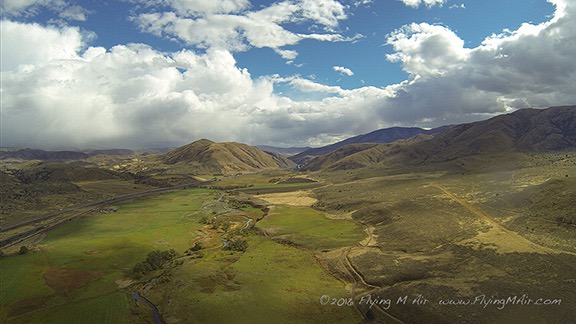
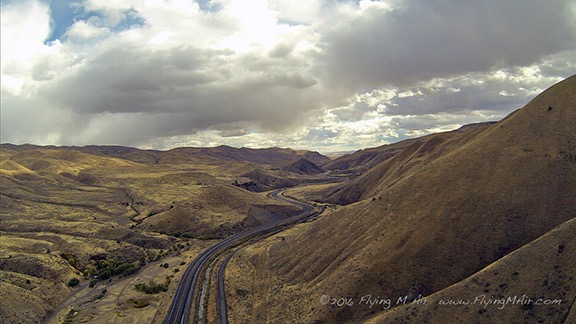
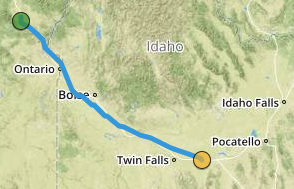
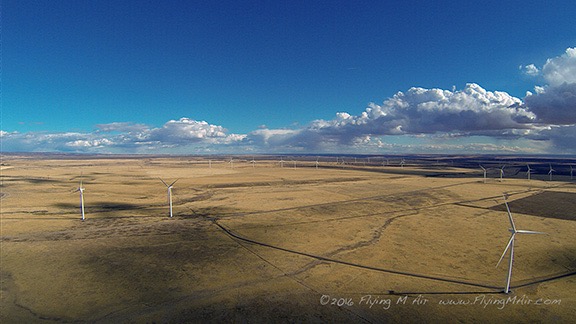
Day 2 of the DriveOn Friday night, I got the trailer hooked up again and mostly ready to go. I needed to be on the road early for the next leg of my trip: from Walla Walla, WA to Draper, UT (south of Salt Lake City), a distance of 606 miles. I was on the road not long after dawn. The route took me south almost to Pendleton, OR, then onto I-84 through Oregon and Idaho and down into Utah, where I picked up I-15. The landscape started with farmland, then mountains, then more flat farmland, then more mountains, and then finally into the Salt Lake basin. I’d driven the route before with my underpowered Ford F150 pickup towing my old 22-foot Starcraft. It wasn’t fun then; Saturday’s drive was much more tolerable. I stopped three times for fuel and twice for food. It was very unlike me to make so many stops; I usually try to get food and fuel on the same stop, but the situation made that tough. I rolled into Draper, UT’s Camping World parking lot at 6:15 PM local time, just 15 minutes after the store closed. I’d called the week before and knew I could park out back, so I did. I even got to hook up 50 amp power.

Ann TorrenceOn Sunday, @AnnTorrence picked me up for a drive to Ft. Bridger, WY. There was a Mountain Man Rendezvous there with hundreds of people in period clothes set up with period campsites. The “period” was apparently mid 1800s. Ann was there to take photos and research a possibly future book project. I was there to take pictures and look around and have a day off from driving. I didn’t take a single photo, although I carried my camera bag around all day. Well, that’s not true. I did use my BlackBerry to take this shot of Ann. She, in turn, used her iPhone to take a shot of me with my only purchase: a genuine raccoon skin, which I hope to turn into a hat.
After a very pleasant lunch at Cafe Trio in Salt Lake City with Ann and her husband, Robert, I went back to their house to relax on the front porch. @BWJones showed up and I finally got to meet him in person. After a tour of the garden, Ann and Robert returned me to Draper for the evening. Again, Camping World had just closed for the day. No one had left any notes on the RV or truck (which was still attached) and the power was still connected. Alex the Bird entertained us for a while.

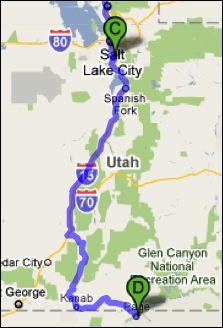
Day 3Monday — Labor Day — was my last drive day. I drove from Draper, UT to Page, AZ, a distance of 370 miles. I got a very early start, pulling out of the parking lot at 6:30 AM local time. By the time I stopped for fuel two hours later, I’d already gone more than 100 miles. (I parked with the big rig trucks and discovered that my rig was about as long as theirs.) This part of the drive was mostly on I-15, but started east on route 20 to Highway 89, which took us all the way to Page. The roads were mountainous and there was a lot of climbing and descending. There were also a lot more vehicles on the road, making driving a bit more of a chore.

Thunderbird RestaurantThe only food stop I made along the way was at the Thunderbird Restaurant at Mount Carmel Junction. The place is a bit of a tourist trap, but it does have good “ho-made” pies (whatever that means). Odd thing happened when I tried to leave. They couldn’t give me a bill because the computer was down. Apparently no one knows how to do basic math. All I had was a piece of pie with ice cream and an iced tea. They apparently expected me to wait until the computers came back online. With Alex the Bird in the front seat of the car, that was not an option. Finally, my waitress disappeared into the kitchen where she may have used her “lifeline” to get help with this difficult math problem. The verdict was $7.79. I was afraid to count my change.

I arrived at the Lake Powell Resort just west of Page, AZ at around 11:30 local time. I’d been on the road for 7 hours.

Mike and PlaneMy husband, who’d flown up in his plane and spent a few hours swimming in the lake, met me at the lodge restaurant for lunch. Afterwards, we put fuel in the truck and parked it (temporarily) at Page Municipal Airport. I gathered my belongings — forgetting only two things, one of which was vital — and we loaded into Mike’s plane. Then we started the long (90 minutes), hot (90°F+), and bumpy (I almost got sick) flight to Wickenburg. The only sights of interest along the way — keeping in mind that I make that flight about 1000 feet lower at least a dozen times a year — were a handful of forest fires east of our Howard Mesa place and a heavy rain shower coming out of a remarkably small cloud near Granite Mountain.

Back in Wickenburg, we put the plane away and went straight home. Hot and sweaty, it was good to take a shower in a real bathroom.

I was asleep by 8:30 PM.

Helicopters 101: Flight Planning

The basics of cross-country flight planning for helicopters.

Articles in the Helicopters 101 series:
- Flight Planning
- CG
- Weight

Recently a reader of this blog wrote to suggest that I cover cross-country planning as a blog topic. I searched my archives and found that I already had. My post, “Flight Planning,” goes into a great deal of detail about the process I use to prepare for Part 135 charter flights, which require a complete flight plan. But that’s probably not what this reader was talking about. I think he was more interested in the nuts and bolts of creating a flight plan.

This weekend, I have to make three relatively long cross-country flights:

  • Wickenburg, AZ (E25) to Page, AZ (PGA) – 189 nm direct
  • Page, AZ (PGA) to Salt Lake City, UT (SLC) – 232 nm direct
  • Salt Lake City, UT (SLC) to Seattle, WA (BFI) – 601 nm direct

I’ve flown the route from Wickenburg to Page and back numerous times. I’ve done Salt Lake CIty to Page once and Seattle to Salt Lake City once. I figured I’d use the PGA to SLC flight, which I’ll be doing alone, as an example of how I plan a flight.

Weather

A few days before the scheduled flight, I start checking the weather along my route. I use the National Weather Service’s NOAA Web site for weather information. After all, the NWS is the source of all the weather data for the United States. That’s where the Weather channel and Duats and the FAA get raw weather data. Although each weather reporting organization may interpret it slightly differently, it’s all based on the same stuff. And the NWS site doesn’t bombard me with obnoxious advertising.

A lot of folks use the Aviation Weather link to get aviation weather information. I don’t — at least not a few days out. Remember, I’m flying a helicopter. I’m 500 – 1000 feet off the ground. I don’t care much about upper level disturbances, the jet stream,or icing in clouds. I’m not getting anywhere near that stuff.

Page Weather

The graphic weather forecast for Page on the morning this post was written.

What I’m interested in is forecasted conditions for the departure and arrival airports, as well as any cities in between. So, in this case, I would check out the weather forecast for Page, Salt Lake City, and possibly Richfield, which is roughly halfway between the two. I’ll pay close attention to the forecast for my day of travel, as well as the day before and after.

What I see today is relatively poor forecasted conditions for Saturday, the day of my flight, with chance of rain or snow at each location. Not what I want to see, but remember, it’s a forecast. It will probably change. I have to hope it gets better.

Route

Next, I plan out my route. Although I listed straight-line distances at the beginning of this piece, I seldom fly in a straight line. Instead, I try to find a route that’s a compromise between a straight line — which, out in the desert, usually means doing a lot of flying in the middle of nowhere — and following roads — which is where people will be if I need help.

Now I need to make it clear that unless there’s a road going the way I need to go, I’m not going to follow roads to get from Point A to Point B. I don’t want to go out of my way — at least not too far. Helicopters are expensive to fly and I’m not made of money. The time budget for this trip is 2 hours — that’s what the client paid for — and I’ll need all of it and then some. So what I want is a compromise that puts me near roads for part of my trip.

I plan my route with charts. World Aeronautical Charts (WACs) are very handy for long cross-country flight planning. But sectionals offer more detail.

Of course, I cheat. I use SkyVector.com. It puts the charts onscreen and enables me to do some very basic flight planning — mostly distances and directions. As the site warns — probably with the advice of lawyers — it’s not for navigation or preflight use. But I use it for preliminary planning. It really helps me get a good idea of where I need to go.

Options

The pink line at the bottom is the direct route from Page to Brice; the red and blue lines are my two options for continuing northbound without overflying 10,000 foot mountains.

In this case, I’m seeing that a direct flight from Page (PGA) to Bryce Canyon (BCE) would take me 57 nm mostly over remote, high desert terrain, climbing from about 4300 feet to over 7000 feet. No major mountain ranges to cross along the way — and that’s good.

From there, I can follow the East Fork of the Sever River and the road beside it northbound between a pair of mountain ranges topping out at over 10,000 and 11,000 feet, then follow a pass that’ll hook me up with Highway 89. This map shows it as the red route. That’s the way I flew last time and the only drawback I recall was the rough air in that pass.

The other option is to continue on almost the same heading to Panguitch (U55), which will hook me up with Highway 89. I can then follow that northbound between two mountain ranges topping out at 11000 feet, staying slightly lower in overall altitude and sticking with a well-traveled road. This map shows it as the blue route.

Completed Route

My planned route, roughed out on SkyVector.

I continue this process for the entire trip. This one’s pretty easy; I’ll be following Route 89 most of the way. When I get to the outskirts of Salt Lake City, I’ll be following I-15. This turns my 232 nm trip into a 259 nm trip and adds at least 15 minutes of flight time. But I’ve minimized my flying time over the middle of nowhere without detouring too much out of my way. The WAC charts I pasted together here from SkyVector screenshots give you an idea of what the entire route looks like. I can also see that my flight without wind could be as long as 2-1/2 hours. My helicopter’s endurance is just 3 hours, so I need to consider the possibility of needing a fuel stop if I hit headwinds. Fortunately, there are plenty of airports with fuel along the last 50 miles of my route.

By the way, the main benefit to following a road when you enter busy airspace and don’t know the local reporting points is that you can state your position to ATC in relation to the road. For example, “Helicopter Zero-Mike-Lima is ten miles south over I-15″ is a very definite location.

Once I get a rough outline of the course, I go into detail with sectional charts. I buy them as needed for my cross-country flights. I’ll check to be sure there’s no special airspace or weird activity (think gliders and ultralights) along the way. I’ll also look for charted power lines — not that I’ll remember them when the flight time comes. I’ll make a cheat sheet of airport names, designators, elevations, and frequencies so they’re easy to enter into my GPS for added navigation assistance during flight.

Although I don’t usually mark up my local charts (Phoenix sectional and terminal area chart), I don’t mind taking a highlighter to the Las Vegas and Salt Lake City Sectionals I’ll use for this trip. I’ll also have a Salt Lake City terminal area chart on hand. Before I start my flight, I’ll fold them all neatly to expose the route. With just one hand to fiddle with charts, it’s much easier to prepare before lift off.

Destination Information

On this particular trip, I’ll be landing at Salt Lake City Airport, a Class Bravo airport I’ve never landed at before. I’ll need to know where on the airport I’ll be landing so I don’t sound like a complete idiot when I talk to the tower.

Airport Diagram

The airport diagram for SLC. General aviation is handled in the southeast corner, not far from the I-15 freeway.

I could pull out my Airport/Facilities Directory and look up the airport, but that green book is already stowed in the helicopter for the trip. So instead, I’ll hop online to the FAA’s AeroNav Services (formerly NACO) web site. Once there, I’ll click the link for Free Digital Products and then click d -TPP and Airport Diagrams on the page that appears. (Note that you can get a PDF of the page(s) for a specific airport from this site, too.) I’ll use links and search to get the Airport Diagram for SLC, which will be downloaded as a PDF. I can print it out for future reference and put it with my charts.

I’ll also go to AOPA Airports and get information for SLC. I’m interested mainly in FBOs. I was told to go to Million Air, so I want its location, frequency, and phone numbers. AOPA Aiports also shows a zoomed in satellite image of the FBO’s location, making it easy to mark on the airport diagram.

While I’m at the AOPA Airports site, I’ll also jot down the phone numbers for the AWOS or ASOS systems along my route. I’ll program these into my cell phone. This way, if I need up-to-date weather information for a specific airport, I can get it by simply calling. This has come in handy in the past in marginal weather conditions. I have quite a few airports stored in my computer and phone.

Note that I always get airport frequency information from FAA sources: up-to-date charts or the Airport/Facilities Directory. No online database that isn’t maintained by the FAA is guaranteed to be accurate. There’s nothing worse than trying to land at a towered airport and having the wrong frequency for it. I’ll also update my Garmin 420‘s database before this flight. I have an annual subscription, but I often skip updates because they’re such a pain in the butt to install.

Final Planning

I’ll keep watching the weather all week. If it starts to look like its getting worse, I’ll start thinking about rescheduling my trip. In all honesty, the only thing that would stop me from doing the flight would be winds in excess of 40 miles an hour (possible, but not likely), low clouds (definitely possible), or freezing rain (possible). Although I mostly fly in great weather here in the desert, I’ve flown in ugly weather, too. A fair weather pilot should not be flying for hire.

The day before the flight, I’ll call Million Air and tell them to expect me. I don’t have to do that, but it’s better than just dropping in. They’ll also give me some insight about where to land/park. I’ll note it on my airport diagram.

The day of the flight, I’ll check the weather again. This time, I’ll use Duats.com. I’ll punch in my flight plan airports and let Duats tell me the official aviation weather and notams and give me a more precise (official) flight plan that factors in the wind.

Could I do it by hand? Yes, if I had to. But I don’t so I don’t.

I’ll also make my fly/no fly decision.

I’ll file a flight plan via Duats. I might forget to open it when I take off, though. I often do when I fly by myself. But I have a Spot Messenger that broadcasts my location to a Web site that my husband monitors. I think that’s better flight following than I could get from the FAA without climbing to 12,000 feet. (Keep in mind that I don’t have oxygen and the R44 vibrates like a coin op motel bed at altitudes above 9500 feet.)

That’s About It

That’s all there is to it. The longer the flight, the more variables to consider. This is a pretty short one. The flight from Salt Lake City to Seattle is another story. Lots of variables there. My co-pilot on that trip will plan and fly the entire route. I’ve already looked at the route he suggested and it seems fine to me. I’ll just follow along on the chart.

The main thing that makes this different from planning for an airplane flight is the altitude issue. Airplanes climb several thousand feet over terrain. Mountains don’t get in their way; they’re above the mountains. Helicopters generally don’t fly that high, so we often look for routes that take us around obstacles like 11,000 foot mountain ranges. We also have the luxury of being able to land almost anywhere if we have a problem

Wheat Fields, Mountains, Valleys, and a Very Long Drive

What I’ve been up to — and why I’ve been too busy to blog.

I haven’t been blogging regularly for the past week or so. That’s because I’ve been on the move.

Monday, July 28

Combine in ActionI spent the morning cleaning out my hangar at Quincy for departure the next day. Then I flew up to Chelan and met my friend Jim. He flew us in his helicopter to Spokane, ID for lunch and then on to Coeur D’Alene, ID where he’s based. He demonstrated a confined space landing by setting down in the parking area of his business property in downtown Coeur D’Alene to offload a bunch of stuff. Then we went to the local airport, fueled up, and picked up his wife for the return flight to Chelan. I got some great photos of combines in action on the dry wheat fields. We landed at Chelan with just enough time to chat with another helicopter pilot before it was time for me to fly back to Quincy.

Tuesday, July 29

I spent much of Tuesday morning preparing to leave Quincy. I had to disassemble my helicopter tow bar and stow its pieces in the back of my truck, then clear out everything else still in the hangar I’d been renting. I also had to drop off my last month’s rent. I bought some cherries and other fresh fruit, too.

I had just enough time for a quick shower before visitors started coming. Louis, who would fly with me later in the day to Seattle, arrived first. Then Teresa, Jim’s wife, arrived with Jim’s pickup. He bought the remaining fuel in my transfer tank — about 50 gallons of 100LL — for $4/gallon. A great deal for both of us, since I wanted the fuel out to lighten up my truck. We pumped the fuel from my transfer tank to Jim’s and Teresa departed.

Then Louis dropped me off at Quincy Airport and drove my truck to Wenatchee. I took my helicopter to Wenatchee to meet him and we flew from there to Seattle’s Boeing Field, on a marginal weather flight I reported in some detail here. After a chat with my mechanic there, Louis and his mom dropped me off at SeaTac. I had a pretty good halibut dinner at Anthony’s before I caught a flight back to Wenatchee. I was back in my camper by 9:30 PM, exhausted.

Wednesday, July 30

Wednesday was the big day. I packed up the camper, stowed Alex the Bird on board the truck in his travel box, hooked up the camper to the truck, and pulled out. I’d been in my campsite for just a few days short of two months.

Palouse FallsMy destination was Walla Walla, WA, about 150-200 miles away. I chose a route that kept me on back roads. I don’t think I ever saw so much wheat in my life. My chosen route took me past Palouse Falls, so I stopped in and got some photos. It was an interesting place and well worth the stop.

From there, I continued on to Walla Walla, with a stop at a drugstore soda fountain in Dayton for an ice cream sundae. I checked into the Four Seasons RV Park around 5 PM, set up the camper for a two-night stay, and went out to grab some dinner. I wound up at a restaurant called Luscious, where I had an excellent polenta dish and a glass of wine.

This is also the first day I gave my new SPOT Messenger a workout. You can track my progress for this entire trip on my Share page, http://www.tinyurl.com/FindMaria. You’ll have to page back using controls under the Waypoints list to see the track for that day.

Thursday, July 31

There was something about dinner that didn’t agree with me, no matter how tasty it was, because I was up at 3 AM, leaning over the camper’s toilet and choking it all back up. I hate to puke but what they say is true: you do feel better when you’re done. But I wasn’t operating at 100% the next day, which I’d set aside to explore opportunities in Walla Walla.

It’s no secret that I pretty much hate where I live right now. Wickenburg is a dead town, full of ultra conservative retirees who live there only half the year and don’t spend much of their money in town when they’re around. They don’t have an emotional investment in the town and don’t seem to care what happens to it. As a result, new businesses — other than those that cater to the budget-conscious — don’t last more than a year or so. There are few decent restaurants and very few shopping opportunities. If it weren’t for the newly built and then remodeled Safeway Supermarket and a handful of longtime other businesses, I don’t know how I could live there at all. To make matters worse, the Mayor and Council seem more interested in growing the town’s population base for the financial benefit of their families and cronies than building an economic base that includes good-paying jobs that’ll attract young, vibrant people. The Chamber of Commerce pushed for an in-town “bypass” that’s destroying downtown parks and other facilities and adding a “roundabout” that’s sure to cause daily accidents. I love my home and its immediate surroundings and it’s painful to see how they’re destroying whatever was good about the town. There’s nothing else here for us anymore. All of our friends in our age group have already left town. We’re the only ones left.

So I’m exploring possibilities and Walla Walla was high on my list. I spent some time checking out the very pleasant historic downtown area, where it was nice to not be the youngest person on the street. Then I went over to the airport to meet with the airport manager about moving my flying business there. She was extremely helpful and enthusiastic and said a lot of things that made me believe I’d be welcome there. (What a refreshing change that was.) There would certainly be a lot more opportunities in that town than where I’m based now. I also checked out a few wineries — there are dozens in the area! — although I couldn’t do any tasting with my stomach so iffy all day.

By 4 PM, I was exhausted. I went back to the camper to relax and wound up staying in for the rest of the night.

Friday, August 1

On Friday, I needed to get an early start. I was expected in Salt Lake City at 6 PM. I’d be spending the night at the home of my friend and editor, Megg, and her family. Utah (MDST) is 1 hour ahead of Washington (PDST) so I’d already lost an hour. Trouble was, I needed to visit the post office to see if a General Delivery letter (containing a large check) had arrived. So I got as much prepared as possible before 9 AM and drove into town again. The check was there. I stopped at an excellent bakery that had been highly recommended by a Twitter friend and bought a fruit tart to bring to my friend’s place. Then I gassed up the truck.

Back at the camper, I was all ready to hook up the trailer when I realized that I was missing a leverage bar I needed for the hitch. I wasted an hour searching for it, then gave up and went to Home Depot to buy a replacement. That little fiasco cost me another hour. I didn’t get on the road until 10:30 AM.

That meant I had to take highways. I drove down to Pendleton and hopped on I-84 eastbound. And thus started a very long, very grueling day of driving. The trouble is, my 1994 Ford F150 8-cylinder pickup truck, when towing, is no match for hills and mountains. On flat areas (or downhill, of course), I could get it up to 65 MPH. But as soon as I started to climb, my speed deteriorated. Down to 35 MPH. Trucks were passing me.

And the roads through eastern Oregon and southern Idaho are very hilly.

I plowed on, stopping only for fuel and some fast food that I ate while driving. The hours slipped away. I was just entering the Salt Lake basin area when the sun set. It was about 8 PM. After making two wrong turns, I pulled up in front of Megg’s house just after 9 PM. I’d been on the road for more than 10 hours and was exhausted.

Megg fed me and helped me bring Alex the Bird’s cage into her dining room. By 11 PM, I was asleep in her guest room.

Saturday, August 2

We got up early and hit the farmer’s market in downtown Salt Lake City. This was, by far, the best farmer’s market I’d ever been to. Plenty of fresh produce, baked goods, and other items you’d expect to find at such a place, as well as other non-food items that generally dominate most other farmer’s markets in this country these days. Megg had her 5-year-old son, Cooper, along and we joined Megg’s friend and her 5-year-old son for coffee and scones at a shady table in the park. I felt as if I could have spent the whole day there — it was so pleasant.

AlbionBut we headed out to the Snowbird ski resort area, where we took a hike in Albion Basin. The area had been recommended by photographer and Twitter friend Ann Torrence, who linked to a photo of the place that made it irresistible. The three of us hiked about 2 miles round trip to Cecret Lake (also spelled Secret Lake). I took a lot of photos; this is one of them. The place was amazingly beautiful. Again, I think I could have spent the whole day there. But we didn’t have a whole day. In fact, I was hoping to be back on the road by 1 PM.

The departure time slipped as we went to the Snowbird Ski Resort and took the tram to the top of Hidden Peak. I’m so out of shape I was huffing and puffing at 11,000 feet. We headed back to Salt Lake City where I scrambled to get everything together. It was 3:30 when I said goodbye and hit the road again with Alex.

My goal had been to reach Page, AZ before nightfall. That simply was not going to happen — especially with the way my truck was climbing hills. I wound up in Beaver, UT, where I had dinner at a truck stop before pulling into an RV park for the night. I didn’t unhook the trailer or pop out any of the beds. Instead, I just plugged in the power cord, opened the sofa, and snuggled up in a comforter with a pillow.

Sunday, August 3

Reflecting PoolI pulled out of the RV park at 6 AM sharp and continued south on I-15 to SR 20 to US 89. It wasn’t until I got to Mt. Carmel Junction that I stopped for breakfast and fuel. I was back in familiar territory — the turn at this junction leads to Zion National Park. After breakfast, I continued down through Kanab, stopping to take a photo of a reflecting pool alongside the road along the way. Then I continued east and was very pleased to see the silhouette of Navajo Mountain off in the distance.
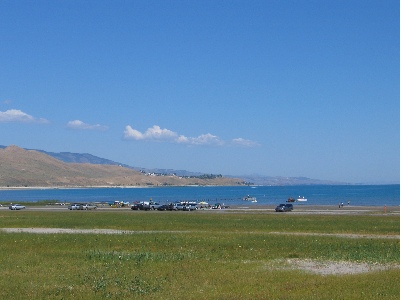
I arrived at the Glen Canyon Dam visitor’s center at 10:30 AM. Mike was already there with his truck and Jack the Dog. We had another breakfast in Page, then went to the airport to chat with the folks I’ll be flying for there, and finally to the campground, where we were told we were “lucky” to get a spot. (There’s more to this story, but I don’t feel like going into it now.) We spent the rest of the day picking up a few things for the camper and then just taking it easy. We had dinner in town, then came back to the trailer and watched a movie on my laptop before falling asleep.

Monday, August 4

We did a lot of chores that morning. We had to button up the camper to move it to another site (which we were “lucky” to get) that was suitable for monthly use. It turns out, the only thing that made it suitable was an electric meter, so if I sucked too much electricity, they could charge me for it. The new site is right near the road, which I’m not happy at all about. But I’m hoping it’ll be close enough to the office to connect to the WiFi network there.

We left Mike’s truck with the trailer and climbed back into my truck with the stuff I wouldn’t need anymore — including Alex’s cage. Then the four of us headed home. We’d gotten about 15 miles south of Page when Mike realized he’d forgotten his cell phone. We went back to fetch it, then bought milk shakes that were way too big (and way too expensive) for the ride. At 2 PM, we were in Flagstaff, where we stopped for a Thai food lunch. We were still full from the damn milk shakes, so we wound up taking most of the food home with us.

We were in Wickenburg by 5:30 PM. I fetched one of my cars from my hangar and came home.

Busy enough for you?

So that’s a whole week and then some, all accounted for here. You can see why I didn’t blog regularly. Hopefully, this long post will make up for it — if you could last through it all.

We hit the road again on Friday morning, when we fly to Seattle to fetch the helicopter and bring it down to Page. I hope to be able to share more stories and photos with readers then.

Until then, remember that you can track my progress for most of my trips these days on my SPOT Share page, http://www.tinyurl.com/FindMaria. Use controls under the waypoints list to scroll back through previous days.

And be sure to check out my photo gallery for larger images of what I’ve shared here: http://www.FlyingMPhotos.com/.

Back to the Desert

Day 13 brings me to the mountainous desert around Salt Lake.

Despite my less than perfect accommodations, I slept reasonably well. I think it’s because of the sound of flowing water that came in through the door to the back deck. I’d left the door open a few inches, trusting the lock on the screen door to keep out any hotel guests who might be wandering around on the deck. I was in the end room, so the chance of someone walking by my door on their way to another room was remote.

I showered. It was the first motel shower I’d encountered in a long time that couldn’t keep a steady water temperature. Every time one of my neighbors flushed the toilet, I’d come close to getting scalded. The third time this happened, I shut the water off and called it quits.

I packed up the car, checked out, and headed south on 89. I had a Doubleshot to meet my caffeine needs. (My friend Lorna, who has been reading these entries faithfully from her home in Maine, e-mailed me to ask what a Doubleshot is. In case you don’t know, here’s the scoop. A Doubleshot is a canned Starbucks coffee drink. It’s an easy way to get a caffeine fix when I’m on the road. I usually buy a couple of them when I’m in a supermarket and keep them in my cooler. When I can’t find decent coffee elsewhere, I drink a doubleshot. I don’t really like them — they’re too sweet for my taste — but they’re easy.)The road began by following the Snake River through a canyon. When it reached the town of Alpine, WY, the Snake River curved to the northwest while I headed south. Alpine was a nice little town with a lot of tasteful new construction and small businesses. The town was very quiet — it wasn’t even 8 AM yet. I almost passed a drive-up coffee stand. When I spotted it, I hit my brakes hard and pulled in for a latte.

The building was tall and it was quite a reach up to the woman inside it. My Clarkston reused coffee grinds experience had left me a little leery of coffee stands, but I had nothing to worry about here. The woman, who was very friendly, made me an excellent large triple latte. I asked her whether she owned the booth and she told me she didn’t. In fact, it was her last day at work. She was moving back to Spokane, WA. The woman who owned the booth was doing okay, but it was hard to do well in the town because of its heavy Mormon population. I later discovered that Mormons don’t drink coffee. I guess a coffee shop in a Mormon town would be like opening up a pork store in New York’s Lower East Side.

From Alpine, I headed due south on 89, which lies on the east side of the Wyoming/Idaho border. I was in farmland again, but at an elevation well over 5,000 feet. Wheat and alfalfa seemed to be the big crops. One alfalfa field had just been cut — probably the previous day — and the smell of the fresh alfalfa was rich and sweet.

I think I was in Afton when I saw the car wash and pulled in. I’d managed to call Megg on my cell phone and arrange to go to her house in North Salt Lake City that afternoon. My car was dirty and I didn’t want to make a bad impression. So I washed it for the third time on my trip. This time, it was the dirtiest it had been so far. The bug situation in Idaho, Montana, and Wyoming is bad and the front of the car was pretty much plastered with dead bugs of all shapes, sizes, and colors. It took six minutes worth of car wash time to get it all off. I dried it with my rags and dusted off the dashboard. Much better.

I crossed into Idaho at Geneva Summit, which was 6,938 feet. That put me into a long valley with a succession of towns: Montpelier, Ovid, Paris, St. Charles, Fish Haven, and Garden City. Every town I drove through was remarkably quiet — nothing seemed to be open. Except the church, of course. All the church parking lots were full and I saw more than a few well-dressed people out on the streets, walking to or from church. Things changed a bit when I got near Bear Lake. Lots of people were out and about at the lake, in boats and in public access areas. There was a lot of housing on the lake side of the road with plenty of Private and No Beach Access signs to keep people out.

Bear Lake

Somewhere between Fish Haven and Garden City, I passed into Utah, the ninth state I’d visited on my trip. At Garden City, I got on route 30 and followed that around the south end of the lake. I climbed a hill and immediately realized that I had slipped into high desert terrain. The vegetation on both sides of the road consisted of tall grass, sage, and a variety of other desert plants. I was getting closer to home, leaving the water wonderland I’d enjoyed since entering Oregon more than a week before. I felt disappointed and did not look forward to what I’d drive through ahead: dry desert, hot sun, empty riverbeds. I realized that I’d fallen out of love with the desert.

I turned right on route 16 with a bunch of other cars, heading southbound. More farmland, but not much more. I passed the bunch of cars, tired of breathing their exhaust. Later, I turned right again onto route 39, heading west. The road climbed and climbed and climbed. I kept checking my GPS for elevation information and the number kept going up. I was certain that when I reached the top of the mountains, there would be a lookout where I could see Salt Lake. I crossed over the Monte Cristo Summit, at 9000 feet, and started down. There was no lookout. The road dropped into a canyon with a small stream on either side. It twisted and turned as it descended. I passed two pickup trucks and some kind of Volkswagen — a Jetta, maybe? — blew past me.

I spotted a restaurant on the left and made a harrowing turn into a parking space. I needed a bathroom and lunch, in that order. I asked for them in reverse order. It would be a 20 minute wait to eat outside on the patio, which looked like a good place to eat. I got directions to the ladies room and while I was doing my business, decided I didn’t feel like waiting. Instead, I’d find a shady spot in a park and eat some of the food in my cooler. So I left and continued on my way.

Trouble was, there was no shady spot in a park. All I passed were campgrounds, and since it was Sunday at midday, all of the campgrounds were full. So I kept driving.

The road dumped me down in Ogden. I got on a main avenue that was also labeled route 89 and headed south toward Salt Lake. I wasn’t in a hurry. I was supposed to meet Megg at around four and it was only 1:30. That meant I had time to kill.

I should have killed time up in Ogden, because when I got closer to North Salt Lake, all of the shops and businesses were closed again. It would not be a good place to kill time. I drove all the way down to the city, then came all the way back up to Bountiful, where I found a Barnes and Noble that was open. I killed over an hour in there, buying books for myself (as if I needed them) and for Megg’s son, Cooper. Then I hopped over to the Taco Bell for a bite to eat. Then I drove around some more. It was around four and I was in a Smith’s parking lot, after buying two pies for Megg and her family, when I finally connected with Megg. I was five minutes from her house. She gave me directions and I made my way over there.

Megg is one of my editors. She works with me on my Quicken Official Guide books, which I’ve been revising faithfully since the Quicken 99 edition back in 1998. Megg hasn’t been stuck with me that long. She inherited me from my first editor on that book, Joanne, about five years ago.

Megg has a lovely and very large house on a hill overlooking the North Salt Lake area. Excellent views, plenty of space. And a very comfy guest room. I met her son and her husband. I then proceeded to join her for a very relaxing afternoon and evening.

Elk and Bison and Bears — Oh, My!

Day 12 takes me through two national parks on my way south.

I slept better at Lynn’s house than anywhere I’d been so far. The bed was warm and cosy, the air was clean and fresh, and the sound of the creek rushing by the house was the perfect white noise for sleep.

I got up my usual time and soon realized that Lynn was awake, too. I had some coffee and Lynn had some tea and we chatted. Then I went up to take a shower while she put the horses back out to pasture.

She drove me to a town called Alder for breakfast. On the way, we stopped at a town called Laurin (which is not pronounced the way it’s spelled, but I can’t remember how to pronounce it) where Lynn showed me two small houses that had been built inside metal grain silos. She said that when she and Ray had farmed down near Klamath Falls, they’d had a bunch of those silos and never knew what to do with them — they didn’t grow grain and no one else in the area did either, anymore. This seemed to be a perfect solution.

We had egg sandwiches at a local farmer cafe and I picked up the tab. Then we went back to her place, where I packed up the car, said goodbye, and headed out.

I gassed up in Sheridan, at the only gas station. I then retraced our miles through Laurin and Alder on route 278. Along the way, I saw a bald eagle. It looked exactly like all the photos I’d seen of bald eagles, but it was picking on some road kill when I approached. It flew off to wait atop a fence post until I was gone so it could continue its meal.

I passed Nevada City along the way. My map indicates that it’s a ghost town, but there was plenty of activity there. Perhaps someone had fixed up the buildings alongside the road as a tourist attraction? Or built them from scratch to look like old western buildings? In either case, there were an awful lot of them and they were right on the road. A sign said that there would be living history events that day. A bunch of tourists had already gathered, including three motorcyclists who had found it necessary to take up a full parking spot for each of their Harleys. Ah, the good old American “I’m all that matters” attitude in action.

A few minutes later, I passed Virginia City, which has to be the most authentic western town I’ve seen so far. There were plenty of old buildings, in wonderful condition, housing shops and museums. Makes me sick to remember how Wickenburg tries to promote itself as “the west’s most western town,” when I pass through one that makes Wickenburg look like a shadowy imitation of something out of a sixties western. Somehow, the fast food joints ruin the effect.

Quake LakeI reached Ennis, which Lynn had told me was very touristy. I didn’t really notice that, but I made my turn there, so I may have missed that part of town. I was still on route 287, but it was heading southbound now. After a while, the road joined up with the Madison River, which I followed for quite some time. When I got to the turnoff for Quake Lake, I turned in. Lynn had told me a little about the place and said she’d wanted to see it when she and Ray had driven past. Ray hadn’t been interested at the time, so they’d gone past without stopping. The place was situated in a canyon where the Madison River flows. In the late 1950s, an earthquake had caused a landslide that dumped debris into the river bed. Twenty-eight people had been killed, although I don’t know how. Perhaps they were on the road there? In any case, the natural dam caused by the landslide had created Quake Lake. I read all this on the sign outside the visitor center. It was all I needed to know, so I didn’t go in. I took a picture of the little lake, then got back into the car and continued on the road as it wound alongside it. There were lots of dead trees sticking out of the water. I imagined a heavily forested canyon suddenly filled with water and the slow death of the trees that were submerged.

The road passed on the north side of Hebron Lake, a manmade lake along the Madison River. There were lots of homes on its shores, a few marinas, and some fishermen. Then, at the junction for route 191, I turned right, heading south.

My car’s odometer turned 14,000 miles about a mile outside of West Yellowstone, MT.

I was going to just drive through West Yellowstone when I spotted an IMAX theater. I enjoy IMAX movies — except the 3D ones, which look blurry to me — so I pulled in. They were showing three different movies: Yellowstone, Lewis and Clark, and Coral Reef. Although I wanted to see Lewis and Clark, Yellowstone was next up, so I bought a ticket to that. Since my cell phone finally had a decent signal, I called Mike while I waited and left him a message telling him where I was and where I was going.

The movie was good. Grand Canyon, which plays at Tusayan near the South Rim, was better, though.

YellowstoneI headed into the park, crossing over the border into Wyoming, the eighth state I’d visited so far. My National Parks pass got me in without a fee. (It works at Yellowstone but not Mt. St. Helens? What kind of bull is that?) I took the map and gave it a quick look. My objective was not to visit the park. My objective was to take a nice, scenic ride south toward Salt Lake City. The problem was, it was a Saturday in August. The park was full. And the tourists were of the most annoying variety: drive-through tourists who will stop their car anyplace someone else has stopped, just to take a picture of whatever that other person is taking a picture of. When I wanted to drive slowly, there was someone on my butt. When I wanted to drive faster, there was someone in front of me. When I wanted to stop in a place where no one else was stopped, two or three other cars immediately appeared, spewing occupants armed with cameras to take the same picture I was trying to take. At one point, I reached a traffic jam on a narrow, one-way road as at least 30 cars had stopped to photograph a grizzly bear on the other side of a creek. I was so wigged out by the crowd that I neither stopped nor saw the bear.

BisonI did see plenty of elk, though. The first herd was right inside the park, grazing along the Madison River. I guess seeing tourists have tamed them, to a certain extent, because some very gutsy tourists were approaching quite close and the elk didn’t seem to care. I also saw a few bison. Most of the bison, as I recall, are on the grassy east side of the park. I was on the west side. I saw four individual animals, each of which were the subject of many tourist photos. But the one that amazed me the most was the one walking alongside the road in a forested area. I think he was lost. But he was walking on the pavement, forcing vehicles to go around him. That, of course, caused a traffic jam because everyone wants the thrill of driving alongside a walking bison. When it was my turn to pass him, I didn’t stop. I just aimed my camera and pushed the button while I kept driving. He was so close that someone sitting in my passenger seat could have reached out and touched him. Although he didn’t seem interested in me (or anyone else), I could imagine what those horns would do to my car’s paint job if he decided he didn’t like the color red. I wondered what he thought of the long line of campers and SUVs and cars filing past him in slow motion. I also wondered where he was going. Probably to the administrative offices to complain about all the traffic and exhaust.

Old FaithfulI took the exit to the Old Faithful Inn, in search of a decent lunch. I got a great parking spot in the shade and got out with my camera. There was a huge crowd of people sitting on benches, facing the Old Faithful Geiser, which was spewing out various amounts of steam to keep them entertained. I tried two places and found a cafeteria and a buffet. I checked out the buffet and was surprised to find that the cafeteria food had looked better (although it didn’t smell better). As I was walking back to my car, Old Faithful let go and I managed to get a bunch of good photos. It was still bubbling water when I left. ChipmunkI also managed to get a photo of this little fellow. It’s unfortunate, but people at national parks find it necessary to feed the wildlife. As a result, they become tame, like this guy probably was, and they forget how to forage for themselves. In the winter, when there are fewer tourists around, they starve. That is if they don’t get sick and die from the junk the tourists feed them.

I found a restaurant with table service at the Snow Lodge. I had a nice salad with warm goat cheese cakes on it. Tasty. Then I got back into the car and made my way out, before a new post Old Faithful eruption could start another traffic jam.

I followed the signs to Grant Village, crossing the Continental Divide twice along the way. At one point, I caught a glimpse of Yellowstone Lake. I was surprised — I didn’t remember it being so big. And I saw plenty of evidence of forest fires: where I’d first come into the park, near Old Faithful, and now as I left the park, driving toward the South Entrance. I passed Lewis Falls, on the Snake River, the first waterfall Mike and I had seen when we’d come into the park from the south years before. I clearly remember the fresh forest fire damage at the falls — there was nothing alive back then. Now the dead trees were still there, but new pines were growing in. It would take a long time for the park’s forests to recover.

Grand TetonsThe road followed the Snake River down to Jackson Lake and Grand Teton National Park. The main feature of Grand Teton is the mountain with the same name, on the southwest side of the lake. It’s 13,770 feet tall, very rocky, and has a glacier not far from the top. In this photo, it’s the mountain that’s farthest away. It was after 3 PM and the sun was moving to the west, making it difficult to get a good photo of the mountains from the east. I followed the road, choosing the path that kept me close to the lake rather than the faster road that went direct to Jackson. A scenic drive.

I passed through the southern boundary of the park and, a while later, was approaching Jackson. By this time, I was exhausted. I’d left the top down most of the day and I had been slow-roasted by the sun. All I wanted was a clean, quiet motel room. I stopped about about a half-dozen places on the north side of town and was told that they only rooms left were either smoking or very expensive. I drove through Jackson, figuring I’d find a place somewhere outside of town, on the south side. Jackson, WY, is a tourist processing plant. Tourists go there, park their vehicles, and then proceed through a series of shops and restaurants and tourist attractions designed to wring their money out of them. I couldn’t believe the number of people on the streets. Traffic was horrendous. And I couldn’t understand what attracted these people, like flies to honey. The real tourist attraction was north of town, the lakes and mountains and wildlife. Gift shops and cheap t-shirt joints can be found anywhere. When I finally got out of town, I was glad I hadn’t found a room there.

I wound up at a motel along a creek, just where the creek merges with the Snake River. I took an upstairs room facing the creek. After getting some dinner at a restaurant 3 miles away, I sat on my patio with my maps and a bottle of wine, trying to figure out where I’d go next. I was on my way home — that was for sure. After nearly two weeks and over 3,000 miles on the road, I was ready for my own bed.