I create a custom log book to track my time on the water.
One of my goals as I head into my “golden years” is to get charter boat captain certification. The endorsement I’m interested in is commonly known as a “six pack,” meaning that I can take up to six passengers for hire on a boat. While I don’t expect to make charter boating my fourth (or fifth?) career, I’d like the ability to be able to cover my boating costs by occasionally taking paying passengers on day or overnight trips.
(And yes, I know I don’t have an appropriate boat yet. I’m working on that, too.)
About the Six Pack
The official name for the captain’s certification I’m looking for is National Operator of Uninspected Passenger Vessel (OUPV) of Less Than 100 GRT. The common abbreviation is OUPV 6-pack. According to the US Coast Guard, which oversees these certifications:
This officer endorsement is most appropriate for uninspected passenger vessels which by law are limited to six or less passengers for hire. These are usually smaller vessels and normally engage in charter fishing, whale watching, SCUBA diving, and tour cruises.
OUPV Near Coastal endorsements may be limited to 100 miles offshore, Inland or Great Lakes in accordance with 46 CFR 11.467 and the service provided. No OUPV endorsement is valid for International voyages.
There are a number of requirements to get this certification. Here’s a simplified list; you can download a more detailed list here:
- U.S. Citizienship
- 18 Years or age or older
- Medical certificate
- Drug testing compliance
- Mariner fees paid
- Sea service accumulated – 360 days
- Sea service recency – 90 days in past 3 years
- First aid course
- CPR course
- Exam or course completion certificate
Sea Service
The sea service requirement will be the toughest to meet and since it must be documented on the application, I’m motivated to keep track of it.
I’ve spoken to numerous people who have told me a variety of things about what constitutes “sea service.” One person I spoke to said that because he’d grown up boating with his family, all of those day trips could be logged as sea service. He said that even though he didn’t have a record of all of those days, he could make a reasonable estimate.
I’m in the same boat — no pun intended. My family had a boat that we’d often take on day trips on the Hudson River near New York City. In fact, a common outing would be a ride around Manhattan Island or down to the Statue of Liberty or up as far north as West Point. Later, when my family moved to Long Island, my family boated out in Long Island Sound. I have no idea how many outings we did as I was growing up, but I don’t think that 50 is an unreasonable estimate.
I also have boating experience as an adult on a variety of inland bodies of water including Lake George, Lake Powell, Lake Mead, Lake Pleasant, the Colorado River, the Columbia River, Lake Chelan, and Lake Roosevelt (in WA). Some of these trips involved overnight stays on the boat. Added up, I’m sure that would account for another 50 days.
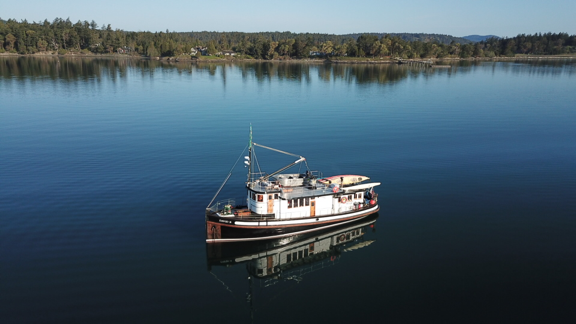
And then there’s the Learn to Navigate the Inside Passage cruise that I went on back in 2019. This was the real deal: I was one of four people on a 65-foot, 90-year-old wooden boat that cruised at the breakneck speed of 6 knots up the Inside Passage between Bellingham, WA and Ketchikan, AK. For 12 days, I was a “crew member” while we learned about navigation and piloting from Captains Jeffrey and Christine. The following year, I joined them again for another 4 days on the water in the San Juan Islands. According to Captain Jeffrey, all this time could be logged.

The David B at anchor in Garrison Bay.
It’s that time that was most valuable given that of the 360 days I needed on the water, 90 days of service had to be on Ocean, Near Coastal, or Great Lakes waters, depending on the kind of charter services I wanted to offer. Because I wanted to offer Near Coastal charter services in the San Juan Islands and possibly on portions of the Great Loop, I needed that Near Coastal time.
And my upcoming trip would be a huge addition to my sea service time. After all, I expected to be on the boat for about two months. That’s a lot of days of near coastal and Great Lakes time.
Finding a Book to Log Time
Of course, the best way to keep track of the time I could include in my sea service submission to the Coast Guard was to log it — much like I already log the time I fly to maintain a record of currency for my pilot certificate. With that in mind, I started looking for a “captain’s log” or “crew log” book.
And I found a lot of books that I just couldn’t see working for me.
The trouble is, most books were designed for either commercial boat captains or pleasure boaters:
- The commercial captains’ logs had lots of form fields for entering daily boat and engine check information, weather, departure, destination, and miscellaneous paperwork information. This is the information you’d expect to be part of a legal record of every single day or trip on a commercial vessel. I simply didn’t need all of those form fields.
- The pleasure boaters captains’ logs had less detailed forms but not much space for including a narrative of the trip. They didn’t seem concerned with logging time as much as logging where the boat went and who was on board.
I wanted something that combined features from both flavors of books, something where I could log each day of the journey and take notes for blog posts or other written accounts. And rather than enter detailed vessel information on each page — after all, I expected to be on the same handful of boats as I built my time — I wanted vessel details listed separately. I also wanted pages that summarized the days logged by month and by vessel.
So I designed my own book.
My Captain/Crew Log Book
Creating my own book pages wasn’t a big deal once I knew what I wanted on each page. After all, from about 1995 to 2012, I did layout of about half the books I wrote using a variety (over the years) of desktop publishing software: QuarkExpress, PageMaker, FrameMaker, and InDesign.
I’ve had a love/hate relationship with desktop publishing software for a while now. In my later days of writing books, I used Adobe InDesign to do page layout and then to generate PDFs and ebook format files for publishing. But when InDesign went from a pay once software package to a subscription software package, I simply stopped using it. I couldn’t see paying monthly for a software package that I only used a few times a year.
Just before I began tackling this design project, however, I got my hands on Affinity Publisher, a desktop publishing package that was inexpensive and didn’t require a subscription to use. I decided to try my hand at using it while doing this project.
It went remarkably well. Affinity Publisher was similar enough to InDesign that the learning curve was relatively easy for me. When I got stumped, I used its online help feature to figure out how to do what I needed to do. Little by little, I built up the master page styles that would make up my book. Then it was just a matter of adding pages.
Some of the design choices I made include:
- 8.5 x 5.5 page size. This is half a standard “letter size” sheet of paper. It makes the book relatively small.
- Spiral binding. This makes it easy to lay the book open and, if necessary, to remove pages.
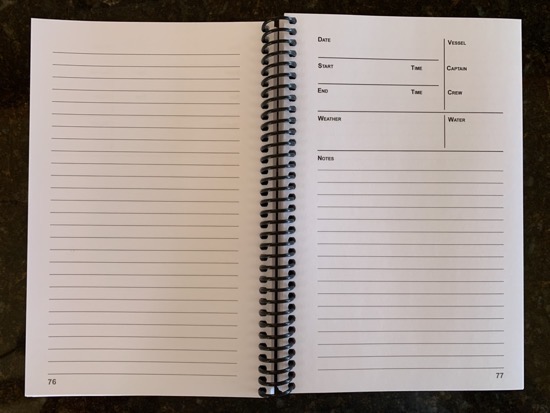
- Double sided log pages. The recto (right side) page has the form to detail the entry and it’s followed by half a page of lines for notes. The back of each page has more room for notes. Again, I wanted to be able to include a lot of notes for each logged day. I chose this format instead of spreads — where the start of each entry would be on the verso (left) side and the rest on the recto side — because I wanted to be able to remove pages if necessary. I’m still not 100% sure about this decision; I think it would work either way.

A log page spread. The entry starts on the recto page and ends on the following verso page.
- Simple summaries at the beginning of the book. I could add entries here as time went on.

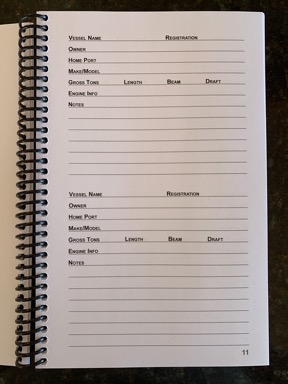
There are three double-sided Vessel Info pages that I can use to enter details about up to 12 boats.
Vessel details at the beginning of the book. Each vessel could be listed on a half-page form at the beginning of the book. This keeps those details off the log pages. I write the vessel name in the log page and then can cross reference it to details in the vessel list.

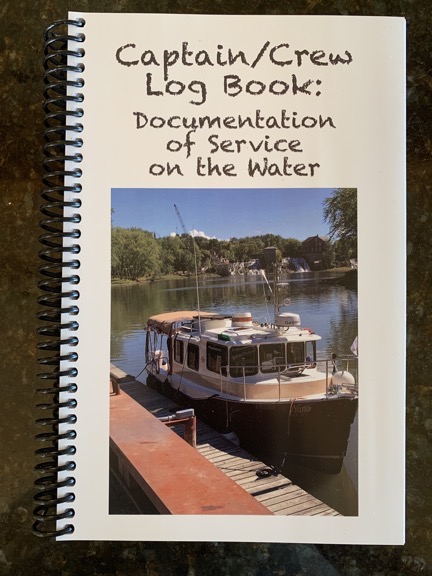
Here’s the book’s cover, with a nice photo of Nano on it.
I got a high-res photo of the boat I’ll be on this summer, Nano, to put on the cover.
I used a service called Printivity to print my books. I submitted a properly prepared PDF, made my payment, and waited. At my request, a representative got back to me to answer some questions and, with the information she provided, I fine-tuned some options.
Although the books were affordable to print, shipping was costly. To get the most bang for my buck, I ordered four copies. I figured I’d give the extras away to my fellow crew members, if they’re interested.
The books arrived two weeks after I submitted the PDF and paid for them. They looked pretty darn good for a first effort. I’m looking forward to making entries in mine during the trip.





 It doesn’t appear in the message here, but I inserted the eye rolling emoji. I like that one. It sums up my thoughts about people who complain about things that they really have no right to complain about. Or when I encounter sheer stupidity. (I rolled my eyes a lot in the last few years of my marriage. Half the time, I didn’t even realize I was doing it, but it drove my wasband crazy.) I use it a lot on Twitter.