
Do they have no respect at all for a person’s privacy?
About every tenth time I connect to Facebook on my desktop computer, Facebook asks me for my cell phone number. They say it’s to protect my account — and there might be something to that, for all I know — but do they think my Facebook account is so valuable to me that I’m willing to hand off my phone number to an organization that apparently sells just about any information I give it?
Today took things to a new level. I was using the Facebook app in bed. This is part of my morning routine: I wake up so early that it’s simply too early to get out of bed. So I kill some time with Facebook and Twitter on my iPad. (I recently deleted both apps from my iPhone because of this.) Two creepy things happened:
- As I scrolled through my timeline, Facebook displayed an Amazon ad for everyday silverware that showed several plain styles. The top of the ad assured me that two of my friends liked Amazon. What was creepy was that I’d used the Amazon app on my phone the previous day while looking at silverware in Fred Meyer to determine whether the prices were reasonable. This could not be a coincidence. How did Facebook know? I thought I’d had my privacy settings buttoned down tightly enough, but apparently I didn’t.
- As part of a chat with a friend in the Twitter app, I used the Safari browser to visit Amazon’s UK website and find a link to a weather station I own. I pasted that link into a tweet. Moments later, when I went back to the Facebook app, Facebook asked me if I wanted to share the link to the weather station — it displayed not only the full link, but the Amazon preview that went with it — on my timeline. That meant the Facebook app was reading and interpreting what I’d copied in another app.
To say I felt dirty is an understatement. Facebook is poking around in my data in places it has no right to be.
On my iPad, I cleared out all Safari cookies and data. I checked settings to make sure I hadn’t missed any sharing settings — I hadn’t. I checked the Facebook app to make sure it wasn’t authorized to talk to the Amazon app — it wasn’t. And then I went to my computer and dug into my settings in Facebook to see what I’d missed.
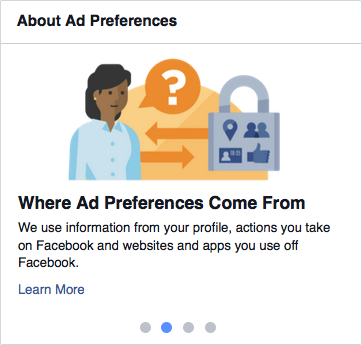
Facebook admits it’s going to get creepy by monitoring “actions you take on Facebook and websites and apps you use off Facebook.” WTF?
Facebook’s settings is a rathole of options, the most important of which are buried so deep that they’re nearly impossible to find. Not only that, but it seems that they periodically change how you access certain settings to make them difficult to re-find in the future.
The one thing I did find was Ad Preferences. This screen lets you add or remove items you’re interested in. The creepy part? The list already includes hundreds of preferences based on things you’ve looked at, commented, liked, or otherwise shown an interest in.
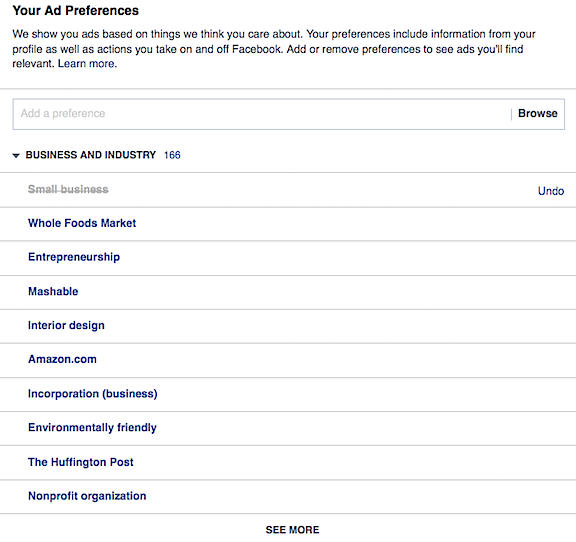
Here’s a partial list of the interests Facebook has collected based on my actions. Some of them are completely off the wall: Harley Davison? Electric guitar? Gold’s Gym? Michigan State University?
I have to individually click each item to remove it from the list. This is a long and tedious process, made even more time-consuming by the need to click See More after each dozen or so items. There were well over 700 items on my list. And clicking a tiny X that only appears when you point where it should be just removes the items from this screen — I’m sure Facebook is keeping its own private list somewhere I can’t modify it.
How can I not sound paranoid?
My Twitter/Facebook friend Pam Baker writes about Big Data. I aways thought to myself, what’s the big deal? How much info could they possibly have about me?
Now I’m beginning to get an idea.
This makes it all the more important for me to use privacy settings. Quite frankly, it’s none of Facebook’s fucking business what I like or do when I’m not using Facebook. And even then, it’s creepy that they’re keeping track of it all.
Will this be the straw that gets me off Facebook? I can only hope.
