I visit Mt. Rainier in near perfect conditions, then make camp in a weird campground on a weirder airstrip.
It was only about 10 miles from Union Falls Trailhead to Chinook Pass and we made the climb pretty quickly. And, for the first time ever, I stopped at the parking area right before the pass to check it out.
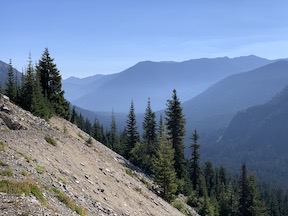
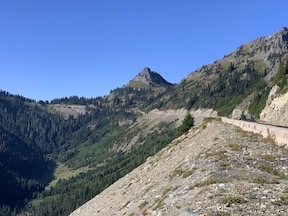
I also stopped along the road before getting to the pass. Here’s a look back down the valley (left) and ahead toward the pass (right).
At Chinook Pass
• Red Top Lookout
• American River Campsite
• Mt Rainier and the Buck Creek Campsite
• A Driving Day with a Crappy Campsite
• The Blacksmithing Weekend
• Dungeness Recreation Area
If you live on the east side of Washington State and do any business or pleasure travel to the Seattle area in the winter, your travel plans are ruled by the passes. North to South, the ones I know that may be open in winter are: Stevens, Blewett, Snoqualmie, Chinook, and White. There are likely other ones; heck, I’m not in Washington in the winter so I have no need to know them all.
From an elevation standard, none of them are very impressive if you’ve lived in high elevations. Chinook, for example, is only 6500 feet; for comparison, I used to own a cabin on some property in Arizona that was at 6700 feet.
From late autumn to early spring, weather and traffic reports always include pass conditions and closure information and no one who crosses the passes in winter travels without studded tires or chains. It’s odd because talk of the passes becomes as common as talk of the weather, even if you have no need to know what pass conditions are.
“That was some storm last night. They closed Snoqualmie and Blewett.”
“Yeah, but I think Stevens might still be open.”
Meanwhile, neither participant in the conversation has any need to cross any of the passes any time soon.
Chinook is the usual choice if you’re traveling from the Yakima area to the Tacoma area and aren’t in a huge hurry. The road that climbs through the pass — Route 410 — is one lane in each direction with the occasional passing lane thrown in to keep things moving uphill. It’s a scenic drive with the top half on the east side being through a relatively winding canyon and the top half on the west side offering stunning views of Mt. Rainier, conditions permitting. And that’s the thing about crossing any of the passes. It could be an awesome sunny day on the east (desert) side but when you cross the pass you could be in the middle of a rainstorm or fog bank. (It was freezing fog that I’d driven through on my west to east trip in October.) I can count the times on one hand that I actually saw Mt. Rainier from the pass. Thursday morning was one of those times.
But now I’m getting ahead of myself.
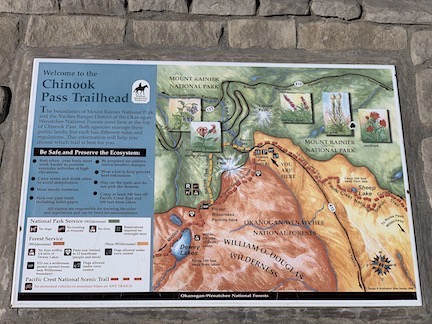
This sign explained what trails were available to hike and reminded visitors that dogs were not allowed on most of them.
I parked in that parking area right before the pass, got the pups out, and walked to where there was a sign telling me what to expect. I should mention here that the lot was more than half full — as was the one across the road — but no one was around. It wasn’t the typical scenic view — looking down the way we’d come into a smoke-filled valley that day — pullout I always thought it was. It was a real trailhead for none other than the Pacific Crest Trail — the west coast’s version of the famed Appalachian Trail.
Of course, there were other shorter trails originating from the location and it’s a good thing there was. You see, no pets are allowed in Wilderness areas, which the Pacific Crest Trail winds through, and there were lots of No Pets signs to remind me. But a segment of the trail that started in the parking area did allow leashed dogs, so I set off with the girls to explore. The 1-1/4 mile hike we’d already had that morning wasn’t enough.
What I was hoping for was a glimpse over the pass down toward the lake right on the other side, which I’d originally planned to hike around that morning. I was also hoping to see Mt. Rainier. But this hike, although pleasant enough through wildflowers and forest areas, didn’t offer any views. Instead, the trail took me to the foot bridge that crosses over Route 410 at the summit of the pass. We walked over the bridge and up the trail a bit more — enough to see that it was a clear day on the other side and Mt. Rainier was visible. Eager to actually see the mountain, we turned around and headed back. The one trail branching off toward the lake was clearly marked with multiple No Pets signs so it looked like the only way I’d see it is by continuing the drive.
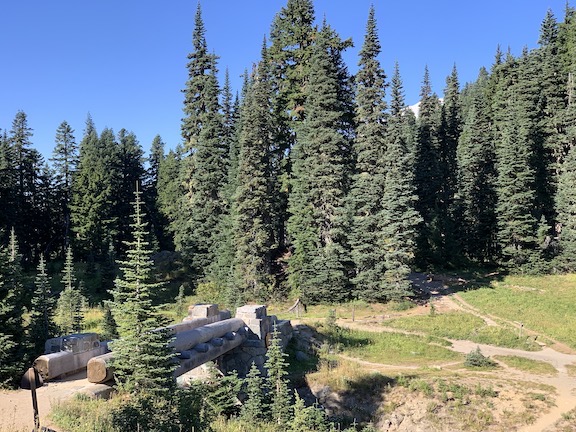
A look back at the pedestrian bridge from the farthest we got on our little walk. That white thing beyond the trees on the right side of the photo is the top of Mt. Rainier.
We hadn’t even walked a mile.
The Photo Session
Back in the truck, we crossed under the footbridge I’d just walked over, rounded a bend, and wow! There was Mt. Rainier in its full glory, sagging glaciers shining in the sun against a blue sky. Right below the road was little roundish Tipsoo Lake, surrounded by green grass, flowers, and evergreen trees. I had just driven into a Bob Ross painting.
I pulled over in the topmost part of the strip of parking that lines the road there and got out to get serious about photography. That meant leaving the pups in the truck — windows cracked wide, of course — and going into the camper to fetch my Nikon. (No tripod; I seldom get that serious in bright light conditions.) I also grabbed my binoculars and strung their strap around my neck. Then I walked back up the hill, looking back now and then for the best view of the peak.
Now this is where casual photography and serious photography part. The vast majority of photography I do these days is casual. I whip out my cell phone, try to compose a decent shot using one of the optical zoom options (1x or 2x on my iPhone Xs these days), and snap. The best camera is the one you have with you. I believe that wholeheartedly. While the iPhone doesn’t have a great camera, it’s usually good enough.
But when I want to get serious about composition, I reach for my Nikon with its 28-70mm zoom (glass) lens. That gives me a huge amount of flexibility in composition, as well as full control over aperture and shutter speed. If you know a little about photography, you know that’s good. If you don’t, well stick to your point-and-shoot; it’ll do a fine job for you.
I’m willing to bet that 95% of the people who stand where I was parked point their camera at Mt. Rainier and push the shutter release. Done! Excellent shot of the mountain on a beautiful day.
But the real story wasn’t just the huge snow-capped mountain looming in the near distance. It was everything else around it: the trees, the lake, the flowers. The rocky peaks nearby. In my mind, the photo had to include some or all of those things. And that meant moving my ass (with my camera) to a better vantage point.
So I walked back up the side of the road, looking over my shoulder now and then to judge the view, and occasionally snapping a photo with my iPhone. Until I found the spot.
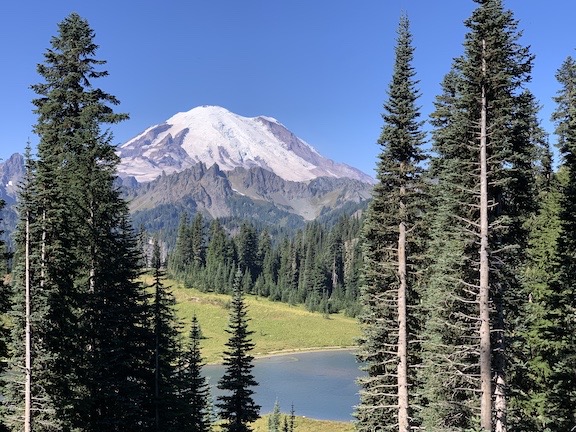
One of the shots I snapped with my iPhone as I walked. I’m liking this one more and more as look at it.
In my opinion, photography starts with two things: light and composition.
I could not control the light. I was there on a sunny day at about 10:30 AM. No matter how you slice it, that’s not going to be “good light.” It’s going to be harsh, white light. Coming earlier — maybe around 7 or 8 AM — would have gotten me better light, but it likely would have put much of the scene in dark shadows. At least I had light on the whole scene.
I did, however, have some control over composition. The image I was imagining had something interesting or colorful in the foreground with the mountain out there in the background. Almost as if I were taking a photo of that foreground thing and this magnificent mountain just happened to be back there.
And that’s what I was thinking when I saw the bunch of yellow flowers — forgive me for not knowing what they are — swarming with bumblebees, with the mountain, trees, and lake beyond them. That’s where I parked my butt, on the gravely dirt alongside the road, whipped around my Nikon, and got to work.
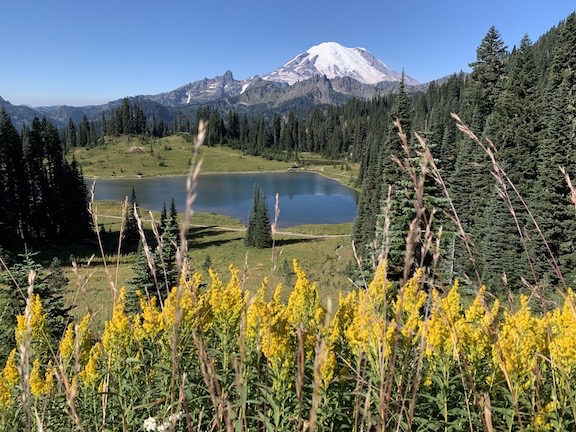
I don’t have the Nikon images available to share — I’m not in the practice of hooking up my camera to my laptop for blog posts — but this should give you an idea of what I was after. I’ll know if I succeeded when I open the Nikon images in Lightroom or even Preview to see what they look like.
I stayed for about 20 minutes — a time so short that a real photographer would laugh. But let’s face it: neither the light nor the scenery would change anytime soon. While I was there, I used my binoculars to study the glaciers on the mountain. There were lots of long cracks in the snowpack and I could imagine avalanches happening on a regular basis. I could just about see the blue of the glacial ice in some places.
I sat for a while longer just listening to the bees in the flowers in front of me. After a while I began spotting them. They were all bumblebees of a kind much smaller than I get around my butterfly bush back home. There were dozens of them, buzzing loudly as they flew around, gathering pollen for the winter.
Then I was ready to go. I returned to T2 to put my camera and binoculars away and got back into the truck where my pups were waiting patiently for me. I started up the engine and we continued on our way.
At Tipsoo Lake
I pulled into the main parking area for Tipsoo Lake, which was just down the road, still thinking about that hike around the lake with my pups. But I already suspected that would not be possible. The lake was within the Mount Rainier National Park and U.S. national parks are among the most dog-unfriendly places in the country. Stated simply by a ranger later in the day, you can’t take your dog off pavement. That means parking lots and campground roads only. No trails. No backcountry hikes.
This is a real turn-off for me and one of the reasons I visit national parks a lot less than I used to.
I sort of understand why they are so strict about dogs. It probably has a lot to do with people not cleaning up after their dogs. There’s not much less appealing than walking down a trail in the forest, enjoying the shade of tall trees and the sound of birds and then stepping into a pile of dog crap someone left on the trail. Or seeing someone’s bag of dog crap alongside the trail, as if putting it in a pink bag with a knot on top was as good as cleaning it up and taking it away. People are pigs and they ruin it for everyone else. I definitely have a blog post coming about that.
So after parking and rolling down the front windows of the truck halfway for my pups, I went to look for signs. Sure enough, there were No Pets signs all over the place. And honestly, the hike didn’t look pleasant enough to do by myself.
There were two Mennonite (or something similar) women by the signs studying the map. They wore typical floral print dresses that looked at odds with their hiking shoes. One of the women wore the little bonnet some of them do. They were trying to figure out how to get on one of the trails that wound around a nearby peak. It was a 3.4 mile loop. They were debating which way to go and eventually asked me. The map was pretty clear and I pointed out how I would go. They then left me, met up with a few more women in their group, and proceeded to walk the opposite direction. Huh?
I went back to the truck, started up, and continued driving down the hill.
At Sunrise
At the junction of Route 123, I got a surprise: a sign stating that Route 410 (the road I was on) was closed up ahead due to fire. I didn’t even know there was a fire on that side of the mountains.
My plan had been to camp out in the national forest near a place I thought might have chanterelle mushrooms. It was getting on to that season — although admittedly early and definitely dry — and a mushroom hunt was part of why I’d come that way. On seeing the sign, I had two questions:
- Was the road really closed? I recalled the previous day when I’d ignored the sign and the road hadn’t been closed at all.
- If the road was really closed, was it closed before or after the spot I’d hoped to camp?
As I did the previous day, I decided to ignore the sign and I kept going.
There was a plain old Road Closed sign at the turn for Sunrise, one of the park’s main access points. That looked pretty conclusive. I checked my watch. It was only around 11:00 AM. I made the turn into the park.
A while later, I was chatting with a ranger at the gate about the road closure (real and at Greenwater, after my mushroom hunting grounds), pet rules (see above), and what I could find at Sunrise (great views of the mountain).
There was a good chance I’d been there in the past; in the late 1980s, my future wasband and I had taken a road trip from Seattle to San Francisco and we’d visited both Rainier and St. Helens from the east side. Of course, I couldn’t remember details from that long ago. (Why do you think I blog? So I can remember details.)
I did know that if the road was closed ahead, fuel might be a concern. My truck’s computer said I had enough to go 184 miles, but my truck’s computer isn’t terribly reliable. I’ve gotten that thing down to 21 miles left on a long trip in the middle of nowhere and the related stress is something I’d prefer to avoid. I always try to fill up before it reaches 100 in remote areas. If I did the 19 miles (each way) to Sunrise and then went to my intended mushroom hunting spot would I have enough fuel to backtrack to Route 123 and Packwood, the nearest fuel? I did some math in my head, considered the number of times I’d passed the turn for Sunrise and not gone in, and thought about how early and dry it was for mushrooms. I headed up toward Sunrise.
It was a pleasant drive on a winding road that would have been a lot more pleasant behind the wheel of my little Honda S2000 than a fully loaded, top-heavy diesel truck. But I made the best of it. I passed a few places where I might have stopped for a little hike — if I were allowed to take my two best friends. There were few people on the road and I didn’t even have to pull over to let anyone pass on the climb back up to 6,400 feet. Soon I was pulling into a parking space in a huge, mostly empty parking lot, with the door of the camper pointing right out toward the mountain.
I took the girls out for a quick walk (on pavement, of course), then climbed into the camper with them for lunch. I reheated leftovers from the night before and sat in the doorway looking toward the mountain to eat them. Behind me, the girls climbed up onto the bed and worked on some chew bones they had there. From my seat, I could see a lot of ugly hand-scrawled signs on orange board that said No Pets anywhere you might logically want to take a dog for a pee. It was a real shame that they ruined the view that way.
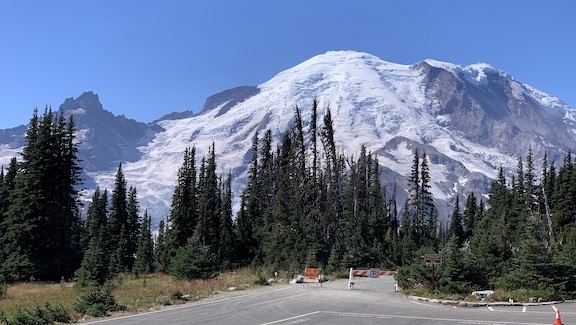
Mt. Rainier out the back of my camper at lunchtime. Whose bright idea was it to scrawl PETS NOT ALLOWED on a big orange board in the view?
After lunch, I locked the pups up in the camper and walked over to the lodge. It was closed. A masked ranger sat at a table under a shade with a piece of Plexiglas in front of her. She had a map and info. I put my mask on, stepped up, and asked her questions. I made the mistake of reaching under the Plexiglas to tap something on the map with a fingernail.
“Don’t touch it!” she said.
Whoa.
I asked again if the road was really closed. She assured me that it was. She told me that the distance from Sunrise to fuel outside the park on a different road that went through the park was 64 miles. “All downhill?” I asked, knowing my truck gets way better mileage downhill than uphill.
She used the map to point out the downhill and uphill portions. It was a nearly even mix. I thanked her and left, noticing yet another Road Closure sign that assured me that the road would be closed for several days.
I went into the gift shop, bought an ice cream sandwich and a night sky reference guide, and went back to the camper. I had no desire to hike anywhere without my dogs. I took them for another pee walk, took another photo of the mountain, and headed out.
I stopped at Sunrise point on the way down the hill. It’s a small parking area nestled in the crook of a switchback. Some rangers were maintaining/repairing the cut stone wall that separated the parking area from the road. We chatted for a few minutes about the CCC, which built the infrastructure for most of the older national parks. (I later learned that this particular road project predated the CCC by a few years and was completed by private contractors for the government.) I checked out the view and an interpretive sign, then climbed back into my truck, where the girls were waiting, and continued down the hill.
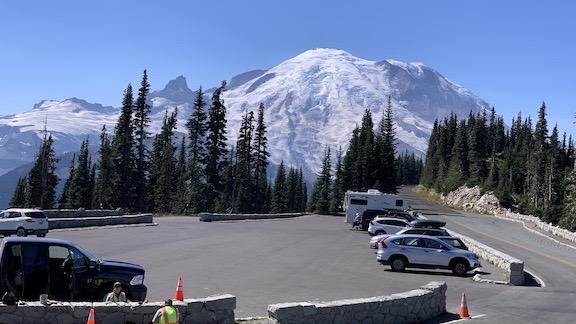
Sunrise Point, looking back toward the mountain. You can see T2 parked among the cars there.
At the bottom, I consulted my truck’s computer. 149 miles until empty, it told me. The gauge said 1/4 tank. GaiaGPS, where I’d put the waypoint for my mushroom hunting grounds, told me it was 15 air miles away. It couldn’t calculate road miles without an Internet connection, which I hadn’t had for nearly 24 hours. It was only around 2 PM and I had no desire to search for a campsite in an unfamiliar area. So I made the left turn, passing the Road Closed sign, and headed toward Greenwater on Route 410.
There was also road construction along the road. I stopped at a flagger. She walked over and we chatted for a while as I waited for the pilot car. She’d just been stung by a bee. The only thing I had for her were some “antiseptic” wipes I’d bought to leave in the truck. I gave her a bunch of them. They were good and wet and I hoped they’d help take the sting out for her.
Then the pilot car came and I followed it past a road crew that was oiling and putting a layer of asphalt on the road. It was one lane for about 3 miles. As I drove, I eyed the forest on either side of me, sizing it up for the chance of finding chanterelles. It was the right kind of forest in many places. We passed out of the National Park and into the National Forest. By that point, I’d already decided to check out a closer camping area for an overnight stop and mushroom hunt: Buck Creek. I saw the sign and turned left.
Buck Creek Camp and Ranger Creek Airport
I’d never camped at Buck Creek, but I had attended two Puget Sound Mycological Society forays at the nearby Black Diamond Camp. That area was rich with mushrooms on the first year I went (when it was wet) and pretty much devoid of mushrooms on the second year I went (when it was bone dry). I figured I’d pull in to check out the camp.
Off 410, I crossed a bridge over the White River. The Skookum Flats Trailhead parking area was right on the other side of the bridge and I pulled in for a look. There was no one there. It might make a decent back up spot if Buck Creek didn’t work for me.
Back on the gravel road, I made the next left, following the signs for Buck Creek Camp. Although my Ultimate CG app had said camping was free there, a sign pointed down the road for a self-pay station. I continued down the road, passing a great campsite where I could back in on level ground under a canopy of evergreen trees with a picnic table. I continued on, wondering if it could get better than that. Unfortunately, the road was a mess and I soon got tired of bouncing along through potholes that must have resembled ponds after a rain. I turned around, went back to that first site, and backed in.
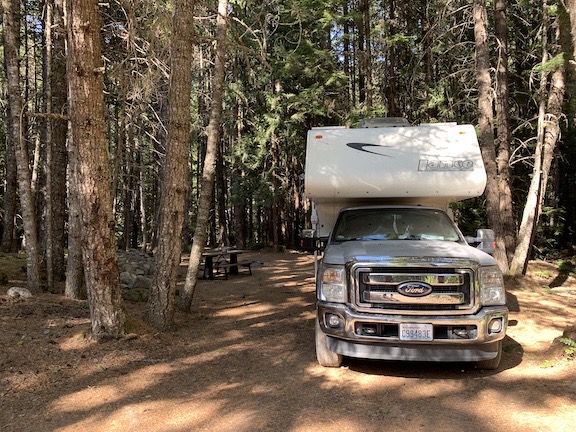
Our campsite at Buck Creek was densely wooded and would have been very private even if we weren’t the only campers there.
We all got out and went for a walk in the forest behind the camper. It was exactly the kind of forest I’d expect to see chanterelle mushrooms, but ten minutes of looking everywhere came up empty. Too early? To dry? Both? We went back to the camper.
Buck Creek camp is right on the Ranger Creek Airport. In fact, one of the sites is right under the extended centerline for the runway. I was at the far end of that, beyond the runway end, but I could see the windsock and a building off in the distance. Although it was hot in the sun, I went with my pups toward that building, keeping in the shade as much as possible, looking for that self-pay station. The temperature varied with the amount of sun a spot got; where it was very warm it smelled like Christmas, if you know what I mean.
I soon realized a few things.
- The campground was completely empty. We were the only ones there. I suspected that the road being closed had a lot to do with this. The only way to get to where we were from the Seattle area was to drive up around the south side of Mt. Rainier.
- The campground appeared to have had buildings on site a long time before. I saw some concrete platforms and at least one stone foundation. Maybe this was a camp for workers when the park was being developed? I could not find any information about this online in a quick search.
- The campground was not consistently maintained. Some sites had tables, others didn’t. I didn’t see any site numbers. I wasn’t even sure what areas were campsites and what areas weren’t.
- The self-pay station was broken and unusable. There was no place secure to put money or even signs/envelopes to tell you what was due. (I guess it was free?)
- The existing building was a pair of pit toilets with Men’s and Women’s sides. Neither door could be latched from the inside, which wasn’t a big deal since there was no one there. The toilets were surprisingly clean and even had some toilet paper.
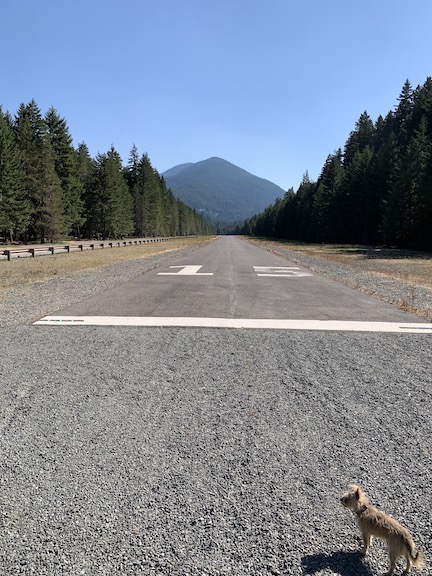
I was very surprised to see that the airport runway was paved.
By the time we reached the building, we were abeam the end of the runway, which I realized (with some surprise) was paved. The whole thing was surrounded by a low metal guardrail I have to assume was put in place to keep people from driving on it. (Too many people are idiots.) We crossed the runway and walked back on the other side, which was cooler with more shade and a few more campsites. I briefly considered moving my rig but decided that I liked it where we were, closer to the creek.
I spent the afternoon sitting at the picnic table with my laptop, working on the previous day’s blog post, adding photos as I worked. None of it could be posted yet, of course. I still had no Internet connection. I figured I’d upload what I’d finished the next day when I stopped at Packwood to refuel. The forest around me was very pleasant, although there were a few pesky flies for a while. I honestly don’t know much about evergreen trees, but these were the kind with the tiny needles and straight, tall trunks. All the way up were short, broken dead branches that had likely grown and thrived for a while before priority was given to the ones higher up. They swayed in the breeze, making occasional cracking sounds as the dead branches hit each other and sometimes broke off.
Sometime later in the day there was a bit of excitement when a plane flew low and I thought it was going to land. Then it moved away — into a downwind, I soon realized — and came in to land toward us. I took some video but it didn’t really come out very well because the plane was so far away. It stopped near the building, turned around, and back-taxied the way it had come from. At the far end of the runway, it turned around and took off again. It was a small yellow plane — that’s all I was able to see since it was already pretty high up by the time it reached us. I suspect it may have been a Cub.
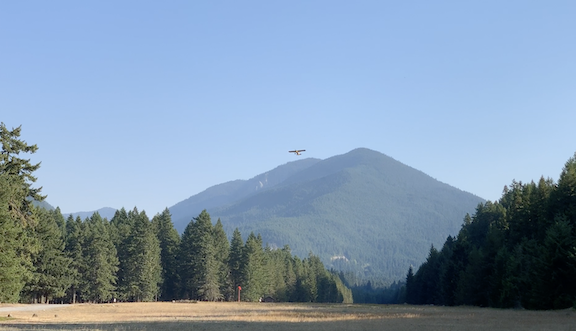
Here’s that small plane departing from the runway.
I gave the girls new chew bones and they spent some time working on them. I noticed that Lily liked to sit atop a mound of rocks and dirt near the truck; I think she found that higher vantage point more secure. Once in a while, they’d wander off but return immediately when I called them. They were really shaping up to be good adventure dogs.
I had dinner outside on the picnic table: a piece of smoked salmon on a salad with some sliced up beets from my garden.
It got a bit too cool to sit outside not long before sunset and we all went inside. I continued working on my blog post. The girls went up to bed where they looked out the windows and occasionally barked at imagined monsters in the forest. I’ve become convinced that Rosie, who is more prone to bark, has poor eyesight and barks at shadows. Those shadows got longer and longer until they disappeared. I climbed up into bed and read for a while before dozing off.
The Other Campers
The first car’s headlights cut through the night around 8:30. I had just dozed off. The girls started barking and I was immediately awake to quiet them down. The car passed by the front of my site, heading toward the bathroom building we’d visited that afternoon.
I picked up my iPad to continue reading.
I was asleep again when the second car passed. More barking. More waking. More shushing.
The same thing happened three more times over the next two hours. By the last car, the girls didn’t even bark. I had no idea where the cars had gone — when I looked out into the darkness later on, I could see only darkness.
I finally fell back to sleep around 11 PM.
In the morning, after coffee and breakfast, I decided to take a walk back down to the bathroom building. Maybe we’d see where all those cars had gone.
We did. They were all parked in the campsites immediately across from the bathroom building. I kept the girls with me so as not to bother the other campers at 7:30 AM — only a few youngish guys were up and walking around. Another was in the bathroom marked Women; I could see him because (if you recall) the doors didn’t latch closed.
I managed to arrange a rock outside the door of the other toilet to give me some privacy. When the guy emerged from his toilet, the girls greeted him. I finished up quickly to keep them from being a nuisance. By that time, Rosie was getting petted by the guys by the cars while Lily was playing keep away.
They were from the Seattle area and, because of the road closure, had been forced to go the long way around to the campground. That had added two and a half hours to their drive, which is why they arrived so late. Of course, this just confirmed that the road was probably still closed and that I’d be on the same long drive soon enough.
I went back to camp and prepped for the day’s drive. I had to be in Maple Valley by noon to meet some old friends for lunch. I’d already decided that the route through Packwood, where I could definitely get fuel, was wiser that the possibly shorter (in distance but not time) route through the park. Because I had no Internet access, I had no way of knowing how long the distance was or how long the drive would take.
It was 8 AM sharp when we pulled out of camp.