Nearly two weeks at my first destination: stress-free to the point of euphoric.
I arrived at my first snowbirding destination before lunch on January 2 after four trying days on the road.
Well, the last day wasn’t trying at all. I left an RV park in Las Vegas where I’d overnighted so I could flush the winterization fluid out of the plumbing, fill my fresh water tank, and fully charge the RV’s batteries. I also stocked up the fridge and pantry. Ahead of me was an easy 3-1/2 hour drive almost due south. Somewhere in California, on the dip-filled road between the Nevada border and Blythe, CA, the last bit of Wenatchee snow blew off the RV’s roof and smashed onto the pavement behind me.
By that time, I was feeling so happy to be on the road with my rig that I was almost in a state of euphoria.
It was a feeling I’d have again and again during the subsequent days and weeks.
Getting There

There are numerous backwater areas along the Colorado River in Arizona. This is BLM land where camping for up to two weeks is free.
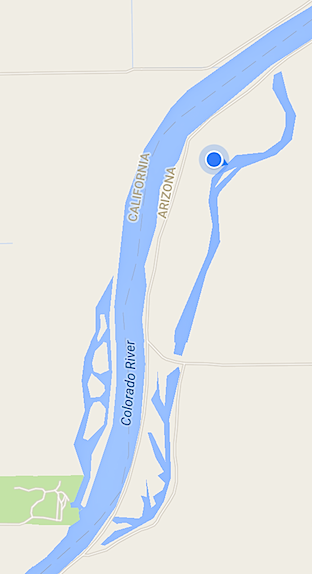
My friends Janet and Steve were camped out on a backwater arm of the Colorado River about six miles south of Ehrenberg on the Arizona side. Janet had assured me that there was plenty of room for the Mobile Mansion and, after a quick stop at the truck wash near the Flying J truck stop to find out what it would cost to wash my RV, I turned onto the gravel road, homing into my destination.

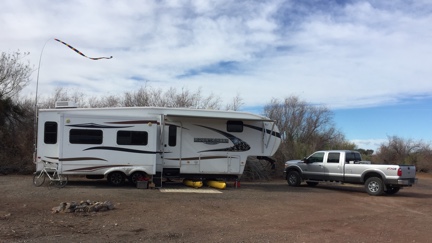
The Mobile Mansion at camp.
Janet was waiting for me about 1/2 mile before the turnoff. I followed her into a large, level campsite with gravel and dirt surfaces just far enough off the road to be completely private. Her little RV and their big three-horse slant load horse trailer were already parked and set up. Steve pointed to an area where they suggested I parked. After getting out, sharing good-to-see-you-again hugs, and setting up my parking cones — visual guides to help me back up — I backed my rig into the spot. A quick check of the level just inside the door showed I was already perfectly level. No need for leveling blocks. Within minutes, the landing gear was down and the Mobile Mansion was unhitched. A few more buttons pushed and the four slides were out. They gave me a hand pulling my two kayaks out of the living space and shoving them underneath.
We chatted over lunch and I went back to the Mobile Mansion to finish setting it up. You see, when I’d picked it up at the sale lot in East Wenatchee that Tuesday, it had been empty. After all, it had been for sale and I’d cleaned it out. Fortunately, because I expected to replace it with another rig, I’d packed all of its gear into a pair of large plastic bins I had. So when it came time to get the gear back on board, all I had to do was put those two bins in the Mobile Mansion’s basement — that’s what I call the storage area underneath — along with linens, clothes, and the other odds and ends I wanted with me. I loaded everything into plastic bins so that if I sold the Mobile Mansion while I was away, I could pack everything back up, toss the bins into the back of my truck, and later unpack them into a new RV. Or just drive them home.
I’d set up my bedroom on Wednesday morning, while I was waiting for the Ford dealer in Pasco to fix my old truck. (You can read all about the fate of that truck and its replacement in another blog post.) And I’d set up part of the kitchen while I was in Vegas the night before. My job that afternoon was to unpack the remaining the bins, put everything away, and then pack all the bins into one of the big bins in the basement. It didn’t take long.
I should mention here that in my excitement to take delivery of my new truck and get back on the road on Thursday, I’d forgotten my small suitcase at the Ford dealer. I was about halfway between LaGrande, OR and Boise, ID when I realized it. It wasn’t a catastrophe. I had plenty of clothes in the RV. But I was missing some toiletries and my glasses, which would become a royal pain in the butt if I had to pull one or both of my contact lenses. I’d already called the sales guy who’d helped me and he promised to put the suitcase in the mail to get it to me in Arizona. I’d given him a General Delivery address at Ehrenberg. Of course, he had to wait until Monday to do all that because of the holiday. I had it by Wednesday.
Once I was unpacked and had opened a bottle of wine — I brought a case and half with me from Washington so I could share my local favorites — I got a chance to take a closer look at our campsite. I was parked on one side of a clearing facing Janet’s little trailer, which was facing away from mine. Outside its door was a campfire pit shaped like the number 8, with a big area for a campfire and a smaller area for grilling. Behind her trailer was the horse trailer with some portable panels and electric wire fencing creating a very large enclosed space for the three horses Steve had brought along.
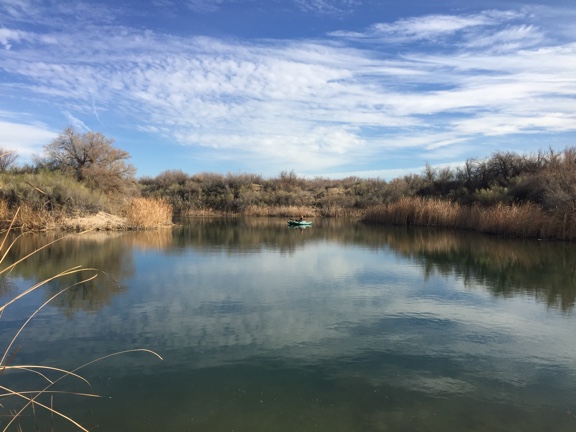
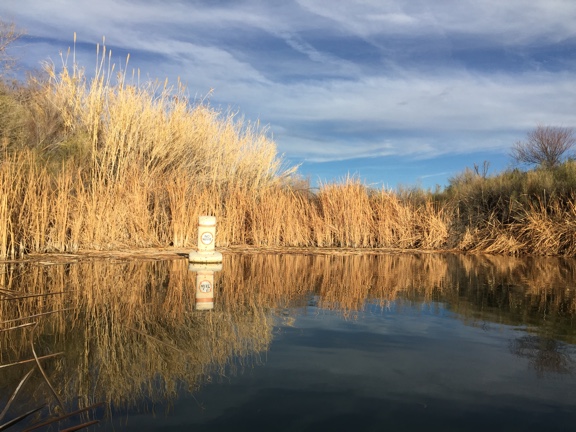
To one side of the campsite was a gravel boat ramp that went — as you might expect — right down into the water. Beyond that was the backwater, lined with tall reeds and normally glass smooth. We had the place all to ourselves.

I shot this photo from the boat ramp at our campsite on the day I arrived. If you look closely, you can see Janet fishing from one of their boats.
We spent the evening polishing off two bottles of champagne in front of the campfire to celebrate our reunion.
The Routine
Over the next almost two weeks, our lives at the backwater settled into a sort of routine. I’d wake up, normally before sunrise (which was at about 7:45 AM) and spend some time in bed catching up on Twitter and Facebook and reading a book or the news on my iPad. Once the sun shined into my bedroom window — my front door faced east — I’d get out of bed, get something warm on — more on that in a moment — and then make my coffee and breakfast.
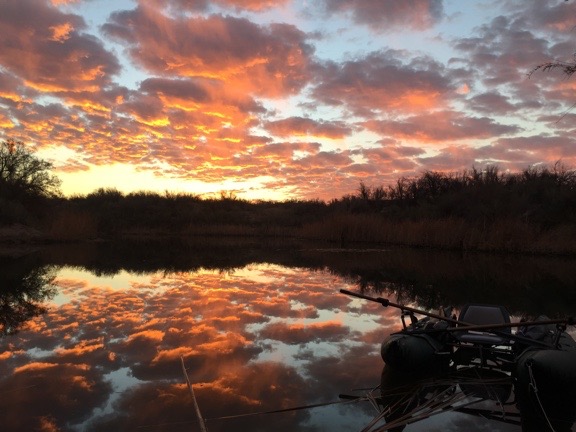
Sunrise was absolutely amazing one morning.

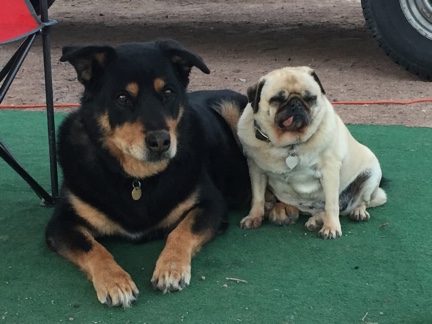
Janet and Steve’s two dogs: Tasha and Lucy (or Lulu).
Janet and Steve and their two dogs would emerge from Janet’s camper a while later. They’d start a fire and I’d go over with my coffee and sit around with them. We’d make some plans for the day and eventually do them — sometimes together, sometimes separately.
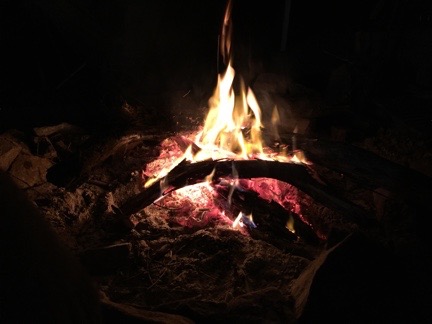
The campfire was the center of relaxation in the morning and almost every night.
Then, at dinner time, we’d make a joint meal. One night, Janet made fish tacos with fish she caught nearby; another night, I made pork tenderloin; another night, she made pasta; another night, I made sausage. One or the other or both of us would come up with accompaniments: a vegetable or salad or bread. We usually ate around the campfire but we did eat inside the Mobile Mansion a few times. When we ate around the campfire, we’d follow up with conversation, often reminiscing about “the old days” when we all lived in Arizona. When we ate inside, we usually played Exploding Kittens after dinner.
Living Off-the-Grid
Understand that we were camping completely off the grid. No hookup at all. That means we had to have enough water and power and holding tank capacity for toilet flushes.
I started the stay with the Mobile Mansion’s 60-gallon tank full of fresh water and its three holding tanks — black, gray, and galley — empty. I’d also brought along all four of my 6-1/2 gallon water jugs, full of water. So I had 86 gallons of fresh water. Janet’s smaller rig had considerably less on board, but they’d also brought along three 6 gallon water jugs full of water. During the almost two weeks I was there with them, I wound up emptying four of my water jugs into my RV for use. So I used just over 80 gallons over the two weeks for washing dishes and myself. I didn’t shower every day, so that saved water, but Janet and Steve each had at least one shower in my rig, mostly because it held so much more water than Janet’s. I used bottled water for drinking, making coffee, and cooking.
The rest of the water pretty much went to the horses. Although Janet and Steve originally led the horses down the boat ramp to drink a few times a day, we started giving them water from our jugs early on. That spoiled them and they sort of decided they didn’t want to drink river water anymore. (You can lead a horse to water…) Fortunately, an odd little convenience store in Ehrenberg let you fill as many water jugs as you liked for $1. So every few days, one of us would go over there with the seven jugs and a short length of hose and fill them up. Sounds like a pain in the butt, but it really wasn’t a big deal. We’d do it when we went out to do something else — often to buy lottery tickets. (The huge Power Ball jackpots were during the time we were there.) While we were out, we usually refilled the drinking water jugs at a place with RO water, which was generally better. The horses didn’t get that.
Electricity was another story. Janet did fine with a tiny solar panel attached to her one deep cycle RV battery and the electric fence for their horses was powered by its own solar panel. I had a sizable solar panel on my roof that charged my rig’s two deep cycle batteries — and provided a charge monitor to see battery levels in volts. Trouble is, the Mobile Mansion, like so many other rigs its size, is designed to be used in a trailer park with a full hookup. It has numerous devices that draw power from the battery all the time — standby, phantom, or vampire power, as it’s sometimes called. So between the stereo (which is always lit up, even when not in use), the water pump (which is constantly sensing pressure), the water heater (which is constantly sensing temperature and then igniting when necessary), the furnace (which is constantly sensing temperature and then igniting when necessary), the refrigerator (which has a light inside when the door is open), the various smoke and carbon monoxide detectors, and god knows what else, the batteries simply weren’t holding enough charge to last though the night. The result: when battery power dropped down below a certain level — usually around 9 volts — the furnace wouldn’t fire and it would get very cold.
How cold? Have you ever seen your breath while you were still in bed? I was very glad to have flannel sheets, a blanket, and two comforters on me.
Although I don’t have my outside air temperature gauge in the Mobile Mansion anymore, local weather forecasts had nighttime lows in the mid thirties. I’m pretty sure it was about that inside my RV one morning when I got up. I know that I really enjoyed sitting on my steps each morning when the sun came up and it soon got warmer outside than inside.

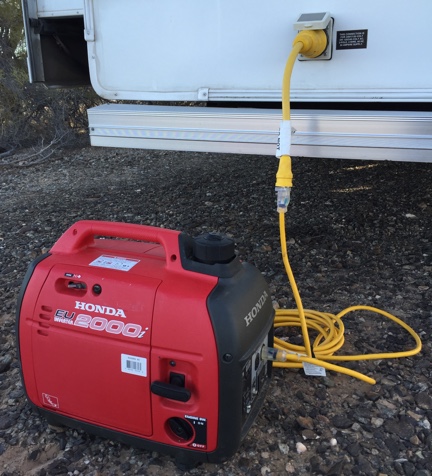
My Honda generator is small and relatively quiet.
Fortunately, I had a solution. I’d brought along my 2KW Honda generator. Although I hated to use it, I hated being cold even more. After a few experiments, I realized that if I ran it for about 2 hours after sunset, I’d “top off” the batteries enough for them to last through the night. The batteries were even more likely to last if I also shut off the water heater and water pump before going to sleep and set the thermostat at about 55°. The heater cycled on and off fewer times and kept the chill out. Then, when I got out of bed in the morning, I kicked it up to 65° and was warm enough inside by the time my coffee was ready.
Of course, none of this would be necessary if (1) the days were longer and (2) it was warmer at night. Still, since I usually ran the generator while we were eating dinner at the campfire and Hondas are pretty damn quiet, it didn’t bother anyone. As an added benefit, I got to charge all my devices a lot quicker and even used the microwave one night.
As far a the toilet flushing is concerned, RV toilets give you control over how much water goes into every flush. I used very little. Not only did I not fill that tank in two weeks, but I didn’t smell it at all.
Activities
We spent our time at the backwaters doing a number of things.
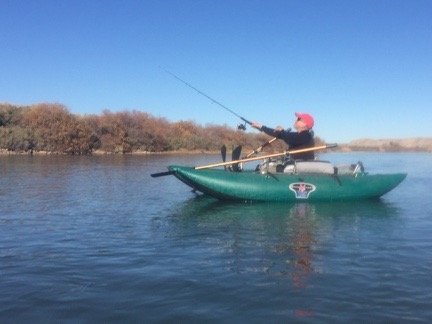
Janet shows off excellent casting skills on the Colorado River.
Fishing.
Janet went fishing just about every day. She learned that the fish start biting at 4 PM and was out there from around that time until after sunset. She came back with at least one fish every day. I wanted to fish but I didn’t have a license and suspected that I lacked the patience and know-how to actually succeed.
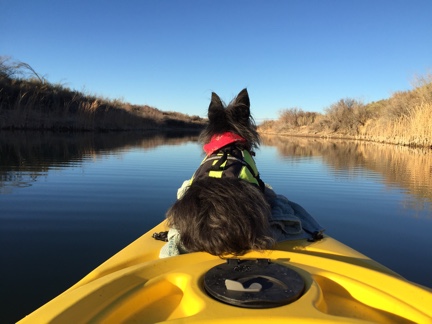
Penny usually sits on the front deck of my kayak when we’re paddling. One day we paddled all the way down to the end of the backwaters.
Kayaking.
I brought along two kayaks and went out a few times. The first time, Janet took the other kayak along with her fishing gear. She quickly learned that she couldn’t properly control the boat while she fished, so that’s the only time she kayaked with me. One day we had Steve drop us off about two miles up the Colorado River from our camp. I paddled my kayak and Janet took her little pontoon boat and flippers (with her fishing gear, of course). We went down past our camp, then paddled up one of the nearby backwaters where Steve picked us up again. Total distance covered was 3.7 miles.
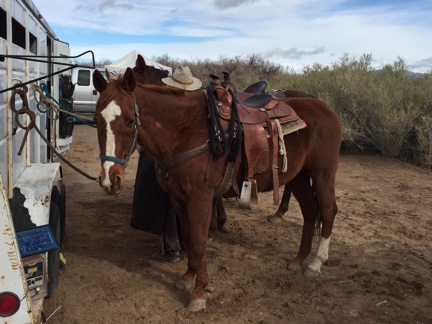
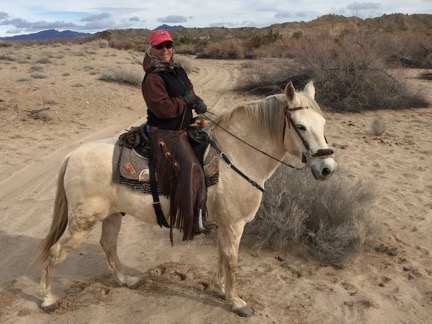
Here’s Flipper, a 25-year-old mare who didn’t seem to mind having me on her back. She still has a wonderfully smooth lope.
Here’s Janet on her horse, Cerro.
Horseback riding.
We went out twice. They put me on Flipper, a horse they’d had for about 15 years. I’d ridden her once before, long ago. She did fine. Afterwards, they told me I was the first one who’d ridden Flipper in about five years. The rides weren’t long, but they were pleasant. We did both of them on cloudy days and were drizzled on once. We saw lots of signs of wild horses or burros in the area.
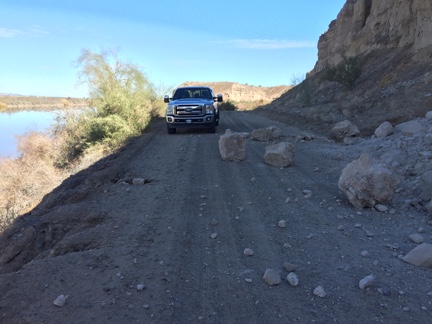
It might look as if I could squeeze by those boulders, but with a 50-foot drop down with loose soil on the left in this shot, I wasn’t about to try.
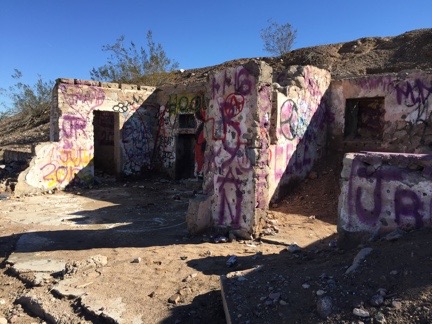
I have no idea what this was, but I do know a lot of spray paint ended up here.
Exploring.
I took the truck south along the Levee Road one day. I’d driven that way years before with my wasband, not long after buying the Mobile Mansion. We were looking for free places to camp back then — so odd that years later I’d be camping in one of them without him. This time, I went much farther. At one point, there was a rock slide that left boulders in the road. I got out and tried to move them but couldn’t. I backed up along the narrow road to where I could turn around and a huge tow truck passed me toward the slide. So I followed him back there. The truck stopped, two guys got out, and they rolled all the boulders out of the way. They continued and I followed them. Later, I stopped at the ruins of some sort of vandalized building. I crossed the river to the California side and tried to come up the river on that shore. I eventually headed into Blythe where I had lunch and did some shopping before going back to camp.
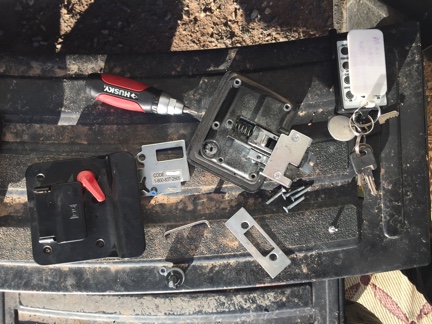
Fixing the lock on my door was pretty simple to figure out once I’d disassembled the whole thing.

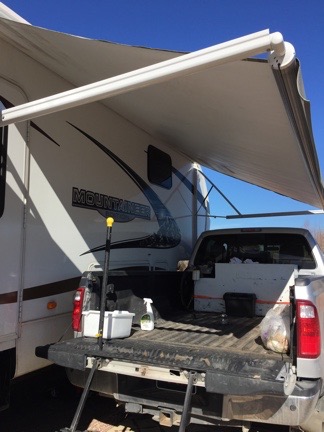
I used my truck as a ladder to clean the underside of my awning.
Maintenance and repairs.
I did a lot of little maintenance and repair jobs on the Mobile Mansion. For some reason, the bottom lock — the deadbolt — on my door didn’t work. That meant I couldn’t lock the door from the inside. I wanted that fixed so I took the door latching mechanism apart. A screw had come loose and a bar that worked the locking mechanism had slipped off. A little work with my screwdriver and it was good as new. Another day, I extended the awning and cleaned the bottom side. (The top was already remarkably clean.) Another day, I took everything out of the basement, swept the floor, and washed it before putting everything back neatly. I added oil, a tiny bit of Gum Out, and fuel to my generator. I worked some WD-40 into the hinges on my front steps. I went up on the roof to clean the solar panel and check for cracks in the roofing material. (There were some along the edges that might need attention.) I thoroughly cleaned my stovetop, under the stovetop, and oven. I neatly recoiled all of my electrical cables and hoses and hung them in their proper places in the basement. I added distilled water to all the cells on both of my batteries. I organized all of the equipment in my truck.
Trips into town.
As mentioned earlier, we occasionally went into Ehrenburg to get water or lottery tickets. I headed into Blythe a few times to do grocery shopping, buy things I needed at the excellent Ace Hardware Store there, and do laundry. I went to Quartzite once to buy propane and see what was going on.
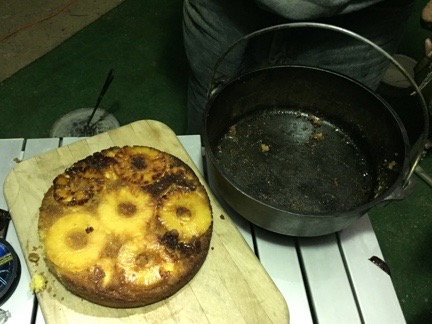
Steve made an amazing pineapple upside down cake in his dutch oven using coals from the fire.
But the best part of our stay — the part I seemed to enjoy most — was the evening campfire, especially when we cooked over the mesquite coals. Steve made us a pineapple upside down cake in his dutch oven twice and it was amazing both times. And the stars — I’d forgotten how clear and dark the Arizona sky can be.
SAD, Cured
I have to admit that 15 years living in Arizona had spoiled me. It’s not the temperature. It’s the sun.
Back in Washington, I realized that despite the general brightness of winter days at my home, I needed sun. As December set in and the shadow time at my home began, I realized that I was suffering from SAD: Seasonal Affective Disorder. I was feeling out of sorts. Not quite depressed, but not my normal active, upbeat self. Some friends advised me to get sunlight light bulbs. I opted for the real thing: sunshine in a warmer climate. That’s the main reason I headed south at December month-end.
It worked.
I can’t remember ever feeling so relaxed. It’s like I haven’t got a care in the world. As I mentioned earlier, I feel almost euphoric. No one is putting any demands on me, there are no meetings to attend, and there are few chores to take care of. I do what I want every day, when I want to do it. While this is also true at home — and home tends to be a lot more comfortable than the Mobile Mansion, especially on a cold night — there are always things that must be done at home: chores, little construction projects, etc. On the road, there’s very little of that and none of it can’t be put off for a few hours, days, or even weeks. Even the maintenance and repairs I listed earlier are things that didn’t really need doing. I think that’s what made me enjoy doing them.
How can anyone have any stress in their life when they’re relaxing in peach and quiet with friends in such a beautiful place?
And I don’t think I’ve ever slept so well: four nights in a row, I slept a full 10 hours straight. Even on the nights when I reverted back to my normal 6-8 hour sleep cycle, I slept solidly, almost like the dead. I was very surprised to have missed a torrential downpour one night that resulted in a puddle so large in the campsite that I named it Lake Louise. (It dried up within a day.) Could it be because the Mobile Mansion’s queen size bed is comfy and cosy with flannel sheets and plenty of blankets? Climbing into bed is like slipping into a warm cocoon. And when I wake up and eventually climb out of bed, I’ve got tons of energy, ready to face the day.
I’m thinking that all this has got to be because of the plentiful sun, slightly longer days, and relatively warm air that’s giving me an emotional and physical boost. Back home, the short winter days and abundant (this year, anyway) snowfall made me feel closed in and almost trapped. Here in the sun, with the desert all around me, that closed in feeling simply can’t exist.
And no where is that more apparent than in the backwaters, camping in total privacy with good friends.
The Next Stop
All good things must come to an end and our backwaters stay is one of them.
On January 13, Janet packed up her van and little trailer and pulled out. She had a booth at one of the shows at Tyson Wells in Quartzsite and needed to get her trailer into position before the booths around her set up.
Steve and I spend most of that Wednesday packing. He had to pack up the horse trailer and I had to pack up and secure loose items in the Mobile Mansion. On a whim, I brought the kayaks to Janet’s space in Quartzsite that evening so I wouldn’t have to pack them inside my living space. When I got back to camp, I hooked up the Mobile Mansion so I could pull out without a lot of fuss in the morning. I wanted to take the Mobile Mansion to the truck wash and was hoping to get there before anyone else so I wouldn’t have to wait.
Steve sat alone by the campfire that night. I stayed in and wrote a blog post to introduce this Snowbirding adventure. My generator hummed under the window at my desk until I was ready for bed.
In the morning, I’d make us both coffee before putting away the last few things and heading out.
More on that in another post.

 Mind you, I’m camped on a construction site across the street from a cherry orchard 8 miles up a canyon from Wenatchee, WA. (The tiny red X on the map marks the approximate spot.) It’s amazing to me that (1) my cell phone works so well up here, usually giving me five [legitimate] bars and (2) I’m able to stay connected to the Internet for so long.

