Where do you get your “news” and what are you believing?

My Twitter profile is a simple list of the things that make me me.
In my Twitter profile, you’ll find the phrase truth seeker. I’m occasionally ribbed by far right Twitter users who don’t like my one-liners, often at the expense of people they support, including Donald Trump, Mike Huckabee, Sean Hanity, Bill O’Reilly, and Ted Cruz. These people, who cry “fake news” whenever they hear something they don’t like, wouldn’t know the truth if it hit them with a baseball bat.
But I take truth seriously. I want to know the truth about things. I want to be able to form my own opinions based on facts. I try to be yet another phrase in my profile: independent thinker.
And that’s why I’m so frustrated when people share inaccurate information, including links to false or seriously biased news stories on social media. It was enough to drive me off Facebook and it keeps me fine-tuning the list of people I follow on Twitter.
But what are good, reliable sources of information? Back in February, I blogged about an article in Forbes that attempted to identify some of them. For the most part, I agreed with the list. But it was limited and it failed to indicate any biases or whether the source presented facts, analysis, or opinion.
Some Definitions
Let me take a moment to define each of these, because it’s very important to understand.
- Facts are truthful statements of what is or was. This is black and white stuff that can be proven and is not questioned (except maybe by people who cannot accept the truth).
- Analysis puts facts into context in an attempt to explain why they matter. This can be extremely helpful for folks trying to understand the impact of past and current events and why they should care. Although knowledgable people can often make their own analysis, when there are too many facts that impact a situation for the average person to understand, fact-based analysis can be vital for the average person to make an informed decision. Bias can come into play in analysis, but the best analysis sticks to facts and avoids bias.

The definition of bias.Opinion is what one person or organization thinks about a situation. Opinion can be well-reasoned, based on solid facts and good, informed analysis. It can also be based on false information and similarly flawed analysis. Most often, it’s falls somewhere in between with a mixture of good and bad information and analysis. But it always includes bias, which can seriously degrade the value of the opinion — especially for someone able to think for herself.

So what am I looking for in my news sources? Facts and unbiased analysis so I can make my own opinion.
The Chart
A while back, I came upon an infographic that listed news media sources on a chart. On the Y (vertical) axis was how factual the source was. Higher was more factual. On the X (horizontal) axis was how biased the source was. Middle was unbiased, left was liberally biased and right was conservative biased. The original version of this chart listed quite a few news sources. In answer to a question a Twitter friend asked the other day, I went looking for it online. I found version 3.0, which I’m reproducing in a reduced size here:
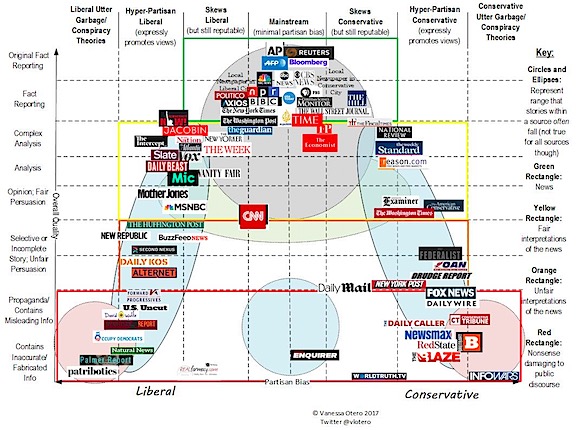
Version 3.0 of the chart by Vanessa Otero. (I highly recommend that you click the chart to view a larger size and the article that explains it.) This is an extremely handy tool for evaluating news sources — so handy that I’ve printed out a copy for future reference and will be looking for updates.
Understanding the Chart
No chart is perfect and if you read the comments on the post that explains this version of the chart, you’ll see that people have argued with its author. In most instances, they’re claiming that various sources should be shifted left or right from their current positions.
If you accept that it’s at least 95% representative of reality — which is where I stand — if you’re looking for facts, you should be most interested in the news sources inside the green box. That actually makes me feel pretty good because that’s where most of the news sources I listed the other day reside: the New York Times, Washington Post, BBC, and NPR. In fact, my main source of news is NPR, which is minimally biased fact reporting. I listen to NPR on the radio all day most days when I’m working at home.
If you want analysis, look for sources inside the yellow box. Ideally, you’d want something in the middle of the yellow box, which is nearly empty. One of my favored news sources, the Guardian, falls slightly left in the top of that box; another, the New Yorker, is slightly down and slightly more left. This isn’t terribly surprising since I lean more liberal than conservative in most of my views. Still, neither source is either “hyper-partisan liberal” or “liberal utter garbage/conspiracy theories.” Whew.
The orange and red boxes contain sources that are light on facts, and high on biased opinion. Unsurprisingly most of the news sources listed are either far left or far right. The red box sources are especially troubling in that they include misleading information and/or inaccurate or fabricated information geared toward either far left or far right media consumers. This is where you’ll find Occupy Democrats and the Palmer Report on the left and Fox News and Breitbart on the right. The chart notes that they are damaging to public discourse. (Duh.)
Using the Chart
How do I use this chart? First of all, it’s made me want to spend more time with sources like Bloomberg, Time, and the Economist. These look like they might be good sources of fact and unbiased analysis.
Next, when faced with a “news” story from an unfamiliar source, I’ll look it up on this chart. If it’s in the red box, I’ll basically disregard it. Why should I waste my time trying to figure out what part, if any, in the story is factual? I certainly won’t share it — and I’ll downgrade my opinion of the reliability and judgement of anyone who does.
If it’s in the orange box, I may or may not disregard it, depending on the topic and the availability of corroborating stories. But again, why should I waste my time trying to figure out what to believe in a story?
Instead, I’ll focus on what’s in the green and yellow boxes, as close to the middle of the X axis as possible.
What about You?
What do you think? I’m not talking about the accuracy of the chart here — if you have comments about that, leave them for the chart’s author and she’ll address them. I’m just curious about where people get their news, what they’re looking for, and what they share. Let us know what you think.
And please — do your best to fight real fake news. Don’t share links to unreliable or heavily biased “news” sources.
 The ACA made it easier to shop for insurance by setting up a marketplace. It prevented insurers from denying coverage or setting unreasonable rates for people with pre-existing conditions. It required insurers to provide a list of basic coverages that a person might need. It covered, at no additional cost to insured people, annual well-care visits to help prevent illnesses or to catch them before they became serious problems. It required more employers to offer health care benefits to employees. It encouraged everyone to get health insurance coverage to increase the pool of insured individuals, thus reducing the overall cost of coverage for each of us. It prevented insurers from taking obscene profits on healthcare coverage by setting maximum profit levels that actually refunded premiums to customers. These are all benefits that help those of us who don’t work for big companies that offer health insurance in a benefits package.