Travel Insanity

Too many miles, too little time.

I’m just recovering from a crazy week with too much travel in too short a time span.

Our Flight Path

Our flight path, recorded on my iPad with GPSTrack. Can you tell where we did some scud running?

It all started last Saturday, when I flew with two companions from Phoenix, AZ to Wenatchee, WA by helicopter in one day. It was almost 11 hours of flight time with mostly very brief stops for fuel. Although I had very little stick time — one of my companions did almost all the flying — I was still alert and able to fly at a moment’s notice.

It got a little tense when we had to do some scud-running in Oregon that lasted far longer than I like to be spending scud running — as if I like it at all. It never got dangerous, but more than a few times, I began scouting the remote hillsides around us, looking for a place to set down and wait it out. I was very glad when the terrain finally descended, dumping us in an area where we could get back on course.

We spent the night in Wenatchee and I parted company with my travel companions, leaving them to catch an early flight to Seattle while I took care of other things locally.

Sunday was relatively restful. I needed to reposition the helicopter to Quincy, WA, where I’d be spending part of my summer. That was just a 15-minute flight. Then I spent some time socializing at Ferguson Flying Services, where my helicopter is parked in Quincy, and the Colockum Ridge Golf Course, where my RV would be parked soon. Then a friend/client picked me up and drove me the 5 miles to his winery in town, where I spent the afternoon socializing with him, his family, and the folks who came for wine tasting. A nice, mellow afternoon.

But at 4:15, the craziness started again. I got a lift to Wenatchee Airport, where I caught a flight to Seattle with a connecting flight to Phoenix. My husband picked me up there at about 10:30 PM. Overnight at our Phoenix condo.

Monday morning, bright and early, we were on our way back up to Wickenburg. I spent the day finishing up some work on a chapter of my book and then packing. It wasn’t until nearly 9 PM that night that we were done and pulling the RV out of the hangar where it lives most of the year. We left it parked in front for the night.

Welcome to NevadaAt 6:45 AM, I was in the driver seat of the truck with Alex the Bird in the seat beside mine. We were starting a 1,295-mile drive from Wickenburg, AZ to Quincy, WA. My goal was to make Jackpot, NV that first day — a distance of 725 miles. I spent most of those miles on Route 93, a two-lane road with speed limits up to 70 miles per hour. There was no traffic and certain stretches of the road were straight and flat as far as the eye could see. We made Jackpot before nightfall. After dinner n the casino, I spent the night in the RV with Alex in comfort — in the casino parking lot.

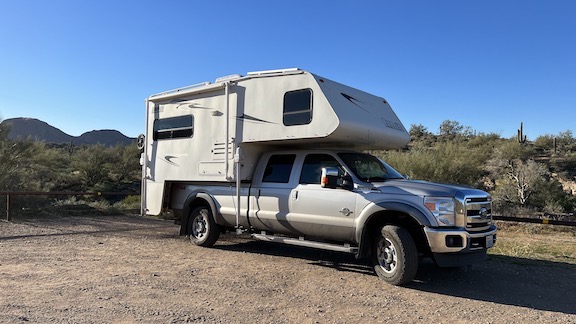
My Rig, in Jackpot, NVThe next morning, I woke at 6:15, which is late for me. Anxious to get on the road, I rushed around making my coffee and Alex’s breakfast and then buttoning up the RV for another day on the road. It wasn’t until after I topped off the fuel tank across the street from the casino that I realized it was an hour earlier; that part of Nevada is on Mountain Daylight Time. So I got a very early start. I left Route 93 behind in Twin Falls, ID, and hopped on I-84. The route was mountainous and the truck sucked diesel at an alarming rate as I struggled to maintain speed up hills. I left the interstate just past Pendleton and got back on smaller, traffic-free back roads to head north. After 10 miles on I-70 and the last five miles through familiar farmland, I rolled into the parking lot at the Colockum Ridge Golf Course RV Park just after 3 PM.

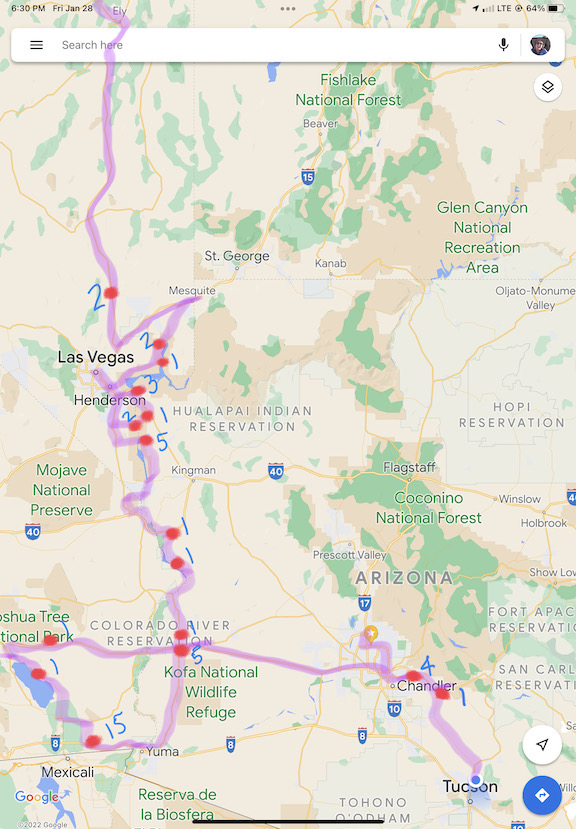
My Route

My route, as captured by GPSTrack on my iPhone.

I was fortunate to have had good weather all the way. Towing 13,000 pounds of fifth wheel RV on wet pavement is no fun — as I learned last year. It was just starting to rain when I finished hooking up my utilities at 4 PM.

Do I need to say how exhausted I was? I’d snacked my way from Wickenburg to Quincy, eating only snacks on my low-carb diet: jerky, almonds, and cheese sticks. The only real meal I’d had was at the casino in Jackpot. My digestive system was a mess for the next two days.

And of course, I developed a bad cold, which I think I’m just coming out of now.

But on the bright side of this, I managed to get all my assets in position for the first half of the cherry drying season. I set up my RV office and yesterday I managed to knock off another chapter of the book I’m working on. I’m also in the area early enough to set up helicopter tours and wine tasting trips with the local wineries.

It’s been a rough week, but now I’m settled in. It feels good to be at my home away from home.

Wickenburg to Las Vegas by Helicopter

Again.

I couldn’t have asked for better weather. That’s what I was thinking as I preflighted my helicopter early on Wednesday morning.

I’d been hired to take three people from Wickenburg to the Las Vegas area with the primary objective of viewing the new bridge near the Hoover Dam from the air. My client, who had flown with me several times before, was willing to make the four-hour round-trip flight by helicopter — and pay for it — just for a look. To make the trip more worth his while, we’d also land at Boulder City Municipal Airport, where they’d rent a car and drive over to the dam for a tour. After lunch, they’d come back to the airport, climb back on board, and I’d take them for a Vegas Strip tour before returning to Wickenburg.

I’d mounted my GoPro Hero camera on the helicopter’s nose and set it up to shoot 720p video of the flight. I expected the flight up there to yield some good images and, if the camera was mounted properly, some smooth video footage. The camera seems to work best with the light behind the helicopter. On the way back, we’d by flying with the sun in front of us, so I didn’t have high expectations. Still, I brought along a pair of 16GB SD cards and the camera’s charger so I could capture it all. The images throughout this narrative are stills taken from that video.

The Flight Up

A thin, almost lacy layer of high clouds veiled the sky as we headed northwest from Wickenburg just after 8:30 AM. There wasn’t a breath of wind. The helicopter glided over the desert, 500 feet off the ground passing over cacti and other desert vegetation, open range cattle, and the occasional manmade water “tanks,” half of which were dry. Our departure from “civilization” to empty desert was almost immediate. As I often tell people, Wickenburg is on the edge of nowhere; I could just as easily say it’s a five minute flight from nowhere. We passed over a lonely ranch alongside the railroad tracks leading to Parker and beyond, then Route 71, which runs between Aguila and Congress, AZ. Then not a single building for thirty miles, when we reached the Wayside Inn and Alamo Lake.

Alamo Lake
Alamo Lake, at the confluence of the Big Sandy River, Santa Maria River, and Date Creek. The trickle of water released from the dam is the Bill Williams River, which eventually joins the Colorado River north of Parker, AZ.

I climbed not only to cross the lake within gliding distance of shore but to clear the mountains on the far side. As we crossed the lake, I was surprised by the number of campers parked alongside its shore and the boats tied up nearby. I suspected that a fishing tournament might be either starting or finishing up. The lake is popular with fisherman, which is probably a good thing. It’s so remote — heck, it’s a 90-minute drive from Wickenburg — that it simply doesn’t appeal to the typical powerboat/jetski crowd. They usually prefer Lake Pleasant, only 30 minutes from Phoenix (or Wickenburg), which is larger and far more interesting for boating.

Beyond the lake and the rugged mountains on its opposite shore was yet another stretch of empty desert. But rather than being just a flat expanse, this one was peppered with rock formations left behind by ancient volcanos. There were areas of broken basalt, including flat-topped mesas. In the distance, to our left, we could catch glimpses of the Colorado River. If we’d been in a plane, flying 3,000 feet higher, we’d have a better view of the river and mountains in the distance; at our cruise altitude of 500 to 1000 feet above the desert floor, we could clearly see the details of the rock formations, dry stream beds, and scant vegetation as we flew.

Beyond Alamo
The desert northwest of Alamo Lake is vast and empty.

Forty-five miles from Alamo Lake, we reached Lake Havasu, one of the Colorado River’s many lakes. Formed by Parker Dam far to the south, the lake widens in a broad valley. The founders of Lake Havasu City bought the London Bridge — the real London Bridge from England — and had it installed across a manmade canal as a tourist draw. The town formed nearby. It’s popular for water sports and has a huge influx of visitors during boat races and Spring Break. A friend of mine who lives there complains that the temperatures top 100°F six months out of the year.

Lake Havasu
Lake Havasu’s surface was mirror calm as we flew over, reflecting not only the graceful arches of London Bridge, but the clouds high above.

I’d chosen our route carefully. Two hours is a long time to spend in a helicopter, especially out over the desert where the terrain can be — and, up to that point had been — very monotonous. I planned the trip to follow the Colorado River, which was quite scenic. From that point on, we’d be over one shore or another or at least nearby. It would give my passengers something interesting to see for the second hour of the flight.

Indeed, the scenery along the river can be breathtaking — especially where the river narrows and passes through mountainous terrain. Topock Gorge is one of those places. Although it’s a short stretch of river and takes only five minutes or so to overfly, it’s dramatic and rugged. During the summer season, when the lake busy, speedboats roar through this area all day long. But that day, the lake was calm and quiet and we were treated to beautiful reflections of the sky and canyon walls.

Topock Gorge
Topock Gorge is one of the more scenic areas along the Colorado River between Lake Havasu City and Bullhead City.

Past the gorge, the river twists and turns in big arcs to the east and west. Rather than follow its course exactly, we headed almost due north. We passed over I-40 where it crosses the Colorado and the farms and communities built up in the Mohave Valley. This was also desert, but desert made habitable by the river that passed through it. Make no mistake: we were still miles from anything remotely resembling a real city — but at least there were people living here.

Mohave Valley
The Mohave Valley, near Needles, CA, is full of farms and small communities clustered up near the Colorado River.

A while later, we were within range of Bullhead City Airport and I called the controller for permission to transition the area along the river. Bullhead City Airport is a real oddity. It was built on the Arizona side of the river to support the casinos in Laughlin, NV. Although it’s well over 100 miles from any international border, it’s an International airport, meaning that you can fly into it from other countries and pass through customs and immigration. It even gets airline traffic; as we flew through the area, a Sun Country 737 was coming in to land. But the airport itself gets very little traffic. This might be because of the natural “wind tunnel” that funnels air up or down the river, resulting in winds that often top 20 knots. But that day, the wind was calm — the first time ever that I’d been there — and other than the jet, we were the only other traffic in the area.

Laughlin, NV
The tall casinos of Laughlin, NV across the river from Bullhead City, AZ. You can see the Bullhead City airport on the far right.

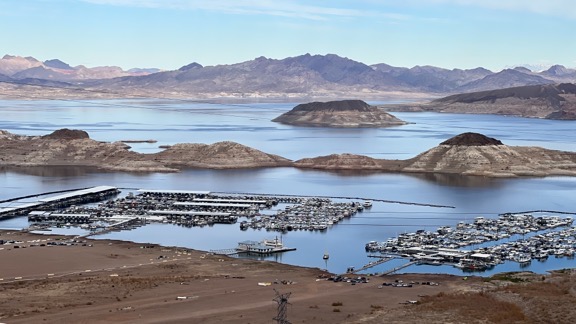
Beyond Laughlin and Bullhead City was the Davis Dam, which forms Lake Mohave. Lake Mohave is another one of the oddities of the desert. Although there are a few marinas and campgrounds along its southern shores, most of the lake is deserted and I seldom see any boat traffic on it. Again, this is likely because of its remote location — although access is easy from the Laughlin area. It seems to me that Lake Mohave would be a great place to become a houseboat hermit.

Davis Dam
The Davis Dam is just upriver from Laughlin and Bullhead City.

Lake Mohave
Lake Mohave seems like the perfect place to get away from it all on a clear, blue lake.

We flew up the eastern shore of the lake and I kept a sharp eye out for wild burros (donkeys). I’d seen them there before. While their trails were easily visible from the air, I didn’t see any animals — or people — at all.

The north end of the lake narrows considerably where the Colorado River winds through a gorge. The rock formations are rugged and starkly beautiful. This isn’t the place you’d want an engine failure — there aren’t many places for an emergency landing. But the landscape draws me to this area each time I fly up the river.

Colorado River
The Colorado River on the north end of Lake Mohave passes through a rugged gorge.

I tuned into the Lake Mead/Hoover Dam tour helicopter frequency and began monitoring communications. I knew that the area around the dam would be full of traffic and wasn’t sure what altitude pilots would be flying at. Routes and procedures are not published; my attempt to get this information from a tour operator failed miserably. (These operators apparently think they own the places they fly over and do what they can to keep everyone else out.)

I reached Willow Beach and made my first call. “Helicopter Six-Three-Zero-Mike-Lima at Willow Beach, heading for the bridge at 2500 feet.”

Some wise-ass tour pilot came on the radio and said “Which bridge? Hoover?”

What an idiotic question. There was only one bridge within 60 air miles. Which bridge did he think? What kind of morons are those tour companies hiring?

“Hoover,” I replied.

“Be advised that there will be four Maverick helicopters over the dam in about two minutes,” he replied. No indication of altitude or any other useful information.

Other pilots were more generous. Although the Papillon Pilots seemed to be crossing the river farther south at 3500 feet, the Maverick pilots were operating near the dam at 3000 feet. I planned to say at 2500 feet, which would keep me out of their way.

The bridge came into view around the same time the Maverick helicopters started appearing overhead. They were flying an odd S-shaped pattern that was obviously designed to give all their passengers a view. I did a three-quarter circle from the right to the left as my passengers leaned forward and then left to see. They got a good look — I was not prepared to loiter and they didn’t seem as if they needed me to. Then I was exiting the area along the road to Boulder City.

Hoover Dam and Bridge
The Hoover Dam and its new bridge are a popular tourist attraction for Las Vegas visitors. They’re amazing from the air.

I wasn’t finished yet, though. Another tour operator does very short tours of the dam and bridge from the Hacienda Hotel just up the road. He was preparing to launch as I flew over. He kindly said he’d wait until I’d passed by, then thanked me for talking on the radio. (Apparently, some pilots don’t — that’s a scary thought.) I thanked him for listening.

Not knowing the approach procedures for Boulder City Airport and anxious to stay out of the way of any other tour traffic, I stayed low as I crossed over the city and headed for the airport. (I was later told I’d likely get in trouble for that, but no one ever called. I guess I lucked out.) There were skydivers falling from the sky near the airport so, to stay clear, I circled around to the east and landed along one of the runways. I was still on edge from mixing with so much other traffic when I set down on one of the helicopter parking spots for the FBO.

Boulder City
Boulder City was built 90 years ago to provide a home for dam construction crews. It’s since grown to a vibrant community — the only one in Nevada that does not allow gambling.

We’d been in the air for 2.2 hours and I was ready for a break.

More about this trip in another post…

On the Road Again

Notes from halfway down the long drive from Wickenburg to Seattle.

I’m writing this from a Walmart parking lot. I’m propped up in a queen sized bed with three pillows behind my back and my laptop on my lap. It’s 3:30 in the morning and I’m pretty much wide awake after just over five hours of sleep. It isn’t noise that woke me — this Susanville, CA parking lot is remarkably quiet. I guess I’m just done sleeping for the night. But it’s too early to continue my travels along winding mountain roads, so I figured I’d share an update on my blog.

This isn’t a pleasure trip — although parts of it have been very pleasant. It’s for work; I’m repositioning a truck and my new RV from Arizona to Washington State for the summer. The RV will be my home away from home as I work on cherry drying contracts for central Washington growers. The truck is needed not only to pull this massive fifth wheel trailer but to carry the refueling system I need to meet my contractual obligations.

The Truck

I’ve written about my new RV elsewhere in this blog, so I won’t repeat that here. But I’ve probably neglected the truck. It’s my husband’s truck: a 2001 Chevy Silverado 3/4 ton pickup. It has a Duramax Diesel engine with towing package and an Allison transmission. A “man’s” truck, capable of towing more than 15,000 pounds. (We bought it new in 2001 to tow a horse trailer with living quarters that I’ve since sold.) Inside, it has many creature comforts, including heated leather seats, power windows, and stereo system with iPod connection. The truck runs well and is up to the task of towing my home away from home over 1,000 miles.

I’ve mounted my old Garmin 60c GPS over the dash and have it wired into one of the DC power outlets. I’d loaded in topo maps (my preferred map type) for my entire route and then some. I’m using it mostly as a trip computer, to calculate distance driven, average speed, etc. I’m keeping close track of fuel consumption so I can calculate burn rates.

I’ve also clipped my cell phone case to the visor and connected it to another DC outlet. I’m wearing my Bluetooth earpiece for most of the trip for safer hands-free communication — when I can get a signal. Verizon has the best network — which is why I use it — but even Verizon doesn’t cover some of the places I’ve driven through on this trip. I can hear the signal fade in and out with beeps in my right ear as I drive.

The Route and Stops

Track Me!
If I’m traveling — whether by helicopter or on a long drive — you can usually follow my SPOT Messenger track online at tinyurl.com/FindMaria

Every year I choose a different route for this drive, shunning freeways as much as possible. This year, the route included stops to visit with friends in Las Vegas and Reno, NV, and Ashland, OR. The route began in Wickenburg, AZ and headed west on route 60. What followed was a numeric alphabet soup of route numbers: 72 and 95 to Parker, 62 and 95 to Needles, 40 and 95 to Boulder City, 95 and 215 to Las Vegas, etc. You get the idea.

In Vegas, I visited with my friends Jim and Judith. Jim is a helicopter pilot who flies a Hughes 500c. He and his wife, Judith, lived in Wickenburg for quite a while but, like most of our other friends, bailed out when the saw the reality of the situation there. They moved to the San Diego area for a while, then various places in California, and finally in Las Vegas.

Jim, an airline pilot who took early retirement years ago — luckily, before the airline went belly up — is an inventor. He designs, manufactures, and sells power external aircraft power units called StartPacs. They’re used primarily for starting turbine engines, although he has a whole range of power products now, from power sources a pilot can use while fiddling with his avionics on the ground to big, self-propelled APUs for bizjets. When they left Wickenburg, they took their business with them. They now employ a handful of people in their Las Vegas office and manufacturing facility. Jim gave me a tour after lunch on Monday and showed me some of the new designs he’s gotten patents for.

I left Vegas and headed west and then north through Pahrump. Another road took me west again. By 4 PM, I was in Death Valley. Although the temperatures should have been topping 100°F there this time of year, it was unseasonably cool, in the high 80s, with plenty of cloud cover. There were also signs of rain coming from the clouds, but the ranger at the Visitor Center assured me that it was unlikely for any drops to reach the ground.

On one ranger’s suggestion, I made my way to Panamint Springs. After a long, slow climb up over the mountains, I experienced a harrowing descent down a 9% grade. The truck’s tow package really helped out, downshifting to 2nd gear automatically to reduce my need to ride the brakes. Note to self: avoid Route 190 between Stovepipe Wells and Panamint Springs when towing a 36-foot RV.

Panamint Springs is still inside Death Valley National Park, but it overlooks the Panamint Valley, which is one valley west. It consists of a motel-like lodge, restaurant, and dirt lot dressed up as a campground. I paid $15 for a water-only hookup for my RV for the night. (I didn’t bother hooking up; I didn’t need water.) I had a heck of a time getting the RV into its pull-through spot. Although it was plenty long enough, the campground designers had placed large boulders at either side of the driveway. Making the turn without damaging the RV’s underside was tough. But I eventually managed and Alex the Bird and I settled in for the evening. I watched the changing light on the mountainsides from a patio table at the restaurant. At night, it was dead quiet and very dark. I stepped outside to admire a sky full of stars with a crescent moon before turning in for the night.

The next morning, I was on the road at 7 AM, continuing west on Route 190. After fueling up just outside of Lone Pine, I continued north on Route 395. I didn’t realize that route was so mountainous. After leaving Bishop, the truck did a lot of climbing, eventually reaching over 8,000 feet elevation. (This was the day after descending to -230 feet in Death Valley.)

On the urging of my friend, Rod, I detoured to the Ghost Town of Bodie. That required me to negotiate 14 miles of narrow, windy road, the last three of which were unpaved. I was extremely pleased to see that the parking area was large enough to make a U-turn in without having to back up. I put Alex in the camper while I went to explore the townsite on foot with my camera. I’ll likely write about that in another blog post, when I get the photos off my camera.

I met Rod for lunch in the Reno area, not far from where route 395 intersects with I-80. Rod lives in Georgetown, CA; I’d visited him and his wife, Liz, there by helicopter several times in the past. This time, I was on the other side of the Sierra Nevada mountains and wasn’t planning on crossing. But Rod made the 2+ hour drive from Georgetown to Reno to meet with me. Rod’s also a helicopter pilot — he flies fires in twin-engine helicopters like Hueys — in the summer. The rest of the year, he does odd jobs around home. We had a very late lunch in a Chinese restaurant in Sparks, NV.

Then I continued my drive north on route 395, ending up here in Susanville.

Highlights of the Trip

I’ve driven through some beautiful scenery over the past two days. Snow-capped mountains, sheer granite cliffs, dry lake beds, sand dunes, layered rock thrust up on an angle and eroded to expose lines of color. Blue lakes, rushing rivers, puffy white clouds in otherwise clear blue skies. Herds of wild burros, pastures full of horses and cattle, deer. The ruins of a town in the middle of nowhere that once was home to over 10,000 people.

It’s all a blur. A trip like this on a route like this shouldn’t be crammed into a few days. It should be slowed down and savored, with stops here and there to take in the sights and sounds and smells. This isn’t quality sightseeing — it’s motoring. I may as well be on a freeway.

Later today, I’ll drop down from the mountains to I-5 near the Oregon border. From there, I’ll follow the Interstate north into Oregon. After another lunch with another helicopter pilot friend, I’ll make my way north to the Seattle area. I’ll camp out in yet another helicopter pilot friend’s yard. Whether I can get there today depends on how twisty and mountainous the roads between Susanville and I-5 are; I’ll know by lunchtime.

Idaho is Prettier than Nevada

And Oregon is, too.

[When we last left our intrepid traveler, she was making herself at home in a 21-foot travel trailer parked in a casion parking lot in West Wendover, NV. You can read about the events leading up to this point here.]

I went into the casino at 5:30 AM in search of a cup of coffee. The espresso stand looked open, but it wasn’t. I asked a person who worked there what time it opened and she said 7 AM. I was about to freak out when I realized that my watch was on Mountain Standard Time and the casino was on Mountain Daylight Time. It was really 6:30 AM. I only had to wait 30 minutes.

After a peek across the street to see if there were another option — there wasn’t, unless you count McDonald’s, which is evidently getting high marks from some folks on their coffee; I’m not that brave — I went back to the camper. I busied myself finishing up the blog entry for the previous day’s drive. I’d just connected to the Internet with my Treo to upload the post when the phone rang, cutting off my connection. It was Mike. He has a real knack for calling when I’m using dial-up networking. By the time we finished chatting, my computer’s battery was nearly dead and the inverter I’d bought to power it in the camper wasn’t working. So the post didn’t get posted.

I went back into the casino, where I spent $5.08 for a 16-ounce “latte” with an extra shot of “espresso.” Note the quotes. I’m putting these terms in quotes because that’s what the casino called this stuff. It’s not what I received. In fact, it was barely drinkable.

Inside CamperI went back to the camper and packed up my bedding. The camper’s two queen-sized beds fold out the front and back of the camper and resemble pop-up camper beds. Although it’s not difficult to set these up, it really wasn’t worth it for a night of sleep in a parking lot. So I left the beds folded up and opened the sofa to a bed. This wouldn’t have been bad if the bed were long enough for my 5’8″ height. I’m thinking it’s about 5 feet long. I slept diagonally with my legs curled up. (This photo, taken with my funky fisheye lens, makes the camper’s interior look a lot bigger than it is. But it’s roomy enough for me. In this shot, the slide-out is fully extended; I usually only put it out halfway for overnight stays. You can see the closed-up front bed in the middle of the shot.) I didn’t have a good night’s sleep, but it really wasn’t bad, given the short bed and the fact that the parking lot’s lights made it bright as day outside all night long. Even the blinds couldn’t keep the light out. In the morning, when I woke up, I had to actually look out the window to see if it was daytime.

I got Alex back into his travel box — he spent the night in his cage — and loaded him into the car. A while later, after topping off both fuel tanks, we headed out. Oddly enough, it was exactly 7:05 AM. The same time I’d left Wickenburg the day before.

My route that morning took me west on I-80 to Wells. The 58 miles took about 90 minutes, mostly because of all the high elevation climbing we had to do. You see, the mountain ranges in Nevada generally stretch from north to south. When you drive north, as I did most of the day before, you’re driving on gentle slopes in valleys. But when you drive west, you have to climb over the mountain ranges in whatever mountain passes are on the way. That morning, there were three mountain ranges to cross. On one of them, the truck actually downshifted to first gear with my foot on the floor, unable to give me more than 35 miles per hour. Fortunately, I did better downhill.

The day was cloudy and it drizzled. When I approached Wells — which may have provided a decent place to spend the previous night after all — I saw that the mountains to the south were covered with fresh snow. In fact, it may have still been snowing.

I headed north on U.S. 93 again. The terrain was changing subtly. By the time I got to Jackpot, NV, on the border of Idaho, it was hilly and green and rather pleasant. I stopped at Cactus Pete’s Casino for breakfast, putting Alex in the camper while I went inside. It had a nice breakfast burrito with a cup of truly undrinkable coffee.

It was unfortunate I didn’t get all the way to Jackpot the night before. As my friend Stan had told me, Jackpot was a very RV-friendly place. It would have been a pleasant overnight stop.

Another refueling, then back on the road. I crossed into Idaho. Soon I was driving through farm country. At Twin Falls, I screwed up and followed U.S. 30 instead of 93. Although 30 was more direct, 93 would have gotten me to the Interstate a lot quicker. But the last 10 or so miles before I finally got on the Interstate was actually quite pleasant, winding alongside a river with lots of little waterfalls. (Maybe that’s what that “Thousand Springs” on the map was all about.)

Meanwhile, the weather remained variable: mostly cloudy with scattered rain showers. By 11:30 AM, I was feeling as if I needed a nap. That’s not a good thing when you still have about 400 miles to drive. I started thinking about maybe not getting all the way to Quincy by nightfall. Maybe an overnight stay in a nice campground would be better. Someplace with an electric hookup and WiFi.

By the time I got to Boise, it was pouring. I kept going. When I reached Nampa, I got off the highway and fairly stumbled into a Wal-Mart parking lot. I wanted to stop at a Wal-Mart or a Target to buy a cheap vacuum cleaner for the camper. You know, the kind on a stick. My mother used to call them “electric brooms.” I figured a walk around Wal-Mart might wake me up a bit. And maybe it would stop raining while I was in there.

I turned out to be a Super Wal-Mart, with groceries. I thought I’d take the opportunity to pick up some food for the camper, just in case my overnight stop wasn’t anywhere near shopping or dining. I bought some soup and eggs and orange juice and cereal. That kind of stuff. Then wiper blades for the truck and the vacuum. I brought it all out to the camper and stowed it away. Then I studied the map and came up with a plan — I’d press on and see how I felt by 5 PM. If I wanted to stop for the night, there were a handful of state park campgrounds I could try.

So I fueled up again and headed back out on I-84. It was about 2:30 PM and the rain had let up considerably.

A while later, I passed into Oregon.

I don’t know if it was my tiredness or my lack of enthusiasm for Nevada’s dull scenery or the changeable weather, but the ride into Oregon on I-84 was beautiful. Rolling green hills, farmland, irrigation canals, streams, rivers, snow-capped mountains, trees, rock formations. The interstate twisted through all this, with the inevitable climbs to slow me down so I could get a good look. Unfortunately, the rain came down very hard sometimes, making for bad visibility and tricky driving. It was also making me tired.

I pulled off the highway at Baker City and consulted the map. There was a state park with a campground about 50 miles farther up the highway. I got back on the road and homed in on it.

Hilgard Junction State Park is a tiny sliver of land alongside a creek just off the freeway. It offers primitive camping that includes a paved parking spot, picnic table, and fire pit. There’s a water faucet every 3 or 4 sites and a garbage pail every 2 sites. There’s also a restroom with cold running water. A campground host watches over all this. The fee: just $8/night.

Camper At Hilgard Junction State ParkI drove in to check the place out. The campsites were right on the creek. I drove down the little road toward the turnaround loop at the end. The sites were not pull-throughs, so I’d have to back in. The hell with that, I thought. I found one with a nice, long driveway and pulled in head first, parking the truck’s nose facing down the creek. This pointed the camper’s front door right up the creek. I just fit in the space. Works for me.

There’s one major drawback to the campground. I cannot get a steady cell signal. This almost caused me to leave — if I didn’t check in with Mike, he’d worry and I’d get scolded. But as I walked toward the self-pay station and tried unsuccessfully to telephone him, I managed to get a few text messages out and get one in return. It seemed the signal would hold just long enough for sporadic text messaging. I’d succeeded in communicating with him so he wouldn’t worry and I could stay.

A while later, Alex and I were settled into the camper. I perked a small pot of coffee — of course I have a percolator! — and made some soup. I enjoyed both while sitting on the camper step, looking out over the creek. My closest neighbors, two sites away, made their dinner on the fire and retired into their Minnie Winnebago with their two dachshunds. I made my sofa bed with an extra blanket on it, did the dishes, and fished out the 300 watt inverter to charge up my laptop. I even ran the heat for a while to get the dampness out of the camper.

As I finish writing this, rain is falling gently on the camper roof. Alex, in his cage, seems to be settled in for the night. I’m less than 200 miles from Quincy. While I probably could have made it there if I drove hard, this one last night on the road is like a little vacation before I get to work.