A Navajo rug with a story behind it.
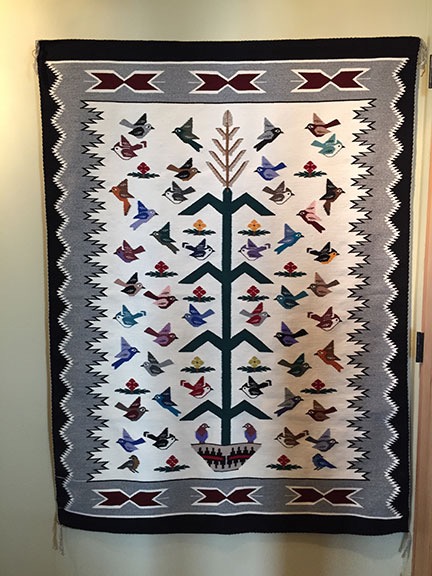
One of my few prized possessions — indeed, one of the very first things I packed when I returned to Arizona in September 2012, expecting the quick divorce my wasband claimed he wanted — is my Navajo rug. This is the real deal, woven by a woman named Rena Mountain who lives on the Navajo Reservation at Cedar Ridge, AZ. Ms. Mountain is known for her pictorial rugs and seems to be an expert on the Tree of Life design.
Re-Hanging My Rug
I unpacked the rug about a week ago to show Kirk. I’d been thinking about it for a while, wondering where I could hang it, and I didn’t want to pull it out until I was ready. But I also wanted to show off this prized possession to someone I thought might appreciate its beauty. (I’m not sure how impressed Kirk was.) I knew that finding a place to hang it would take some thought.
One of the great things about my new home is the windows that line most of the walls. But those windows leave very little room to hang art. They also let in a lot of sunlight — much of it direct at certain times of the day and year — that can fade colors and cause sun damage. Where could I hang it where I’d enjoy its beauty while protecting it from direct sunlight?
And if you’re wondering why I don’t just put it on the floor — after all, it is a rug — you’ve probably never owned something so beautiful and relatively valuable. Simply said, this isn’t something I could imagine walking on. Ever.
I finally decided to hang it in the hallway across from the bathroom door. There’s a little stretch of hallway there and the walls of the hall perfectly frame the rug’s 45 x 60 inch size.
Back in Arizona, I’d hung it in the living room near the fireplace with velcro on a piece of wood that fastened directly to the wall with screws. I’d sewn the soft side of the wide velcro strip to the back of the rug using big, fat, easy-to-remove stitches. I’d stapled the rough side of the velcro strip to the wood using a staple gun. Then my wasband had drilled holes in the wood and, using molly bolts for extra support in the drywall, screwed the wood strip onto the wall. When I’d taken down the rug, I’d taken down the wood strip, too. I’d even, by some miracle, kept the molly bolts and screws. So I had everything I needed to re-hang it in my new home.

My Navajo rug, hung in its new home.
I did this yesterday afternoon, using my stud finder to confirm that a stud was not available and a level to make sure I mounted the wood strip properly on the wall. The whole job, including fastening the rug to the wood strip, took just 10 minutes.
And it looks great. I can even reposition the track lights in the hallway to shine directly on it if I’d like to.
I posted this photo on Facebook when I was done. Almost immediately, my friend Jeremy asked for the story behind the rug.
How did he know there was a story? There is and it’s a pretty good one. I promised a blog post — this one — to tell it.
The Story behind the Rug
It was in September of 2000 or 2001. Or possibly 2002. I’d been living in Arizona for a few years. My writing career was building momentum and I’d finished my Quicken book, which ruined ever summer, a few weeks before. I had free time and was eager to get away for a while after working too many 12-hour days at my desk to get the book done on time.
I don’t remember who came up with the idea — it might have been me — but I decided to take a road trip with two friends to the Navajo Nation Fair in Window Rock. This is an annual event, like a county fair, but its held on the reservation and has a definite Navajo flavor, with lots of Navajo arts and crafts, food, and dancing. Along the way, we’d go exploring on the Reservation, visit the Hopi Reservation (which is completely surrounded by the Navajo Reservation), and do whatever struck our fancy. In other words, we make things up as we went along. I love traveling like that.
My two companions for the trip were Shorty and Martin.
Shorty was about 10-15 years older than me, a real cowgirl who spoke with a Texas drawl and had been married four or five times. She was short (hence the name), lean, and kind of gnarly, with skin browned and somewhat wrinkled from too much time in the sun. She was currently between husbands, living in her pickup camper in a friend’s yard, with her horse staying in a pen there. Over the two or more years we were friends, she’d move from place to place — even spending a few weeks camped out in my yard and housesitting for me — work at a local dude ranch, and train my rather difficult paint horse. I’d also be the maid of honor at her Las Vegas wedding — and that’s one hell of a crazy story — spend an evening catching Colorado River toads at an off the grid adobe house she lived in for a while, and dog sit for her three dogs while she went to England with what she hoped would be her next husband — another long story.
Martin was a young — maybe 35 years old? — good-looking guy from Germany. Like so many Europeans, he’d fallen in love with the west and dreamed of being a cowboy with a Fresian horse. (Not exactly a practical choice with all that hair to keep neat and brushed.) He was in the U.S. on a visa and was friends with the man who owned the local German restaurant. He tagged along with us, smoking whenever we stopped for a break. Shorty insisted on pronouncing his name mar-TEEN, claiming that it was the German pronunciation. Since he never corrected her, I got into the habit of doing the same.
The three of us headed north in my Jeep from Wickenburg, AZ. Martin sat in the back with the luggage in the tiny space behind him.
We pretty much bee-lined it up to the Hopi Reservation. Shorty wanted to send a friend a postcard from Old Orabi, which was founded back in 1100, making it one of the oldest continuously inhabited settlements within the United States. We got there and I don’t recall there being much to see. That has a lot to do with the simple fact that the Hopi people do not generally welcome visitors and many of them prefer to continue their traditional lifestyles. We walked around among a lot of seemingly deserted pueblo style homes — the Hopi are a Pueblo tribe — and then moved on to a Post Office where Shorty could mail her card. I’m pretty sure that was Hotevilla-Bacavi, also on Third Mesa.
The post office had a bulletin board and there was a card on it advertising fresh ground cornmeal. We found a payphone — back in those days, we didn’t all have cell phones — and called the number. We then got directions to a Hopi woman’s house nearby. We drove over and were welcomed in. The house was simple but modern, sparsely furnished but clean and comfortable. I clearly remember there being a bunch of kittens playing together in one of the rooms. The cornmeal, we were told, was leftover from a wedding ceremony. (Corn is an important crop to the Hopi people and plays a big role in their traditions.) It was stored in a big galvanized trashcan, lined with a plastic bag. The woman used a tin can to scoop out the cornmeal — did I mention that it was blue? — and put it into a Bluebird Flour bag (which I still have). Shorty paid for the cornmeal — I can’t remember how much, but it wasn’t much. The woman, likely seeing the opportunity of spreading tourist dollars to friends, told us about another woman who made dance shawls. Before you could say Kykotsmovi Village, we were off to another home. Shorty wound up buying two or three of the shawls. They weren’t my style, so I declined.
I totally enjoyed this side trip — cornmeal and dance shawls — because it gave me an opportunity to see the modern culture of these very private people.
Afterwards, we stopped by the Hopi Cultural Center, where I bought a “Grandmother” cradle Kachina, thus starting my limited Kachina collection. Our last stop in the Hopi land was Tsakurshovi, a native crafts shop in Shongopovi. That’s where I was introduced to Hopi Tea. I’d later come back to this wonderful shop several times to add to my Kachina collection.
We continued on our way, leaving the Hopi Reservation and continuing through the Navajo Reservation. We stopped at the Hubbell Trading Post in Ganado, which is a National Historic Site and still a trading post. I wandered into the Rug Room and that’s when I saw it: the most beautiful rug I’d ever laid eyes on. Rena Mountain’s Tree of Life.
I fully admit that when I looked at the price tag I had a serious case of sticker shock. I’d never spent that kind of money on anything that couldn’t be driven or slept in.
I left the room and continued wandering around the Trading Post. But I kept thinking about it.
I wanted the rug. In fact, I don’t think I’ve ever wanted anything as utterly impractical as that rug as badly as I wanted that rug.
I grabbed Shorty and brought her into the room to see it. I was hoping she’d talk me out of buying it. But how could she? It was beautiful. And we both knew that I could afford it.
Yes, I could afford it. As I said earlier, my writing career was booming and I was bringing in more in royalties every year. I’d been investing in real estate and, in October 2000, bought my first helicopter. But my mind was stuck in budget mode and the idea of spending that kind of money on a rug I couldn’t even walk on was outrageous.
But I could afford it. And Shorty wasn’t going to talk me out of it.
So I got a sales person and brought her over to the rug. I timidly asked if they could do anything for me on the price. She cut it by $500. The next thing I knew, I was at the cash register with my American Express card out.
The cashier had to call American Express. They wanted to talk to me. I’d never spent this much on my card before and they wanted to make sure it was me.
The clerk folded up the rug and they put it in a plastic bag that looked remarkably like a garbage bag. I put it in the Jeep, way under the seat. For the next few days, I’d take it into the motel room at night and worry about someone stealing it out of the Jeep during the day.
We continued the trip. The Navajo Nation Fair was an amazing event. We saw more rugs on display — if I hadn’t already bought one, I would have bought one at the fair — ate mutton, saw traditional dancing and costumes, and watched the country’s only all-Indian rodeo, which was announced in both English and Navajo.
After two days of that — staying in a Gallup Hotel because Window Rock’s were booked — we headed out to Canyon de Chelly near Chinle, AZ. This is a National Monument with limited access. Because we had a 4WD vehicle, we hired a Navajo guide who rode with us in the Jeep and told us about what we were seeing. I loved the sound of his voice and the way he phrased things and repeated certain things in almost a sing-songy way. It was there that I learned about the brutality of Custer and his soldiers and got an idea of how mistreated Native Americans were in the 1800s. When I saw a point of interest — some rock formation — and asked him about it, he was strangely quiet. I asked him if there was some significance to the place that they didn’t share with visitors and he nodded. I asked him if there were many places in the canyon like that and he nodded again. I didn’t ask any more. I respect the culture and privacy of these people. Not everything needs to be a tourist attraction or photo opportunity.
I don’t remember getting into Monument Valley on that trip. I suspect we went home right after Canyon de Chelly. I do recall exploring a road back near Tuba City with views down from a mesa top and seeing petroglyphs that weren’t on any map. Real exploring — not following tourist guidebooks — that’s how I like to travel.

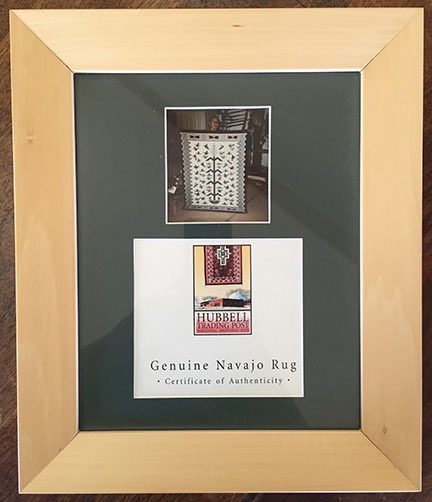
The Certificate of Authenticity, with a photo of the weaver, hung beside the rug for years.
I got home with the rug and, with my wasband’s assistance, hung it on the wall as described above. I took the tag, which featured a photo of Ms. Mountain holding up the rug, and asked my friend Janet’s partner to mat and frame it for me. It hung on the wall beside the rug. (I just spent about 30 minutes looking for a photo of how they hung together but can’t find one — all the photos I have of my house’s interior are either of damage/neglect by my wasband while I was in Washington or after I’d begun packing. As I mentioned earlier, the rug was one of the first things to be packed.)
Postscript
Time marched on. Although that was one of the most memorable trips of my life, it was not to be repeated. Shorty married Martin to keep him from getting booted out of the country. I was maid of honor/witness at the crazy Las Vegas wedding. Later, Shorty met her “soulmate,” a retiree from Britain who stayed at the dude ranch where she worked. Their courtship lasted a few months, during which time I assume she and Martin were divorced. But the wedding plans fell through and it wasn’t long before both she and Martin fell out of my life.
I went back to the Navajo Nation Fair the following year. It was a non-event. The Navajo young people were wearing the same falling-down pants as the rest of the brain-dead youth in our country and much of the charm I’d experienced the year before was gone. You know what they say: you can never go back. This is a perfect example.
But the rug remains and now it hangs in my new home to be part of my new life.
I’m glad to have it and the memories that go with it.




 I admit I wasn’t looking forward to the gig. The two photographers claimed to weigh 242 pounds (converted from kilos) and I knew they likely weighed more fully dressed and carrying camera equipment. I calculated the weight and balance as soon as I had this information and discovered that I’d have to strip all non-essential equipment out of the helicopter to lighten it up so we could take enough fuel for 2 hour flight segments (plus FAA-required reserves). Anything that was left on board would have to be shifted from under my seat to under the seat behind me, just to shift weight backwards. Having two fatties — yes, including me — up front would make us front-heavy. Having two fatties on the left side would make us heavy on that side. But even after adding 15 pounds of weight for each of them, I confirmed that’d be in balance with 2/3 fuel or less on board.
 Using
Using  What fascinated me was the way the light changed throughout the flight. At first, it was partly cloudy. Then the sun slipped behind the clouds and it was cloudy. Then the sun began to break through, speckling the mountainsides with light. This still image, captured from the video, gives you an idea of what I mean. The light changed numerous times over the two-hour period of the flight — at one point, clouding over completely only 1,000 feet above me — giving the illusion that the flight was conducted over multiple days.
 One of the highlights of the flight was crossing the red rock cliffs west of
  When I got to the empty expanse of the Navajo Reservation, I dropped down and flew low over the ground. There were few homes in the hundreds of square miles and only a handful showed signs of life. In the video, my helicopter’s shadow is clearly visible: small when I’m flying higher and larger when I’m flying lower. The video makes it seem as if I’m going much faster during this portion of the flight, but I’m not. I managed to keep a steady 100-110 ground speed for most of the flight. It’s just an illusion: the closer the camera is to the ground, the faster I seem to be flying.