Christmas Off-the-Grid, Part III

It can’t all work right at once.

I woke early Tuesday morning with a bright light in my face. It was the light of the full moon.

A Winter Morning at Howard Mesa

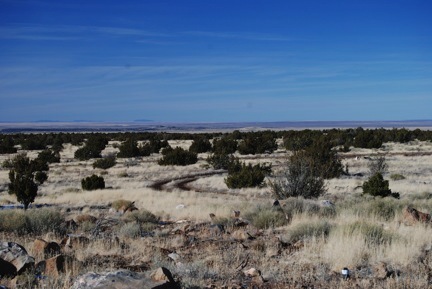
View from ShedWe sleep on a loft in the camping shed. There’s a wall to wall carpet up there with a mattress on top and a pair of very short night tables, one on each side. We make the bed just like we make our bed at home: with sheets and blankets and a cosy comforter. Our heads are right beneath a window that looks out on my favorite view: northwest toward Mount Trumbull.

We usually sleep with the blinds open so we can look out at the night sky if we happen to wake in the middle of the night. On a moonless night, its very dark outside, with just a few pinpoints of light representing far-off ranches. The sky, of course, is full of stars and the glow of the milky way on most moonless nights. If it’s cloudy, we can see the reflection of the lights of Las Vegas, at least 100 miles away, on the cloud bottoms out to the west.

But the moon yesterday morning was so bright that I had to shut the blinds to get another hour of sleep.

It was cold in the shed: in the 50s. The heat was on and set to 70° but the shed, which is insulated, was no match for the 27° cold outside. I changed from my pajamas to a pair of sweatpants and a sweatshirt. Since the power level was a bit low, I made my coffee with a stovetop percolator. I heated up Alex the Bird’s scrambled eggs — which I’d made in the microwave at home before coming to Howard Mesa — in a piece of aluminum foil on top of the heater. I let Jack the Dog out and then back in. With the critters fed and Mike still up in bed, I spent some time working on a blog entry.

Toilet Woes

[Note: The following is a somewhat graphic description of a sanitary problem we're having at the shed. If you're easily offended by discussions of toilet operations, please skip this section.]

The toilet was not working properly. The shed has an RV toilet, which we installed because it would use less water.

Now most folks reading this probably know how a standard toilet works. There’s a fixture with a seat and a bowl and a tank on back (or up high). You do your business in the bowl and then use a handle or a pull-cord to flush. The water in the tank rushes into the bowl, flushing the bowl’s contents down the drain and filling the bowl with fresh water. Pretty basic stuff.

An RV toilet works a bit differently. There’s no tank of water. Instead, there’s a foot or hand pedal that lets you put water from your water source into the bowl. You do your business and then use the pedal to open the bottom of the bowl so the contents drop out. Clean water swooshes around the bowl to clean it a bit, but it goes down the drain, too. So the bowl is usually pretty empty between uses. The benefit of this system for an RV — or cabin where you have to haul your own water — is that you can use as much (or as little) water as you like to take care of business.

The problem with the toilet was that the valve to let water into the bowl wasn’t working. You’d push the foot pedal and the bottom would open to drop the bowl contents into the septic system, but no water would rush in to clean the bowl, etc. We used what we called “manual flush” — we kept a bucket of clean water in the bathroom and used that to add and flush water down the drain after using the toilet. Sanitation was not impaired; the bathroom was still clean and the toilet was still flushed.

And the rest of the plumbing worked fine — right down to the water heater.

We figured that the toilet’s valve had water in it that had frozen, thus preventing the flow of water. But the shed had been above freezing for close to a full day, so the chances of it still being frozen were minimal.

After breakfast, Mike worked on the problem. He removed the valve. The plastic pipe had bulged and cracked under stress where water had frozen in it. The valve was broken.

It was the day before Christmas, on a Monday. We worked the phones, using our Flagstaff phone book. The one place that was likely to have the part was closed. No other place that was open had the part.

Mike put the bad valve back on so the pedal would work. (I was not interested in reaching behind the bottom of the toilet to manually twist and untwist the valve control after using the facilities.) And we realized that we’d be on manual flush for the rest of our stay.

It seems to me that every time we come up here, something isn’t working right. Last time was the heater — Mike had to remove a mouse nest from it before it would work. On other visits, it was the water heater not relighting automatically when it should, the water pump cutting out in the middle of a shower, or cracked pipes.

It would be nice to come up here and have everything working right at the same time.

Flagstaff

We spent a good portion of the day in Flagstaff, the nearest city to Howard Mesa.

Flagstaff is a great town, with a wonderful mix of people of different ages and nationalities and backgrounds. It’s a melting pot where young and old get together to steer economic growth. So you’ll find all kinds of businesses there, from hippie gift shops smelling of incense to book shops to sporting goods shops to natural food stores. It also has all the standard big box stores, including Home Depot, Wal-Mart, Target, and Sam’s Club.

Yesterday, we went into Flagstaff for lunch, to walk around the historic downtown area, and to pick up a few odd things we needed. There was quite a bit of snow on the ground, but it had been plowed or shoveled off the roads and sidewalks, leaving scattered ice and some very impressive icicles hanging from rooflines. Traffic was lighter than usual — probably because NAU was between semesters and most of the students had gone home. We still had some trouble finding a parking spot downtown, but soon were parked on Humphrey’s.

There was a Japanese restaurant on Route 66, right around the corner, that I wanted to try. When we got there, it was closed.

We walked around town. There was a Thai restaurant at the Hotel Monte Vista. I like Thai food, but every time we’d looked into the place at lunchtime, it was empty. On that day, there were about a half dozen people inside at noon. We decided to give it a try.

Good choice. The menu was extensive, the service was friendly, and the food was served good and hot. We shared a hot pot of soup, some spring rolls, and an order of short ribs. The ribs were good, but when the guy next to me got his curry, I decided I’d try that next time. I really like curry. Meanwhile, the place filled up. It wasn’t until we left that I realized the place was under new management.

We went into Babbitt’s and a few of the other downtown shops. They were all winding down from the Christmas shopping rush. There were other shoppers, but not many.

Wal-Mart and Beyond

Mike decided that there might be a chance of finding the toilet valve at Wal-Mart, since some Wal-Mart stores stock RV parts and supplies. He talked me into going into Wal-Mart with him. The day before Christmas.

We parked on the side near the garden shop area, which was full of Christmas stuff. One step inside and my stress level rose considerably.

I’ve been in Wal-Marts before, but the one in Flag has to be the worst. It’s an older store, much smaller than the Super Wal-Marts going up all over the country. To fit all that merchandise in the store, they have very tall shelves on rather narrow aisles. The result is claustrophobic. The store was full of last-minute shoppers looking for crap from China to give as gifts or to decorate their homes.

We found the RV Accessories aisle and realized after a moment that they wouldn’t have the part we needed. I immediately went into escape mode, plotting my way out of the store with the least interaction with anyone else. Mike, on the other hand, wanted to get all the items on our little list there: a pencil sharpener, RV antifreeze (to fill drain traps when we leave), distilled water (for our solar setup’s batteries), 9v battery (for our smoke/carbon monoxide detector), hand sanitizer. That would have us running all over the store, which was not a viable option for me. So when he found the antifreeze not far from the RV Accessories, I talked him into buying just that and stopping at a supermarket for the rest.

I endured the recorded sound of dogs barking to the tune of Jingle Bells at the check out area before we emerged back into the sunshine.

We got back into the truck and drove to the nearby Basha’s Supermarket. We got everything on our list there, then headed back to Howard Mesa.

Afternoon and Evening at the Shed

Back at the shed, it was nice and toasty. The outside temperature had risen to the 40s but the sun was very strong, beating on the front of the shed and coming through the front windows. It was in the 70s in the shed. The wind was blowing lightly outside — not enough to find the cracks around the windows and the rest of the structure.

We each took good, hot showers and changed into comfortable lounging clothes. I made up a little cheese platter and opened a bottle of wine. We relaxed and read and studied IFR charts.

We each opened a present. I got a bottle of absinthe from Mike. Mike got a watch-winder cabinet from me. We had three presents left to open: two for me and one for him. I’m pretty certain there’s a small pile of presents on my doorstep at home.

Mike made some pasta for dinner. I was still full from lunch and our snack, so I didn’t eat much.

For our evening entertainment, we tried to play a DVD we’d brought along. My MacBook Pro’s CD/DVD drive is dead — I discovered that just the other day and will be sending it back to Apple for repair next week. So Mike had brought his Dell laptop. Unfortunately, it didn’t seem able to play a DVD either.

So we played dominos and listened to music.

Now this might seem boring to you. I won’t lie and say it’s exciting. What I will say, however, is that it’s restful. Our place is small and far from neighbors and paved roads. No one drives by. The only sound is the wind and an occasional coyote howl.

The only thing that could make this a nicer place to spend Christmas eve is a fireplace with a real yule log burning in it.

And a fully working toilet.

The End is Near

I’m almost done with a month on the road.

On September 14, I left home to start the first of a string of flying gigs that kept me away from home for 16 of the past 28 days. I estimate that I flew at least 3,000 miles during that time. (I flew about 200 miles just today.) I know I slept in 9 different hotel rooms — plus my camper — and ate in at least two dozen restaurants.

Right now, I’m stretched out on a Sleep Number bed — in other words, an overpriced, remote controlled air mattress — in Flagstaff’s Radisson hotel. The linens are nice. I’m watching the Weather Channel, angry that I just missed Stephen Colbert on Larry King, and amazed that there’s nothing else on worth watching.

Tomorrow is the last day of our Southwest Circle Helicopter Adventure. Normally, I think I would have enjoyed every minute of the trip. But somewhere about halfway through this week, I realized that I was tired of traveling, tired of being away from home.

Fortunately, my passengers want an early start tomorrow. So I’ll pick them up at their B & B at 8 AM and whisk them away to their last activity: a hike around the ruins in Walnut Canyon. I suspect that I’ll be too tired to join them on the hike in, so I’ll hang out in the rental car (a PT Cruiser, I think) or on a sunny bench and read until they’re done.

Then, it’s back to Flagstaff airport, where the helicopter has been fueled by the excellent crew at Wiseman Aviation and the hour-long flight back to Deer Valley Airport. I’ll say goodbye to my clients, give them the parting gift that I’ve been lugging around for the past five days, and high-tail it back to Wickenburg. With luck, I should be back in my own home by 3 PM.

I think I might spend the afternoon napping in my own bed.

Best of all is what’s on my calendar for the next seven days: nothing.

No books to write, no clients to fly, no meetings, no phone calls. I might even shut off my phone to keep it that way.

Okay, so I’ll be honest: I do expect to work next week. I need to start writing Leopard articles for Peachpit’s Web site. I’m hoping to knock off about 20 of them during the next two months. And I do need to start thinking about the video I’m under contract to do for MacPro Video. And develop a new brochure for Flying M Air’s multi-day excursions. And put together a proposal for the Navajo Film Commission. And create a package for Phoenix-area concierges.

But I’m not going to do it all next week. I’m going to take a little break and knock off just a few of the east tasks.

I deserve some time off.

Hopi Tea

A soothing beverage from the Rez.

My first visit to the Hopi reservation was about 6 years ago. I was traveling in my Jeep with two friends. Our main destination was the annual Navajo Nation Fair in Window Rock, AZ, but my friend Shorty wanted to drive through the Hopi Reservation and visit Old Orabi, which is the oldest continually occupied village in North America. Shorty wanted to mail a letter to a friend with the Old Orabi (or possibly Hotevilla) postmark.

The Book of the HopiThe Hopi tribe, unlike many other Native American tribes in the Southwest, is working hard to hold onto its culture and heritage and keep it from being commercialized by outsiders. This is probably why so few people know anything about the Hopi people. Their ceremonies are usually closed to the public — as are entire villages sometimes — and photography is not allowed. The reservation is completely surrounded by the Navajo Reservation in northeastern Arizona and only a few paved roads go through it. There aren’t many shops or restaurants and there are no casinos. The place isn’t very tourist-friendly because they don’t want tourists around. (This may be changing as the Hopi tribe realizes the importance of tourist dollars for the tribe’s economy. I just hope they don’t lose their identity in the process.) You can read more about the Hopi people on the Tribe’s Web site or in The Book of the Hopi by Frank Waters.

With all this in mind, we drove into the reservation and found Old Orabi. I don’t remember much about it. The Hopi tribe are pueblo indians and they built their homes on the edge of the three Hopi mesas: First, Second, and Third Mesa. I remember walking around one of the villages, past ancient stone homes, some of which were still occupied.

Eventually, we got to the post office, which I think was in Hotevilla. I remember this a bit better. It was a standard tiny-town post office with a bulletin board in the outer vestibule, where all the mailboxes were. Shorty spotted an “ad” for blue corn meal. We made a call from a pay phone and were soon on our way to a Hopi home.

It was a more modern home than the stone structures in the old villages. We were invited inside and I remember being surprised at how remarkably “normal” it was. (I don’t know what I was expecting.) We sat on a sofa while kittens played around us. The Hopi woman we’d met there had a big galvanized metal trash can that was absolutely filled with finely ground corn meal. She measured out quantities of the stuff with a round, flat pan not unlike a cake pan and stuffed it into a Blue Bird Flour bag. She told us how the cornmeal had been ground as part of a wedding ceremony. This was the leftover cornmeal from that celebration. When the bag was full, Shorty handed over some money and took the bag. (I wound up buying about half of the cornmeal from Shorty and still have some in stock.)

The conversation turned to dance shawls. A friend of the woman’s made them and had some for sale. Were we interested in seeing them? Shorty was. So we hopped into the Jeep and followed the woman to her friend’s house. The shawls were pretty — square or rectangular with really long fringe — but the colors were too bright and gaudy for my taste. Shorty bought one or two, possibly to be polite. And then we got on our way.

This whole experience really made the visit to the Hopi reservation special to me.

From there, we stopped at the Hopi Cultural Center for a bite to eat. Unlike my companions, I had a traditional Hopi dish that included lamb. This was before the vendors started setting up stalls outside, so after lunch we continued on our way.

As we were leaving Second Mesa, we passed a shop on the left called Tsakurshovi. (Don’t ask me to say that.) We stopped in. It was a small shop that caters primarily to the Hopi people, offering the materials they need to conduct their ceremonies. There were dozens of traditional-style Hopi kachinas — figures carved to represent Hopi religious and ceremonial people — furs, herbs, and more. The shop had two small rooms and a friendly young Hopi man behind the counter.

Turns out, this shop is owned by the Days — Janice and Joe. Janice is Hopi, Joe is not Native American. And it was mentioned in a recent story on NPR, which interviewed Joe’s son, Jonathan. Jonathan grew up spending his summers on the Reservation and the rest of the year in Boston with his mother. He now lives in Flagstaff where he runs a shop that I suspect is very similar to his father’s.

Traditional Hopi Kachinas: A New Generation of CarversI don’t remember why I bought the hopi tea. Perhaps Shorty bought some. Perhaps I asked the guy behind the counter what the bundles of sticks in a Ziplok bag were all about. In any case, I bought a bag of three bundles of sticks for $4.

I also bought a copy of Jonathan Day’s book, Traditional Hopi Kachinas: A New Generation of Carvers, which I had autographed on the spot by the guy behind the counter, Wallace Hyeoma, who happened to be one of the featured artists (page 47). (A year later, I would return to the shop and buy several traditional style Kachinas, one of which was carved by Wallace’s uncle.)

We continued on our way, leaving the Hopi Reservation. Our next stop was at the Hubbell Trading Post, where I wound up buying a Navajo rug. But that’s another story.

Much later, when I returned home, I found the bundles of sticks in my luggage. I boiled some water, broke off a few sticks and leaves, and dropped them in. In minutes, I had a hot cup of some of the most soothing tea I’d ever tasted. Clean, fresh, and simply delicious. No need for sugar or milk or lemon. This tea, like green or jasmine tea, is perfect straight. Now I commonly drink it on cold, lazy afternoons, when I feel a cold coming on, or when I’m feeling blue. To me, it’s like a comfort food beverage.

Those three bundles of sticks lasted a long time. A few years ago, I was back on the Hopi reservation and bought more. But today, waking up with a head cold, I decided to forego my usual morning coffee in favor of the clean flavor of Hopi tea. As I brewed up a cup, I realized two things: (1) the long story of how I’d discovered Hopi tea might be interesting to at least a few blog readers and (2) I was running low again.

I did some research for this blog entry. I discovered that Hopi tea is from a plant commonly known as greenthread and scientifically known as Thelesperma filifolium. You can see some photos of it as a plant and stick bundles, learn how to brew it, and read about its medicinal values on the New Mexico State University’s Medicinal plant Web site. I learned that it grows in abundance in the Navajo, Hopi, and Zuni reservations of the Four Corners area. I also found an online source for purchasing Hopi tea online, High Desert Farmers. High Desert is a small scale grower which sells Hopi tea as traditional bundles (they call it “bulk”), loose, and as tea bags. Since the bundles weren’t available, I bought bags and loose. It cost me $14.50 (including shipping), but saved me a 200+ mile trip to the Hopi reservation.

If you like plain, soothing hot teas like green tea, you’ll probably like Hopi tea. If you ever see some in your travels, I recommend it. And I hope you story of first acquisition is as memorable to you as mine is to me.

The San Francisco Peaks

And Jack the Dog.

San Francisco PeaksI took this photo on the hiking trail to…well, I can’t remember the name of the place now. I think it’s called Red Mountain. It’s off route 180, between Valle and Flagstaff in northern Arizona.

The photo shows the San Francisco Peaks, which are the tallest peaks in Arizona. Mt. Humphreys is the main peak. There’s a ski resort up there that’s open in the winter when there’s enough snow. They want to use reclaimed water to make snow up there, but the Navajo indians are against it. You see, the San Francisco Peaks are one of the four sacred mountains of the Diné.

If you look closely, you should see Jack the Dog running towards the camera in the photo. Jack’s always running somewhere. He gets ahead of us on a hike and we call him back. We figure that he runs 2 to 3 times more on a hike than we walk. Ditto for horseback rides.

As for Red Mountain — if that’s what it’s really called — its an interesting spot at the end of an easy hike. It’s the remains of a volcanic mountain that collapsed years ago. Inside, past the lava, are hoodoos very much like you’d find at Bryce Canyon National Park. They’re even red like the ones at Bryce. There are trees in there and plenty of quiet places for a picnic lunch. Best of all, not many people know about it so it’s never crowded. I recommend it

Southwest Circle Helicopter Adventure, take 2

I finally make the tour a reality.

A while back, I wrote a post that outlined my ideas for a 9-day helicopter tour to various destinations in the southwest. After writing up the tour, I realized some of the impracticalities of it — for example, booking the hotel rooms and tours in advance and the little FAA rest rule that forbid me to fly part 135 flights more than 7 days in a row (oops).

Since then, I’ve been thinking a lot about the tour. I’ve since shortened it up and devised a more reasonable plan: a 6-day, 5-night excursion that includes Sedona, Grand Canyon, Lake Powell at Page, Monument Valley, and Flagstaff, with excellent accommodations and side trips and tours at each destination.

You can read the finalized description on the Flying M Air Web site’s new Excursions page. I haven’t added the photos yet and I’ve just begun work on the brochure. But I do have 7 sets of dates scheduled and ready to go. With a more approachable price tag of $4,995 per couple, most folks I’ve spoken to seem to think it’ll sell very well. Now all I need to do is get the word out about the trip’s availability.

Are you ready to go on a helicopter adventure? Well, what are you waiting for? Stop by the Flying M Air Web site and get the details. Then give me a call to book your trip.

helicopter, excursion, Sedona, Grand Canyon, Lake Powell, Page, Monument Valley, Flagstaff