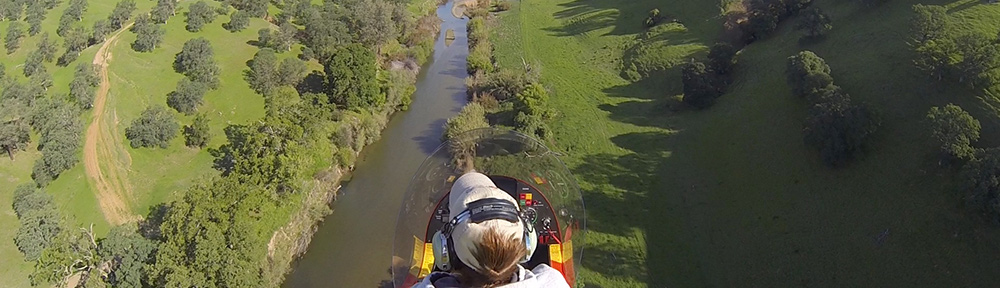
Descending into the desert’s warmth and well-known flight routes.
– Logistics and Flight Planning
– Day 1: Over the Mountains, IFR
– Day 2: Desert Heat and Familiar Terrain
I woke at around 5 AM. Actually, Penny woke me up that early. She left the bed and for a while I just lay there, half asleep, wondering where she’d gotten to in the vast attic guest room. Then I remembered that I hadn’t closed the door and realized that she might have gone downstairs. I jumped out of bed and headed down to find her.
She was in the kitchen at the back door with the other three dogs. I opened the door to let them all out. The morning was cool and the sky was clear with the waning gibbous moon hanging high in the western sky. The autumn leaves rustled in the gentle breeze. I waited patiently, then got the dogs back in, one at a time, and closed the door.
Megg was awake, getting ready for work. We talked quietly in the kitchen for a few minutes before she headed off to the shower and I headed back upstairs.
A while later, Megg was upstairs to say goodbye. I wasn’t sure how long we’d stay — it depended on when Jeremy could be ready — and she knew she wouldn’t be home until at least 10 AM. I hoped to be in the air by then. So we said goodbye, possibly until July, and she headed off to work.
Meanwhile Jeremy was still asleep and I wanted coffee. Megg had told me about a place walking distance from her home, Alchemy Coffee. I checked it out on Google Maps and saw that it was only 0.6 miles away and opened at 6:30 AM. I got dressed, grabbed my coat and Penny’s leash, and headed out for a walk — or more like a mission — in the predawn light.
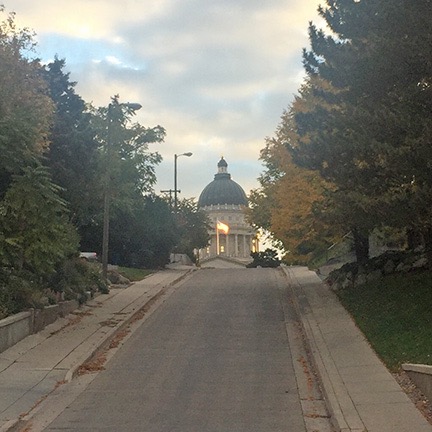
I got a neat view of the Capitol building as I walked back to Megg’s house. There was something kind of surreal about the way the first light illuminated the flag outside.
Megg lives in Salt Lake City proper, not far from Capitol Hill. If you think it would be very urban, you’d be wrong. It’s a really nice residential neighborhood with lots of houses of various styles and ages. Sidewalks on both sides of the street keep you off the road as you wander past front yards, often under overhanging trees. It wasn’t a long walk at all, but there was one steep hill, about two blocks long, just as Megg had warned me. I passed within two blocks of the Capitol building and arrived at Alchemy right around 7 AM.
I had my latte and an almond danish while sitting at an outside table with Penny. By that time, it was fully light, although the sun hadn’t cleared the mountains to the east yet. The coffee shop did a brisk business, with about half of its patrons parking briefly at the curb while they ran in for their coffee.
I caught up on Twitter and Facebook activity while I slowly drained my cup. I also checked in for my flight out of Phoenix the next day, very pleased that I’d gotten a First Class upgrade again. I switched my seat from an aisle to a window seat using the Alaska Airlines app. (Does anyone other than me remember the red paper tickets we used to have and waiting on line to change a seat?)
I texted Jeremy to let him know that I wanted to head out by 9 AM. He agreed that an early start would be best. Then I headed back on a slightly different route, really enjoying the variety of architecture along the way.
Back at the house, I let the dogs out again as Megg had asked me to. Her son was still asleep and I tried not to bother him. Jeremy was packing up. When he was ready to go — I’d already packed up before leaving for coffee — I used my phone to call an Uber. A car was at the curb less than 5 minutes later.
We talked Uber along the way. I’d recently become an Uber driver but didn’t drive much, mostly because demand was so low in Wenatchee that it was a waste of time to hang out in town waiting for a call. I learned a few things from the driver’s point of view. Unfortunately, he had trouble finding Skypark and I had to direct him the last mile or so. The fare was only around $12, which I thought was good for a 7-mile drive.
Leg 4: Salt Lake City to Bryce Canyon
After preflighting and adding a quart of oil — I added either a quart or half quart at every fuel stop — we loaded up the helicopter, climbed on board, and started up. It was probably about 9:15 when we got airborne.
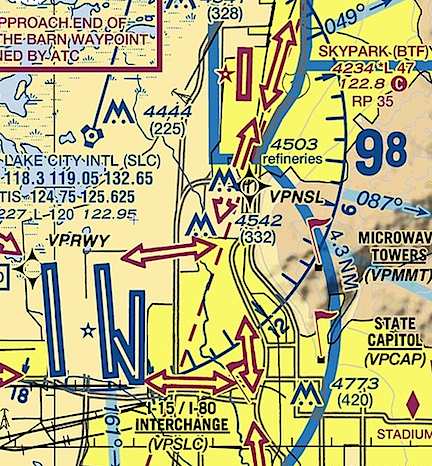
This closeup of the Salt Lake TAC shows how close Skypark is to Salt Lake City’s surface airspace.
The first challenge was crossing through the surface area of Salt Lake City’s Class Bravo airport along the I-15 freeway. I had to get clearance and I wasn’t able to make contract until I was airborne. Because Skylark is right next to Salt Lake City’s surface airspace, I had to head due east to make contact and get clearance. I called on the wrong frequency (of course) and had to switch to another one, which I managed to screw up once. So I was orbiting a bit out there until we got it sorted out and I got the clearance I needed. Then it was an easy flight south.
The only thing I regret is not turning on the GoPro. Although I had remembered to turn on the wifi and camera, I’d forgotten to turn the camera on. It’s a real shame because I think I could have gotten a few nice shots as we flew past downtown Salt Lake City.
The last tower I had to talk to — at least for a while — was Provo. Again, I asked for and got clearance to follow I-15 south. Using a landmark like a freeway makes it very easy to tell a tower what you want and make sure you both know exactly where you’re supposed to be.
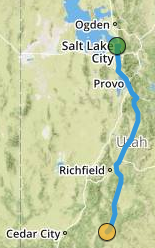
The fourth leg of our trip, recorded by ForeFlight.
Past Provo and abeam Spanish Fork, I veered to the east a bit to enter the valley that would take me along route 89 to Bryce Canyon. That put us in a series of long, relatively narrow valleys between mountain ranges that rose up to 9,000+ feet on the west and 11,000+ feet on the east. There were a few towns along the way and lots of farmland. Very rural, almost remote. And then another narrower, more remote valley with 11,000+ foot mountains on either side. It was 213 nautical miles from Skypark to Bryce Canyon and it took us nearly 2-1/2 hours to cover that distance. I’d been hoping to refuel at Page, AZ, but it didn’t look like we’d make it so we stopped at Bryce.
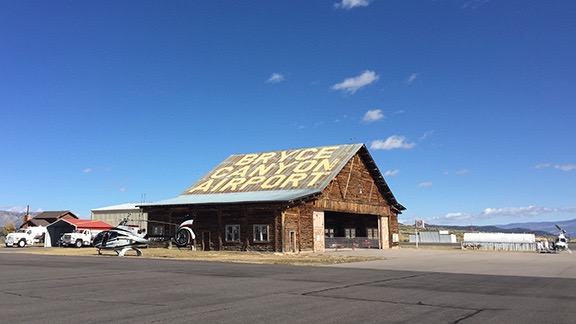
The old log hangar at Bryce Canyon Airport.
The last time I’d been to Bryce Canyon Airport had been way back in January 2013 on a photo flight with a good client. He’d been assigned by Airpano to get pictures of Bryce Canyon in winter for their panoramic image project. We flew up from Phoenix and wound up getting snowed in for two nights before we could do the shoot. You can read a bit about it here. On that last visit, the airport guy had been extraordinarily helpful with weather-related problems — so helpful that my client and I had each tipped him $100. I still have the t-shirt he gave me when I wanted to buy one; I call it my “hundred dollar t-shirt.” I was looking forward to seeing him, just to see if he remembered me. But he wasn’t there. It was a different guy who was older and not quite as friendly. I think he was put off by Penny, who first came into his office off-leash. Oops.
Anyway, he fueled us up while we used the bathroom. I was out on the ramp again chatting with him when the local sheriff’s office guy came up, in uniform. I wondered if we’d done something wrong but couldn’t imagine what it might be. But he was just there to chat with his airport buddy, to kill time on a nice day.
And it was a nice day — unseasonably warm for October, especially at Bryce’s 7590-foot elevation. The kind of day you’d want to sit out in the sun on one of the chairs they had on the FBO porch. In the 50s, at least. I didn’t even need my jacket.
Leg 5: Bryce Canyon to Sedona
Of course, Bryce Canyon Airport is only a few miles from Bryce Canyon National Park, so there’s no chance we’d leave there without a nice little flyby. I felt bad for Jeremy, who’d really hoped to visit friends and his daughter on the way south. I thought of Bryce Canyon, which he’d never been to, as a sort of consolation prize.
Bryce Canyon is really a misnomer; it’s not a canyon at all. It’s basically a cliff face where Mother Nature has eroded rocks with wind and rain, exposing the red sandstone layers and carving out towers called hoodoos. These are visible from various lookout points along a rim road on the top of the cliff as well as from the air to the southeast of the park itself. At least one tour operator does helicopter tours there. Although the airspace is clearly marked for the National Park, I know the rules: pilots are requested to avoid flight within 2,000 feet of the ground or cliffs (or hoodoos) within that area. That doesn’t mean flight is forbidden. So a quick flyby wouldn’t break any rules and likely wouldn’t bother many tourists. After all, there’s a tour operator likely flying by multiple times in a day for a lot longer and a lot closer.
And I did keep it quick. I made a big loop out toward Tropic and then came in closer with Jeremy’s side facing the park. He shot a bunch of photos. The nosecam didn’t really get any good shots, but one was sharable. Then we continued on our way.
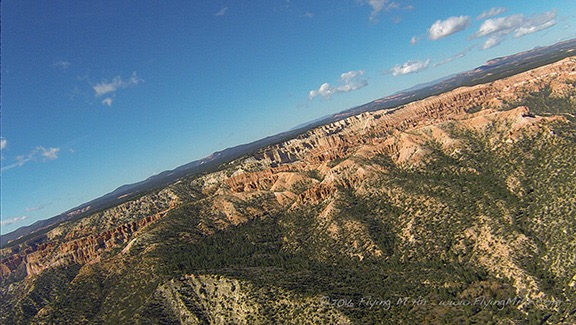
Keep in mind that I was turning when the nosecam captured this image of Bryce Canyon.
It was around then that I first caught sight of Navajo Mountain. This is a huge landmark for me. It means coming home, returning to a place that I know very well: Lake Powell. I can’t tell you how many hours I’ve spent over the lake with photographers on board. Easily over 200. I missed it and I wanted to fly it again, but I wasn’t interested in flying over it with a nearly timed-out engine that was making metal shavings. I’ve tentatively planned a photo shoot there in April 2017, before I bring the helicopter back to Washington from its California frost contract. If you’re interested, you might want to check this out. And tell your friends.
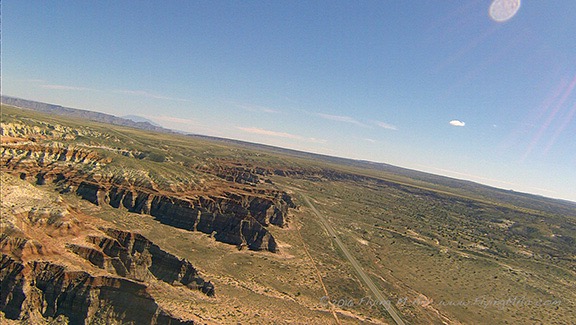
Typical terrain west of Page, AZ. If you look closely at the horizon, you should be able to see Navajo Mountain off it in the distance.
We took an almost direct route to Page, AZ from there, taking a slight detour to visit the Wahweap Hoodoos. Then we flew past the Glen Canyon Dam, over Horseshoe Bend, and down toward Lees Ferry. I skirted the edge of the Grand Canyon Airspace, flying over the Navajo Reservation, seeing wild horses and the remains of old hogans. All of this was familiar to me but new to Jeremy. For some reason, the helicopter felt lighter, happier, faster. Probably my imagination, but maybe it knew it was returning to familiar terrain?
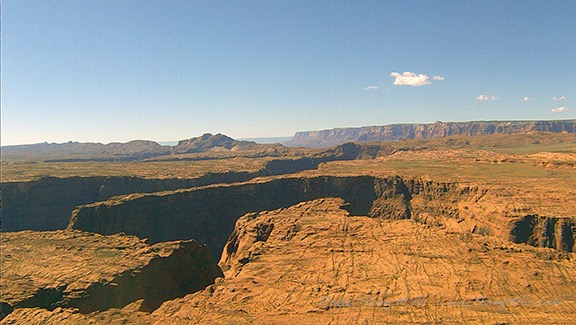
Horseshoe bend from about 700 feet up. Not nearly as impressive as it is from much higher looking almost straight down.
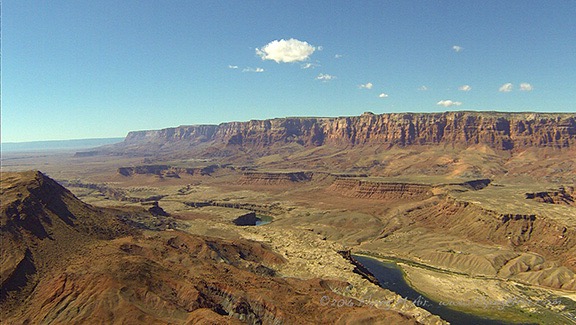
Lees Ferry with the Vermillion Cliffs behind them.
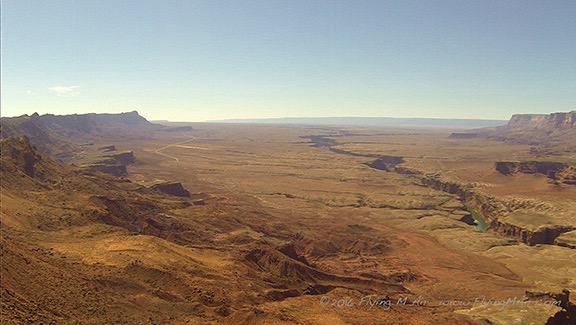
Marble Canyon looks like a giant crack in the earth as it winds across the plateau toward the Grand Canyon.
We reached the Little Colorado River Gorge and I flew along the top of it, keeping the nosecam in mind for a different view. I think I could have gotten better shots from higher up, with the camera pointing more down. Next time?
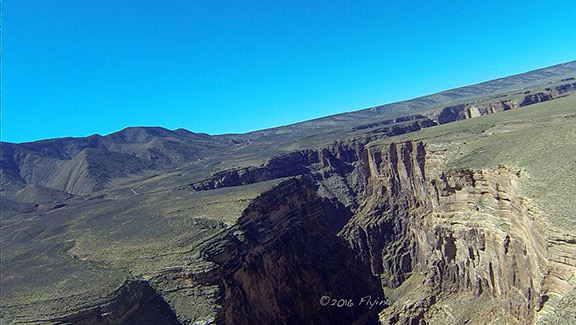
The Little Colorado River Gorge, heading toward the Grand Canyon.
Then we climbed up onto the Coconino Plateau and I steered almost due south toward Sedona. There’s a lot of nothing out there, but Jeremy managed to spot some wild horses where I’d never seen wild horses before.
Closer to Flagstaff, the air was smoky. There were fires burning but because there were no TFRs in the area, I assumed they were controlled burns. We dropped down into Oak Creek Canyon just west of Flagstaff Airport’s airspace. It was a bit bumpy as we followed the canyon down. We were flying into the sun again, so the nosecam didn’t capture any good images. I can’t remember, but I’m pretty sure this was Jeremy’s first time in Sedona. I think he was impressed by the red rocks.
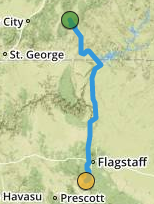
The fifth leg of our trip, as recorded by ForeFlight.
We lined up to land along the taxiway. I was just looking for parking on the ramp when I remembered that they liked helicopters to park in the remote helicopter landing area far to the southwest corner of the field. I decided to try landing with the planes, which was much closer to the terminal and restaurant. I chose a spot in the last row, isolated from the parked planes, with my tail rotor out toward the taxiway so I didn’t have to worry about anyone walking behind me. In the old days, someone would get on the radio and tell me to move. But that day there was silence. There was someone mowing out by the helipads and I figured they either didn’t care or weren’t using them that day. So I shut down.
Of course, the woman operating the mower came out to scold me when the blades had stopped. She claimed it was “safer” for me to park down in no man’s land. (Okay, not what she called the helipads.) Safer? I couldn’t see how, especially since it required us to walk along an active taxiway to get to the terminal. I feigned ignorance and said we’d be gone soon anyway. Knowing she couldn’t expect me to start it back up just to move it for an hour-long stay, she left us, looking frustrated and annoyed.
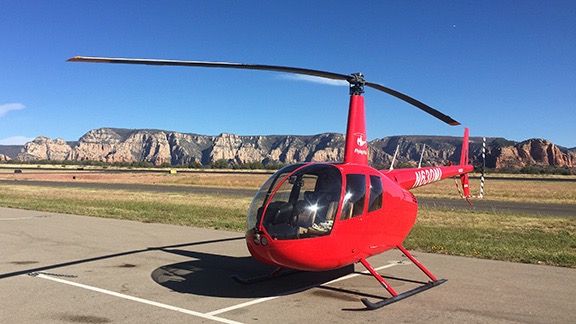
I don’t see what’s so unsafe about this parking spot.
I ordered fuel and we chatted with the pilot of a Cessna on floats that was on a cross-country from Minnesota (if I remember correctly) to California. Seaplanes are pretty rare in Arizona (although the state does have more boats per capita than any other state in the country).
We went to the restaurant and got a table outside so Penny could sit with us. Our waiter, whose name was Ferrari, was very pleasant but not a very good waiter. It took forever for him to bring our drinks. (Penny actually got water before we did.) We were all famished so I ordered an appetizer to share. We both ordered salads. The food, when it came, was good and really hit the spot. I shared some of the chicken from my salad with Penny. I also had one of their mango cake desserts, which was just as delicious as I remembered it being. Jeremy picked up the extremely large tab, I paid for gas, and we headed back out to the helicopter.
Leg 6: Sedona to Phoenix
By this time, my dinner date in Wickenburg had been cancelled and I’d made arrangements to meet my friend Mike at his airpark home near Phoenix instead. He had to go to work so time was limited. Still, I couldn’t resist detouring through Wickenburg. Since my old house was sold in 2015, I’d become friends with the new owners. They’d made some improvements to the house since moving in and although I’d seen a few pictures, I hadn’t actually seen the house itself since I left it in May 2013. I thought it might be nice to do a flyby. Maybe Jeremy could get some nice aerial photos that I could pass along to the new owners.
So we left Sedona flying northwest, along the red rock cliffs. Although the light wasn’t quite right for photos, I did manage to get a few good images.
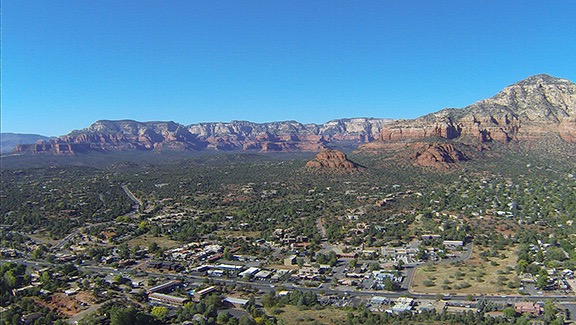
Here’s a look at Sedona right after departing northwest bound from the airport, which sits atop a Mesa.
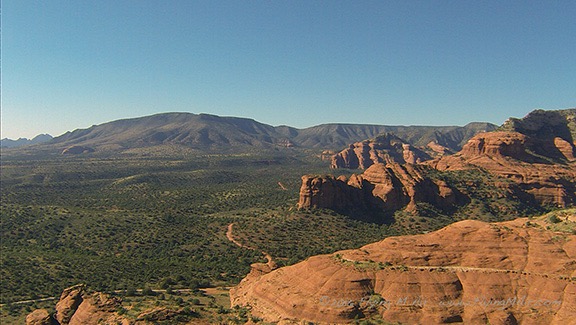
The red rocks of Sedona, west of town.
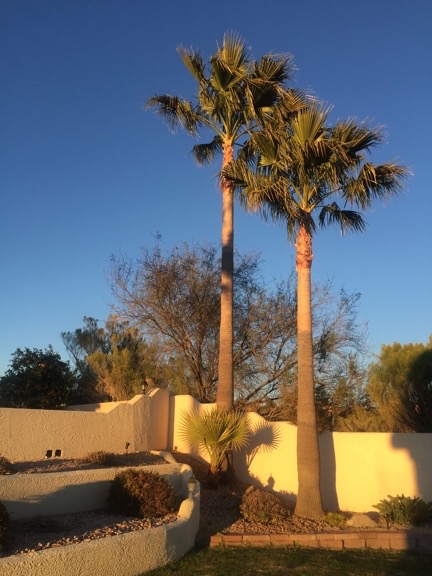
After crossing Sycamore Canyon, I headed toward Prescott on a path that took us within sight of Jerome. From there, we transitioned the southeast side of Prescott’s airspace and followed the Hassayampa River all the way down to Route 93 in Wickenburg. I adjusted my course to intercept Cemetery Wash and followed that up past my old home. It looked great from the air — the new owners are really taking good care of it. I was amazed by the size of the Mexican fan palm in the side yard — I remember planting that tree when it was shorter than me and now it stands at least 30 feet tall. I circled the house and Jeremy shot photos. I still haven’t seen them, but I’m sure he got at least one good one to share.
From there, we headed southwest toward Vulture Peak. I did a quick flyby, pointing out the trail that wound up to the saddle for Jeremy’s benefit. I looked forward to hiking the peak in a few months when I was back in town with friends.
Then I headed southeast toward Hangars Haciendas, the airpark where my friends Mike and Cheryl live. I worked the GPS and radio. I had to connect with Luke Approach to enter and transition the jet training area northwest of Glendale. That was the biggest challenge since I was flying only about 700 feet up — my usual cruise altitude — and had to call from so far out that they couldn’t pick up my transmission. That meant climbing. We finally connected and I got a squawk code and transition instructions. They asked for my destination and I told them Hangars Haciendas.
“What airport is that near?” the controller responded.
“It is an airport,” I replied. “A residential airpark southwest of Sky Harbor.”
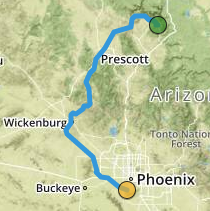
The sixth leg of our trip, recorded by ForeFlight. This was the scenic, time-wasting portion of the flight.
Clearly, he had no clue where I was going, but he understood that I had to go through Goodyear’s airspace so he handed me off to that controller when I got closer. That guy cleared me to transition eastbound along I-10. There was a tense moment when he pointed out an aircraft in downwind and I couldn’t see it. I offered to stay north of I-10 and he accepted that. Jeremy saw the plane before I did and it really was no factor. But I could tell by the controller’s voice that he was concerned. I’m sure he was glad to cut me loose.
Of course, Hangars Haciendas does not appear on my Garmin GPS, although it is on ForeFlight. I used that to zero in on it. It was very difficult to find! I finally caught sight of it and eventually saw Mike, in his uniform, waving us in to his concrete hangar apron. I landed in the corner and immediately popped my door open. It was hot!
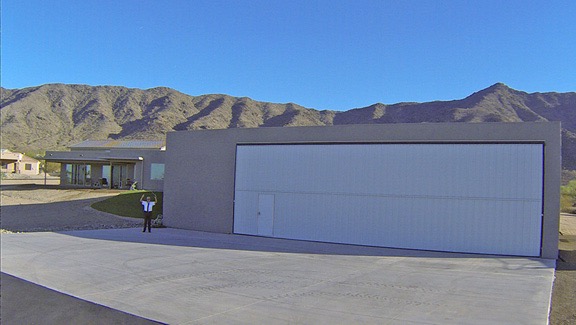
The nosecam caught this photo of my friend Mike waving me into parking on his hangar apron.
I cooled down the helicopter while Penny and Jeremy got out. It’s kind of funny when you think about it — the next stop would be the engine’s last stop before overhaul. Why bother doing a proper shutdown? Well, why not? Surely I could spare the extra two to three minutes to take care of an engine that had been so good to me for so long.
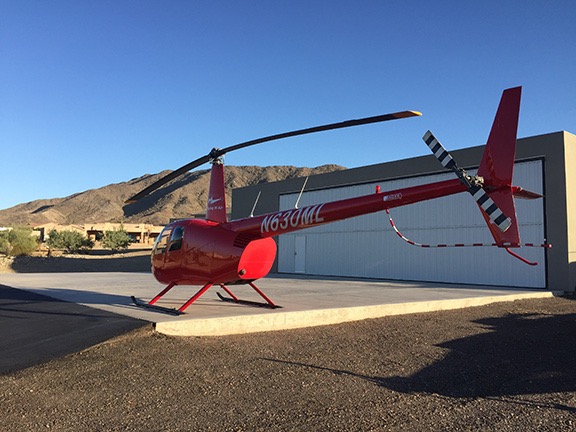
Zero-Mike-Lima parked in front of my friend Mike’s hangar.
Mike only had about 20 minutes to spare for us. He’d been on standby and had actually been called in to work. He needed to leave before 5 PM. So he wasted no time showing off his new plane and helicopter, both of which were tucked into his hangar. I also got a chance to see his home, which was still in its final construction phase the last time I’d been there. I didn’t get a chance to see his wife Cheryl because she was basking in the sun in Hawai’i that week. She’d be home later in the week, just before he left for China.
We parted ways a short while later. Mike drove off to the airport while Jeremy, Penny, and I went back to the helicopter for the last leg of our journey.
The Last Leg: Phoenix to Chandler
I have to say that the last leg was kind of bittersweet for me. Not only would it be the last time I flew until January or February, but it also marked the end of my helicopter’s first life. Its tired airframe, engine, rotor blades, and other components would be stripped down, rebuilt, and replaced. When I got it back, it would be the same helicopter, yet different.
We took off heading almost due east along the north side of South Mountain. Jeremy spotted another helicopter at our altitude nearby — he’s actually a pretty good flying companion — and I tuned into the Phoenix Air-to-Air frequency (123.025), which I hadn’t used in three years, to make a call. The pilot of the other helicopter, with a Firebird call sign — I’m thinking either DPS or Phoenix Police — responded immediately. They were doing some training work, hovering over a South Phoenix neighborhood. We exchanged pleasantries and I continued on my way.
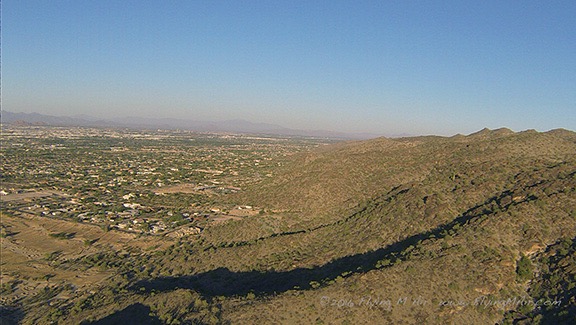
Flying eastbound along the north side of South Mountain near Phoenix. I don’t miss Phoenix’s smog layer at all. That day was actually clearer that most.
After I crossed I-10 and made my first radio call to Chandler tower, I turned on the cockpit GoPro, which had been set up for the entire flight but never turned on. I figured I’d document this last leg of the flight. I started off chatty enough, but soon lapsed into silence. I guess I didn’t have much to say. You can see for yourself in the video below. It’s a shame that the setting sun over my right shoulder puts so much glare into the cockpit.
For some reason, I thought it was a good idea to document the last leg of our flight with a video.
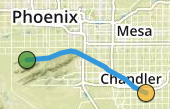
The last leg of our flight was very short. See it on ForeFlight.
It was a very short flight — less than 15 minutes from takeoff to landing. Again, cooled down the engine before shutting down. I patted the controls and talked to the helicopter. (Yeah, I do talk to my machines, even though none of them have names or genders.) When the blades had stopped, I got out with Penny and went to find the Director of Maintenance, Paul.
Post Flight
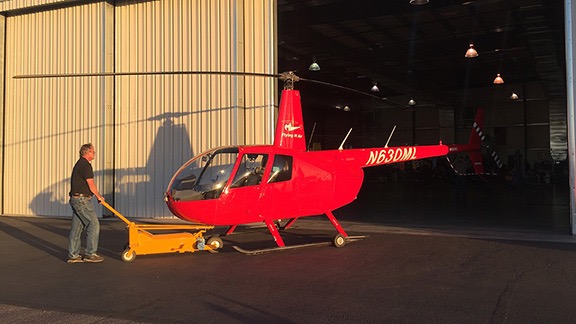 Paul wheeled the helicopter into the hangar where the overhaul work would be done.
The next hour or so was spent helping Paul bring the helicopter into Quantum’s big hangar, talking to him about the little problems it had that needed attention, and discussing core and replacement options. Together, Jeremy and I unpacked the helicopter, separating everything in it into three piles: his luggage, my luggage, and the stuff that would stay with the helicopter in the wheeled box I’d brought along. I was glad that my day pack had been lightly packed for the trip because I did have to take a few things home with me — my GoPros, Penny’s bed, and my Square card reader equipment. Finally, everything was organized and packed for taking or leaving. The sun was down and we were ready to leave.
I didn’t take one last photo. After all, I’ll see Zero-Mike-Lima again in December. I know they’ll have started work by then and it’ll be partially stripped. That’s okay. I’d rather remember it from the last few photos I took during that final flight. I left it parked between two other R44s, knowing that it was in good hands.
The folks at Quantum gave us a lift to the hotel I’d reserved off I-10. The driver was studying to be a helicopter mechanic and working toward his private pilot license. He refused to take the tip I offered when he dropped us off.
We checked in and got information about a restaurant with an outside patio that was within walking distance of the hotel. I was very pleasantly surprised by how comfortable and clean my room was. This was a Quality Inn — which allows dogs — and the room rate was only $65 with tax. I had very low expectations and was so glad they delivered a much nicer room than I expected.
We walked to the restaurant, which turned out to be a very nice Italian place in a strip mall. We sat outside, where the evening air was comfortable and cool. I had two drinks to celebrate the end of the journey. We had a light dinner — mostly because we’d eaten so much at lunch — and walked back to the hotel.
I slept like a log.
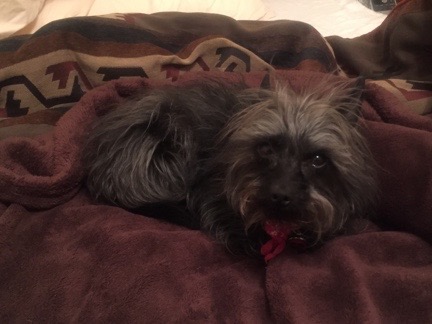
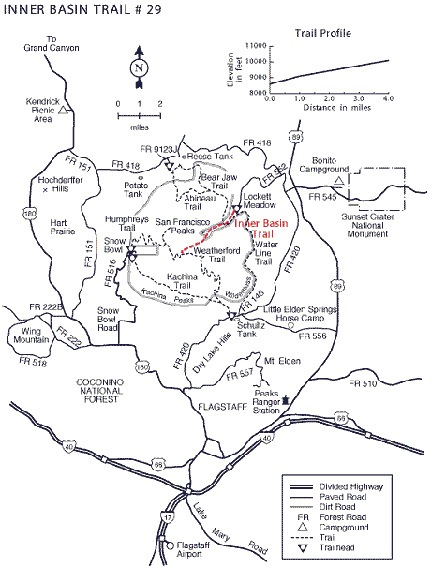 The road to Lockett Meadow is not paved. I was driving my Honda S2000, which probably has about 6 inches of clearance on the bottom. (At least it seems that way.) I was a little concerned when I saw the sign that said “Road Not Maintained for Passenger Vehicles,” but when you consider that the road to my house is not maintained at all and is currently in deplorable condition and I drive it every day with the Honda, I was willing to give it a try.
 Lockett Meadow Campground was at the end of the road. So were the aspen groves. I stopped and snapped a few photos, including this shot of my car parked alongside the road.
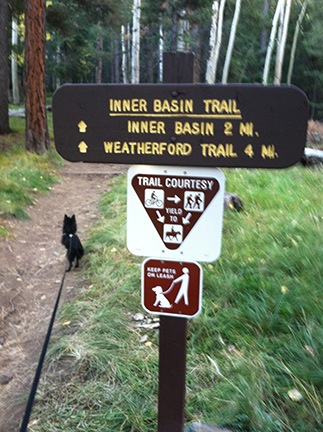 In the back of the campground was the trailhead for the Inner Basin trail. I parked the car among the SUVs in the small lot and got out with Penny to take a look. The trail looked dark and wound into the forest. It didn’t look very inviting. Although Penny was ready to go, it didn’t look like the kind of hike I wanted to take early in the morning. I was more interested in photographing the aspens; there were plenty of subjects back out in the meadow.
 I love including reflections in my photographs. This location did not disappoint me. I was able to make a number of photographs that really showed off the view with perfect reflections.
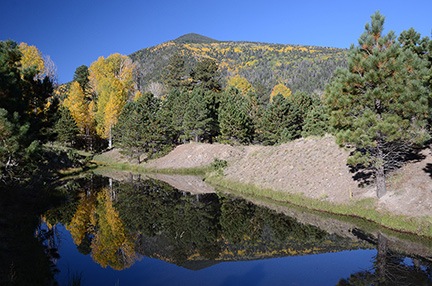 I got back into the car again, now ready to leave. But again, as I was driving off, I caught sight of another place where still water was surrounded by trees. Leaving Penny in the car, I went to investigate and made a few more reflection photos. It was really much more than I had hoped for.
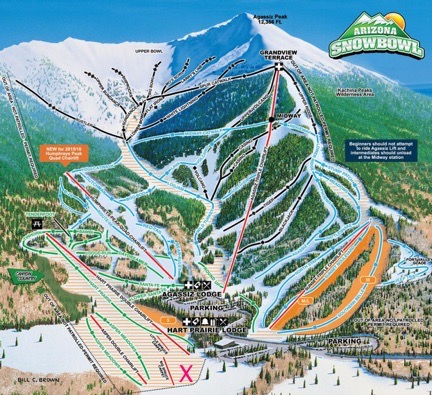
 When Rod and I finished talking, I felt better. Penny and I got back into the car and continued to the Snowbowl. We followed the winding road all the way up to the entrance to the ski area. Just to the right was the parking area for the trailhead.
 Like the other trail, the Kachina trail led into the woods. But whether it was the time of day — after 10 AM — or just the kind of trail, it seemed a lot brighter and more inviting. But what really surprised me was the elevation — the GPS in my phone reported nearly 9,300 feet. Whoa.
 The trail was relatively narrow and wound up and down through the forest, between trees and around large rocks. Penny, on her leash, led the way, stopping occasionally to sniff at something. We met a young family with children walking the other way. I kept up a good pace without getting winded, despite the elevation, and was glad again for the health benefits of my recent weight loss.
 On the way up to the Kachina Trail, I’d passed a place called Aspen Corner. There was a parking area there with paths through an aspen grove. Those trees were at near peak color. I decided to wander around there for a while.
 Penny and I wandered around for a while. I asked another photographer to take a photo of usy, but the exposure was so bad you can barely see us. I also tried a self-portrait using the camera’s timer and did a little better — although I’m squinting into the sun so badly that I don’t really look very appealing. Oh, and do you know how difficult it is to prop up a DSLR vertically on a log?


