Use less fuel.
 Yesterday, during the brief time I was in the Jeep running errands in town, I caught part of an NPR interview with someone about the current fuel price situation. His take was that the fuel companies are gouging us — they’re obviously charging far more than it costs them to produce and deliver fuel.
My response to that: What the hell do you expect them to do?
Addicted to Oil
As one of my least favorite presidents so accurately quipped years ago, “Americans are addicted to oil.” (That may have been one of the few truthful things he uttered during his eight years reign.)
I agree. We are addicted to oil.
Look at it this way: the oil companies are drug dealers. They hook us on their product by making it relatively affordable — the U.S. still pays far less for gas than Europe and most of the rest of the world. The car companies help the process by selling us vehicles that are impractical for most people but have lots of “style” or “status” — which insecure people apparently need. Cities like Phoenix and Los Angeles further encourage us with their urban sprawl and insufficient mass transit, forcing us to drive to work from our dream homes in distant subdivisions.
So we settle in, like junkies, burning our daily fix of fuel. We drive everywhere in vehicles that are far bigger and more costly to operate than we need: trucks and SUVs instead of more fuel efficient sedans. We live in the ‘burbs and commute, alone in our cars, to our workplaces, which are sometimes thirty miles away or more. We’re too lazy to walk anywhere — we’ll often drive across the street from one shopping center to another.
When we’re good and hooked, the prices start coming up.
Bravo, oil companies! You sure know how to work that bottom line!
Hypocritical Whiners
In Wickenburg, I’ve been listening to people whining about fuel prices for the past ten years. They never seem to shut the hell up about it.
It’s the same complaint: local filling stations are gouging them on fuel prices. Wickenburg pays at least 10¢ more per gallon than they do in Phoenix. Funny thing is that these complaints are coming from the same people who think nothing of doing their grocery shopping down in Surprise, 35 miles away. So not only are they driving far more than they need to, but they’re likely buying their fuel where it’s cheaper anyway.
Still, they think our government should somehow intervene and cap fuel prices.
That’s the kicker. The same people who are complaining about fuel prices are the ones who voted in Republican congressmen and senators who are pro big business. The ones that are right behind tax breaks and other incentives for the oil companies. And they’re the same people who are saying we need smaller government and less regulation.
Guess what, folks? You can’t have it both ways.
We Have Empowered Them
I can’t complain about the fuel companies gouging us — which I agree that they probably are. Why can’t I complain? Because I recognize the right of a business to maximize its profit any way it legally can. If that means charging as much as the market will bear, so be it.
You see, there’s this little economic theory called Supply and Demand. As long as there’s demand for a product the provider of that product can charge as much as it wants — or as much as it can get away with. There comes a point, however, when the amount they charge is just too much and demand falls off. As supplies increase, prices go down.
This is basic economic theory.
So as long as we keep buying fuel, they’ll keep selling it to us at the highest prices they can squeeze out of us.
And I can’t fault them for that. We’ve made it possible for them to gouge us.
You Are the Solution
But we also have the power to make it stop.
Instead of complaining about it and carrying on like usual, do something about it. Want some ideas? Try these:
- If you have a big fat SUV or truck or full size sedan, replace it with something more fuel efficient. There are lots of great options out there and, in some states, hybrid or electric vehicles also come with tax incentives.
- If you need a big vehicle now and then to haul people or stuff, get a second, fuel-efficient vehicle for other driving. You might find that over time, you’ll save enough in fuel to pay for that vehicle. Or if two vehicles are completely out of the question, consider renting the big truck when you need it.
- If you commute to work, carpool. Yes, I know this means sitting in a vehicle with other people while driving to and from work. But is that so bad? I carpooled to college for a semester during the first energy crisis and lived to tell about it. You can, too. Best of all, you can drive in the HOV lanes, which will get you there faster.
- If you have an office job, telecommute. This might be a tough sell to your company, but why not try? Telecommuting not only saves you time and money, but it saves your employer money. How? Well, for starters, the more telecommuters they have on staff, the less office space they’ll need. Sure, you won’t get an office or cubicle with your name on it — you’ll likely have to use a shared space on the days you do come in — but think of going to work with your slippers on — and not having to fill your car with gas twice a week.
- If you live too far from the office, move. Okay, so this isn’t easy to do, but you have to admit that it is possible. Right now is a great time to buy real estate, too — if you can afford it. Here’s a not-so-secret: Because there aren’t any good jobs in Wickenburg, where we’ve been living for 14 years, my husband works 55 miles away in Phoenix. We bought a cheap condo down there so he wouldn’t have to make the long drive every day. And guess what? He has a roommate who is in the same boat!
- If you live too far from work, change jobs. Okay, so this isn’t too easy either, but again, it is possible. (Unless you live someplace with no jobs.)
- If you often drive more than 10 miles to shop, shop online. I’m not talking about groceries here — I’m talking about the other things you might need to buy. The closest bookstore, tech store, and full-blown department store are 35 miles from my home. This might explain why Amazon.com gets so much of my business. And don’t try to say that they’re burning UPS/FedEx fuel. Those carriers are coming to Wickenburg anyway, so the incremental fuel cost is minimal.
These are just a few basic ideas. Surely you can think of more.
And before you start spouting excuses why you can’t do any of these things, why not do a little research to see if you can?
And instead of complaining about the problem, why not be part of the solution?
Remember, the reason they’re gouging us with fuel prices is because they can. We have empowered them. The solution is not government regulation. It’s consumer lifestyle change. When they start to see consumption go down, they’ll know our addiction is faltering. Their logical course of action is to drop prices to get the hook in a little deeper again.
It’s happened before; it’ll happen again. Why not give it a try and see?
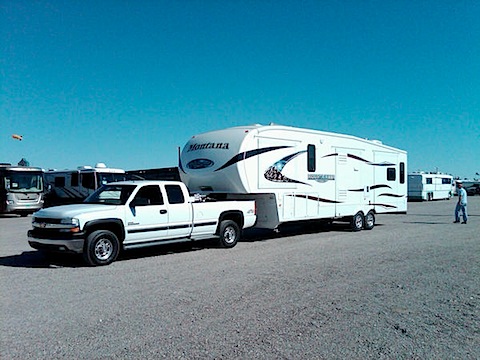
 This photo shows the trailer parked in the spot next to mine. It’s been here longer than me and I suspect it isn’t going anywhere soon.