Here’s what I do to keep my batteries ready to provide power when I need it.
If you’re looking for advice on how much solar power to install or what kinds of batteries work best, you’re in the wrong place. I’m not prepared to give anyone advice about that stuff, for two reasons:
- I don’t know enough to advise anyone.
- Whatever I tell you today will be out-of-date in two years. Or less.
There are plenty of resources online to help you set up or improve a system. This post is just going to provide advice on how to make the most out of any system you have.
I’m back in my camper, on the road, for the first time since February or March 2022. I’ll be honest: I didn’t expect to be here. In September 2022, I bought my Ranger Tug, which is basically a camper on the water. I spent the next 17 out of 24 months cruising in the Pacific Northwest and along the Great Loop. That’s when I really began to understand the similarities between RVing and traveling in a pocket yacht. As a matter of fact, most of the things I discuss here were learned during my RVing days and came in very handy on my cruising days.
The reason I didn’t expect to be here was because I tried to sell this camper. I didn’t need it anymore. But then, when I got back from my Great Loop trip and another month and a half cruising in the PNW, I felt that I was burned out from cruising. Instead of taking the boat south to Lake Powell and Lake Havasu for the winter, I stowed it in my garage. And instead of staying home for the winter, I remembered why I always went away. So I loaded up the camper and headed out on Christmas Eve day. I’m writing this now from the Pahranagat National Wildlife Refuge, which has 15 campsite on a lake.
Memories of a Bad Power Situation
Ironically, the last time I stayed here, in December 2021, I had some very serious battery issues. Like this trip, I spent the first night at Three Islands State Park in Idaho. The campground there is partially open in the winter, providing campsites with power for a reasonable rate. (The water is turned off and the bathrooms are locked. I think the RV dump station might be open but I never need it.) It is usually mostly deserted when I arrive there — this time I was the only camper. So I was plugged in on that first night.
The next day, I set up camp at Pahranagat. It was the first time I’d ever been here when almost all the sites were taken. I managed to get the last site, which was on a little spur road shared by another campsite. I arrived right around sunset. When the sun went down, it got cold fast. Very cold. (Like 15°F by morning.) My pups and I climbed into the camper and closed the door and all the blinds — the windows are not well insulated but the blinds help — and turned on the heat. I had it turned just high enough to get the chill out.
Now let me take a moment to explain how my heat works. It’s a propane furnace which uses DC power to run a fan to bring that heat into the camper’s living space. (This is remarkably like my boat, which has a diesel furnace that uses DC power to run a fan and distribute the heat.) So all night long, every time the heat came on, it used battery power. Of course, it also uses battery power to run its thermostat, so even if the fan wasn’t running, it’s using a tiny bit of power.
Well, in the middle of the night, the batteries didn’t have enough power to run the fan. They actually didn’t have enough power to run anything, including the propane-fueled fridge, which also has a DC thermostat. It was the beeping of the fridge that woke me at 3 AM. After turning it off, I then spent the next three hours shivering in bed.
In the morning, I dragged my Honda 2kw generator out of the truck. I couldn’t get it started. That’s when I realized that its internal fuel tank was empty. I’d loaned it to a friend and he’d apparently used all the fuel in it before returning it. The gas can I had with me was empty, too. And my truck takes diesel.
I couldn’t get the camper off the truck because there wasn’t enough power to run the jacks. So I secured what I could, loaded my pups into the truck, and drove about 7 miles to the closest gas station. I filled the gas can, and drove back. I then ran the generator long enough to get everything powered again. When the sun shined on my solar panels, it took over the charging job.
When the sun set, I was showing more than 12v of power, just as I had the previous evening. And that night was basically a repeat of the night before. Something was going on, but I didn’t know what. The batteries were new; I’d replaced them the previous year.
Long story short: I camped for two or three nights at Valley of Fire State Park. We had some stormy weather and it was nice to be plugged in. Then more dry camping out on the Overton arm of Lake Mead. And more power issues.
I had to get the problem resolved. So I drove into the outskirts of Vegas and stopped at a Camping World. They were willing to replace the batteries but they weren’t willing to test them. Either I spend $500 for the new batteries plus labor or I move on. I moved on. Needless to say, I cannot recommend Camping World for any kind of repair or maintenance job.
I finally wound up at an Interstate Battery shop. That’s the brand of the batteries on my rig. They tested the two batteries and quickly discovered that one of them was bad. They exchanged it under warranty and offered to replace it for $150 in labor. I told them I’d replace it myself, and I did. (And if you had any idea of how batteries are crammed into a truck camper battery compartment, you’d be pretty impressed. I know that I am.)
And guess what? Battery problems were resolved. I spent two or three nights camping out in Kingman Wash not far from the Hoover Dam and didn’t have to run the generator at all.
The Tips
Well, my backstory has gone entirely too long — as my backstories usually do. I like putting things in context, but sometimes I get carried away.
Here are my tips, in no particular order. I’m sure that if you’ve given this any thought you’ve come up with at least half of them. And guess what? Just about all of them apply to boats, too.
If You Have Solar Panels…
Got solar? Here are some tips for that.
- Point your solar panels in the general direction of the sun.
If you have fixed solar panels, try to park so you point them south (in the winter) or north (in the summer). Mine are mounted on the front part of my camper roof, which angles down a bit. I keep that in mind when parking. If you have portable panels, try to remember to move them periodically throughout the day. This will help maximize the sun you capture. And this should go without saying: try not to park in the shade. - When charging a device in a camper with solar power, charge during the day.
It’s better to use power when power is coming in than when it isn’t.
If You Can Plug In or Run a Generator…
Here are a few tips if you do have an opportunity to plug in to a power port or have a generator you can connect to.
- Plug in whenever you can.
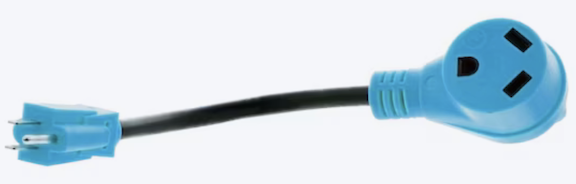
This is a no-brainer. If you have access to AC power, plug in. Campground, parking spot next to your garage, storage yard, plug in. If you’re parked in a friend’s driveway, plug in. What’s that? Some of these places don’t have the 30 or 50 amp outlet you need? Well, why the hell don’t you have a 30 or 50 amp to household current adapter? You should have one on board. Don’t think you need more than a 15 or 20 amp household current to keep your batteries charged. Just be aware that you probably won’t be able to run the air conditioner and microwave at the same time.
You can get an adapter like this at Lowes for $15. - Charge mobile devices while you are plugged in or the generator is running. That’s also the best time to do any energy intensive tasks. For example, in my little 2-battery rig, if I’m plugged into power at a campground, I make sure I do all the dishes (which requires the water pump) before I unplug and move on.
If You Have an Inverter…
An inverter is a device that takes DC power from your batteries and converts it to AC power, often to make wall outlets work when you’re not plugged in. My camper does not have an inverter but my boat does. Here are some tips if you have an inverter in your rig.
- Turn off your inverter when you don’t need it.
My camper doesn’t have an inverter but my boat does. It keeps all AC outlets — including the one the microwave is plugged into — turned on. Vampire power then sucks away at the battery, after converting DC to AC, which also uses up power. If you don’t need those outlets, turn the inverter off to save power. 
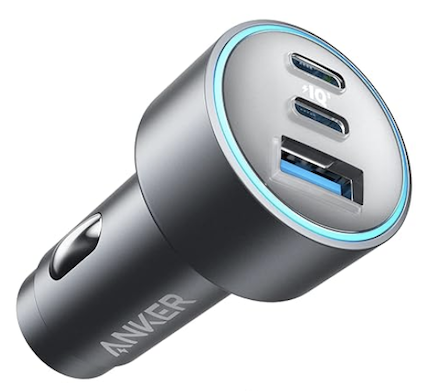
A DC charger like this offers several options for charging devices.When charging mobile devices in your camper, use DC chargers rather than AC chargers with your inverter.
Here’s something a lot of folks don’t know: your phone charger that plugs into a wall outlet converts the AC power from the wall to DC power before charging your device. So when you use your inverter to convert your camper battery’s DC power to AC power for an outlet, you’re making two conversions when you charge your phone through the outlet. Each conversion wastes power. Why waste power? Use a DC charger to charge your devices.
Tips for Every Kind of Setup
And finally, here are some common sense tips for making the most of your battery situation.
- Turn off any devices that use power if you don’t need them.
Another no brainer. I’m talking about lights, water pump, heat, fan, stereo, TV, etc. When you leave the camper, everything other than the refrigerator should be turned off. - Fully charge mobile devices before relying on your camper’s battery power to charge them.
Okay, so you have a phone and maybe a tablet and maybe a laptop. They all run on battery power, but they all need to be charged periodically, just like your camper batteries. When I travel with my camper (or boat), I use DC power adapters to charge my devices while under way. For example, I was on the road, driving my truck for 8 hours yesterday. During that time, I kept my phone and tablet plugged into DC charging ports in the truck so I didn’t need to plug into the camper’s ports while I was camped. You can take advantage of charging opportunities anywhere you find them. - Bring (and charge) battery packs.
Years ago, I was in a Office Depot and saw 10,000 mAh battery packs with 2 USB-A ports on sale for $10 each. They were clearance items. I couldn’t imagine them being any good, but I bought two of them. I quickly discovered that they were very good and went back to buy the last 5 they had. I’ve been using them for years to keep GoPros running past their internal battery life and to charge my phone, tablet, and Apple watch when I don’t want to use my camper’s battery power. I also have a 20100 mAh battery pack that will charge my laptop while I’m using it. I charge these battery packs when the camper is plugged in or when I’m driving my truck. What does this do for me? It reduces my reliance on my camper’s battery to keep vital devices charged. I am, in effect, storing extra power. - When nights are cold, close windows before the cold gets into the camper.
I’m a fresh air person and like to keep the windows open whenever the weather is nice. When I travel south to Arizona in the winter, that’s pretty much every day. But the desert is cold at night in the winter. I make sure to shut my door and windows before the outside temperature dips below a comfortable temperature. This makes it possible to wait a while before turning on the heat.


 And there is this added cheat: a movie — no matter what length it is — counts as just an hour. But, at the same time, an “hour-long” TV episode watched without commercials, which is really only about 44 minutes long, would also count as an hour. I’ll need a scorecard to keep track. It should be interesting to see how I do.
 Yes, I need to lose weight again. Doesn’t everyone?
 One of the things social media time has stolen from me is writing time. Instead of sitting down to write a blog post or an article for a magazine or even a chapter of a book, I spend that time on Facebook or Twitter or even (sometimes) LinkedIn. Or surfing the web. This are mostly unrewarding, unfulfilling activities. I get so much more satisfaction out of completing a blog post or article — especially when there’s a paycheck for the article.
 Why do I go in there? The coffee isn’t even that good!
 And don’t say it’s the dark chocolate covered graham crackers. Although it could be.