My first book review as an Indie Story Geek judge.
In December, I applied to be a judge for the 2024 Indie Ink Awards managed by Indie Story Geek. I’d heard about the contest on Mastodon and thought, why not? I like to read. Maybe this would expose me to some new authors that I would not otherwise find on my own.
To be honest, my reading lately has been mostly a mix of non-fiction thought pieces like Stolen Focus by Johann Hari and Filterworld by Kyle Chayka — both recommended if you think social media and addiction to our mobile devices might be a problem (spoiler alert: they are) — and, believe it or not, novels based in the Star Wars universe, primarily those that are part of the canon. (Yes, folks, there’s more to Star Wars than 11 movies and a handful of TV shows on Disney.) My fiction tastes run to science fiction and mystery, but I’ll also read some fantasy. I don’t like heavy, depressing books that make me sad. What I like to avoid is juvenile writing — either writing meant for kids or “young adults” or books written by authors who write like that.
The Judging Experience
I was very surprised to be selected as a judge. One of the reasons for the surprise was that when I filled out the application form, it asked me what my pronouns were. The pronoun thing doesn’t bother me nearly as much as it bothers crazed conservatives, but it is becoming tiresome. I think that field should be optional on any form. If it matters to you and it’s not the usual he/him for males and she/her for females, by all means, fill it in. But if I identify myself as female — another field on the form — I should be able to skip that question and let you assume I’m a she/her. But the field could not be skipped so I wrote “I’m a straight female and old school; figure it out.” I figured that my sarcasm would disqualify me but it did not. They’re either in the same camp I am about this topic or desperate for judges.
Interestingly, half of the judging categories are related to “Writing the Future We Need,” which relates directly to LGBT, disability, transgender, Asian author, Black author, or a variety of other topics that they want judges to be “qualified” to judge. This is easy for me — I wasn’t qualified for any of them, not having the kind of first hand experiences I think they were looking for. This actually makes sense when you consider their pronoun question. They want to be inclusive, which I think is great. But they also want the judges on these topics to actually have a clue about them. That’s also a good idea.
I was accepted and invited to join in on a Discord forum (or whatever). I signed up and joined in. That’s when I realized that at age 63, I was probably old enough to be the mother or grandmother of most of the other participants in the judging process. Animated emojis are a big thing among my fellow judges. I’m sure their social media feeds are plastered with selfies and memes that include poetry and flowers.
(Do I sound cynical? I hope so. That’s my intent here.)
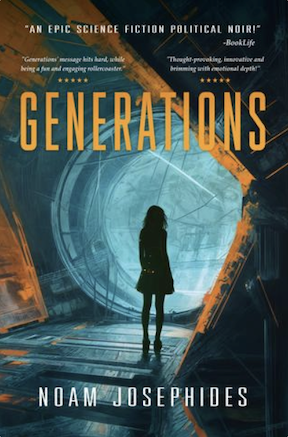
Anyway, once I got set up with the Judge’s Portal on the Indie Story Geek website, I was able to get to business. The process is pretty simple. You “reserve” a book to judge — you need to read and judge at least 3 over over the next four or five months — and then download it as an EPUB, PDF, or (if available) audiobook. I chose Generations: A Science Fiction Mystery Thriller, which has the following blurb:
WINNER: 1st Prize – 2024 BookFest Award • WINNER: Global Book Awards – Silver Medal • “An epic science fiction noir!” – Publisher Weekly’s BookLife • “Extraordinary… dense and enthralling journey” – Kirkus Review • “An amazing space story of mystery, adventure, and exploration. It’s smart, funny, but above all, endearing” – Reader Views
Are Humanity’s leaders steering them into a trap? And can one woman stand up to power and uncover the conspiracy that had been brewing for generations?
The THETIS is humanity’s last hope: a generation-ship carrying the last remnants of Earth to resettle on a new planet.
But, under the facade of a tolerant and cooperative society built across two centuries of space travel, a deeply-buried secret lies – a secret that puts humanity’s new beginning at risk.
The key to uncovering that conspiracy lies in the hands of SANDRINE LIET, an Archivist introvert who has everything to lose by pitting herself against the most powerful people on the Thetis.
The deeper she digs, the clearer it becomes that there is only one way to save both herself and the rest of her fellow Thetans – and it’s the most horrible choice imaginable…
GENERATIONS is a heart-pounding space mystery, an instant #1 Amazon Science Fiction Bestseller of 2024.
I downloaded the EPUB and imported it into the Books app on my iPad. (I’ve been trying to stay away from Amazon and Kindle these days.) And I started to read.
My Thoughts on Generations
First of all, I was not pulled into the book as I hoped I would be. It wasn’t a real page turner — at least not in the beginning. The writing was good, the characterization was good enough, but the plot was a bit slow to take off. The author hinted at backstories for characters here and there and, over time, revealed missing information. Maybe that was supposed to make me want to keep turning pages and learning more? It didn’t. I assumed that important information would be revealed as the book progressed and I wasn’t disappointed.
What the book excelled at was world building. This is so important for science fiction (and fantasy). The author had obviously thought out the world he was writing about in great detail, inventing a spaceship where generations of people would live for a two hundred year journey after the demise of Earth. The description of the ship, Thetis, wasn’t all laid out in a long descriptive passage. Instead, it was revealed little by little, just like the characters’ backstories. And it was believable.
Unfortunately, the plot wandered into a plot device I absolutely detest: protagonist’s name is smeared by people more powerful than her and she’s set up to take the fall for things she didn’t do. Fortunately, this wasn’t the whole book, but was enough of it that I had no trouble putting the book down to do other things.
To make matters worse, an early plot development revealed (at least to me) part of the book’s conclusion. Not only was the “mystery” not much of a mystery to me, but I was frustrated that the protagonist didn’t see what I did. This only got worse when my suspicions turned out to be correct. No, I didn’t solve the entire mystery right at the beginning — that would be impossible since a key piece was not made known until nearly the end. But I knew exactly which way the plot was heading.
But I think the thing that bothered me most was how the protagonist escapes from danger near the end of the book. It was completely unbelievable. I don’t want to spoil the book for readers, but the chances of her succeeding at a certain point were pretty much nil and yet she succeeds. I really wish the author would have gotten her out of that jam in a more believable way.
In re-reading this, it sounds like I hated the book. I didn’t. As I mentioned, the writing was good and the characterization was good enough. The mystery was interesting, despite me seeing the answer coming before it arrived. It wasn’t trite or clichéd. It wasn’t written for children. But the best thing it had going for it was the world-building. When it was over, I was left wishing I could stay on board for when Thetis arrived at its destination and Generation 10 could start developing their new world.
Maybe the author will take all the work he did on building Thetis to take us there? I would read that.






 It doesn’t appear in the message here, but I inserted the eye rolling emoji. I like that one. It sums up my thoughts about people who complain about things that they really have no right to complain about. Or when I encounter sheer stupidity. (I rolled my eyes a lot in the last few years of my marriage. Half the time, I didn’t even realize I was doing it, but it drove my wasband crazy.) I use it a lot on Twitter.