A Dinner with Friends

Salmon, local wine, and home-made cherry pie with friends.

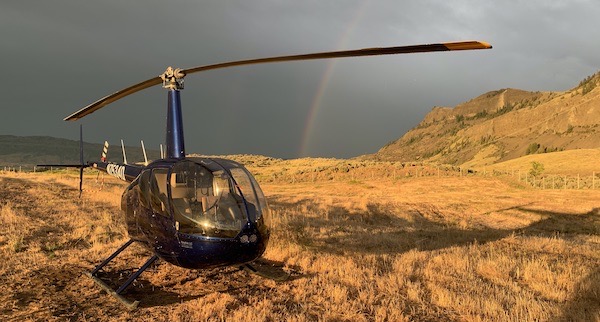
If you’ve been following this blog or my Twitter or Facebook accounts, you know that I’m in Washington State on the last of several cherry drying contracts. I’m not the only helicopter pilot doing this work. At the peak of the season, there were probably about 20 of us working in central Washington state for a handful of service providers. My company, Flying M Air, is probably the smallest of those service providers; this year I was able to add a second pilot for about half my season.

My friend, Jim, has been doing this work for about fifteen years. He starts the season in the Mattawa area and ends it in the Chelan area. He usually starts before me and finishes before me.

This year, I met Lisa, who was new to this work. She worked for the same service provider as Jim, starting down in Kennewick, moving up to Brewster for a while, and then ending the season in Malaga.

Unfortunately, I only met Lisa last week, on Thursday. I say “unfortunately,” because we really hit it off. She came up to my RV for dinner that evening and accompanied me to the Beaumont Cellars Dinner on the Crushpad event the following evening. We went wine tasting and had dinner together again on Sunday. By then, I felt as if I’d known her a long time.

The End is Here

On Friday, my contract in Wenatchee Heights was extended two weeks. It made sense; they’d barely started picking the 86 acres I was responsible for. Since this particular client picks by color, it would take at least two weeks to finish picking. Lisa was told she’d be needed until Wednesday. Jim, the last pilot left in Chelan, was waiting to get cut loose any day.

Moonset over Squilchuck

My view at dawn.

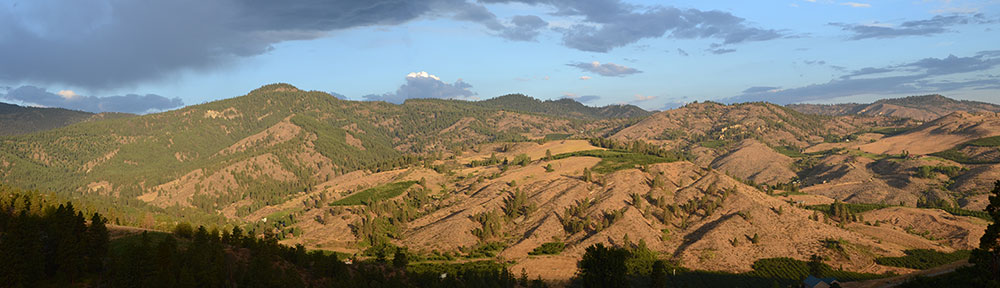
Weather moved in Sunday night. Asleep in my RV at the edge of a cliff over looking Squilchuck Valley, I was awakened by the wind at 3:30 AM. I looked out the window and realized I couldn’t see any stars. I fired up the Intellicast app on my iPad and was shocked to see the green blob indicating rain mostly to the south of my position. I dozed fitfully for an hour, expecting to hear rain on my roof at any moment. It may have been drizzling when I finally fell back to sleep.

At 7 AM, I woke to the sound of voices, trucks, and construction noise. The mostly blue sky was full of puffy clouds. Down in the lower part of the orchard, the pickers were already at work. There was no rain in the forecast at all.

Jim called at about 10 AM. I knew instinctively what he would say and beat him to the punchline: “You’re calling to tell me they cut you loose.”

“You’re a mind-reader,” he said. “Today’s my last day.”

We chatted for a while and then I remembered that Lisa had an opportunity to do a trip with a friend and would probably be open to letting Jim take over her contract for the next two days. He was also open to that, so I hung up and called Lisa. I told her what we were thinking.

“That’s great,” she said, “but today’s my last day, too. They’ll be done picking in about an hour.”

It was then that I realized that both of them would be gone by the next day.

Errands, Favors, and a Cherry Pie

The end of a cherry drying contract comes with logistical challenges.

Lisa’s challenge was easy. All she had to do was pack up, move out of her motel room, and drive the company pickup truck back to Spokane. Her employers would be sending some pilots in time-building mode out to Malaga to pick up the helicopter. She needed to send them the GPS coordinates for where the helicopter was parked so they could find it. She was toying with the idea of leaving that afternoon so she could spend some time with her family before her trip.

Jim’s challenge was a bit more…well, challenging. His helicopter was four hours from its 100-hour inspection, which needed to be done by his mechanic in Seattle. Flying to Seattle was usually a challenge in itself — the weather in the Cascade Mountains was typically miserable with low ceilings, making it a difficult, if not dangerous, flight. A weather window was required, but you never knew when that would be. After dropping his helicopter off in Seattle, he’d have to come back to Wenatchee to fetch his truck and drive it home to Coeur d’Alene. Of course, both his helicopter and truck were in Chelan, about 40 miles farther up the Columbia River. He needed to move his truck to Wenatchee to stage it there for his return from Seattle by airline. Then he needed to get back to Chelan so he could fly out with his helicopter the next day. He suggested a farewell dinner that evening and I promised to drive him back to Chelan.

I had a bunch of errands to run in Wenatchee and I got around to starting them that afternoon. While I was out and about, Lisa called. She’d decided not to leave that day; she’d leave first thing in the morning instead. What she really wanted to do was make a cherry pie. We’d already planned to do that before she left, but that was before she was cut loose early. I had an oven in my RV, so it made sense to do it at my place.

We decided to do it that afternoon. And instead of Jim and me going out to dinner in a restaurant, I’d pick up a piece of salmon and salad fixings and make dinner for all three of us. I was finishing up my errands and heading back to my RV when Jim called and I told him our revised plan. He was on board.

Lisa showed up around 5 PM. Since Jim was still a half hour out, we each took a bowl and headed into the orchard. Five minutes later, we had enough cherries for a pie — and then some.

Back in the RV, I gave the cherries my usual three-soaking bath in cold water to clean them thoroughly. Then Lisa went to work with my junky cherry pitter. It didn’t surprise me much when it broke when she was only half finished. She pitted the rest by hand. By the time Jim showed up, her hands were stained with cherry juice, making her look like a mass murderer.

Jim helped me put a filled propane tank back into its cabinet on my RV and hook it up. The strap that holds it in place bent and he was determined to fix it — which he did. If I wanted to be mean, I would have shown him the strap on the other tank which had similarly broken but had not been fixed. But instead, we went inside and kept Lisa company while she worked on the pie.

We also drank wine. Both Lisa and I had bottles that we’d opened recently but had never finished. We polished them off, one after the other over the course of the evening. I even opened another bottle to keep the wine flowing.

The Salmon Recipe

When the pie was safely in the oven, I got to work on dinner. That’s when Jim gave me a recipe that another one of the pilots had shared over the summer. Oddly, I happened to have all the ingredients. I reproduce it here because it was so excellent:

Ingredients:

  • Salmon filet
  • Mayonnaise
  • Onions, sliced thinly
  • Bacon, cut into pieces

Instructions:

  1. Place the salmon on a piece of aluminum foil.
  2. Spread mayonnaise on the fleshy side of the salmon.
  3. Sprinkle the onions and bacon pieces over the mayonnaise.
  4. Fold up the foil to make a packet.
  5. Place the packet on a preheated grill set to medium heat. If possible, cover the grill to keep the heat in.
  6. Cook until the salmon is done.

The Summer’s Best Dinner

I’d bought a beautiful 1-3/4 pound Coho salmon filet. It was too large to fit on my portable grill in one piece, so I cut it into three portions and made three packets. I absolutely lucked out with the timing. The fish was fully cooked, but still moist. The onions and bacon were cooked to perfection.

I served it with a salad of mixed greens, cucumber slices, vine-ripened tomato, bacon bits, goat cheese, and bottled balsamic vinaigrette dressing.

At one point, Jim said it was the best dinner he’d had all summer. I thought about it and had to agree.

It was the conversation that made it perfect. We talked about flying and about the surreal situation of a cherry drying contract. They seemed to think I had the best setup, living in my mobile mansion on a cliffside with a view, with 86 acres of cherries just steps away. I agreed that it would be tough to go home in September.

Jim was happy that his contracts had gone long enough to cover his annual insurance bill and the cost of his upcoming maintenance. He added up the hours he’d flown during the ten or so weeks he’d been in the area. It wasn’t a lot — cherry drying is not a time-building job — but it was more than usual.

Lisa said it was the best summer she’d ever had and that she’d do it again if she could. Her future holds bigger and better things, though: she’s starting officer school with the Coast Guard in January. She was already looking forward to the trip she’d be starting on Wednesday with a friend.

After dinner, Lisa sliced up the pie, which had been cooling on the stovetop. I produced some Haagen Daaz vanilla ice cream from my freezer. The cherries were big and plump and tender — not the mush you usually find in a cherry pie. It was a perfect finish to a great dinner.

The Party’s Over — and So Is the Summer

The party broke up after 10 PM. Lisa left to drive back to her motel for one last night. Jim and I climbed into my truck and started the long drive to Chelan. We talked politics on the way. We don’t agree on all points, but we’re both too stubborn to give in to the other. We’re also too smart — and too close as friends — to let our disagreement hurt our friendship.

I dropped him off at the house he’s renting. In the morning, his boss would pick him up and drive him to the orchard where his helicopter is parked. Then, weather permitting, he’d make the one-hour flight to Seattle. I’d pick him up at Wenatchee Airport at 5:12 PM and bring him back to his truck. The plan set, I started on my way back.

I got back to my RV just after midnight. The moon was up by then, casting a gray-blue light over the valley spread out before my RV. I listened to the crickets and looked out over that valley for a while. I had 12 days left in my contract and there was a slight chance that it would be extended again.

Yet with my friends gone, I felt as if my summer was over, too.

Weather Forecasting: A Bad Joke?

Each “source” of weather tells a different story.

My work this summer is highly dependent on weather. Simply stated, if the weather is picture perfect and there’s no chance of rain, I pretty much have the day off to do what I like. But if there’s any chance of rain, I need to stick around my base just in case rain starts. And if it’s raining, I go to work.

So, as I mentioned elsewhere on this blog, I’m really in tune with the weather.

Or at least I try to be.

The trouble is, I track the weather using multiple sources on my computer, iPhone, and iPad. And it’s very seldom that they all agree.

Today is a perfect example. Here are screenshots for the various sources, all captured within the save 5-minute period. What interests me is what it says for Sunday, Monday, and Tuesday.

National Weather Service

The National Weather Service website is my preferred source of weather data. It’s a no-frills site that doesn’t have very good weather graphics — radar, etc. — but does have well-described weather forecast data.

National Weather Service Forecast

Note that in this forecast, they’re showing a 20% chance of rain on Monday.

The Weather Channel

Everyone loves the Weather Channel website. I don’t. It’s full of ads and info that most people who are serious about weather forecasts has no interest in. But it is a source of weather info and I do occasionally consult it — usually for radar graphics.

The Weather Channel Forecast

Note that this forecast indicates a 20% chance of rain on Sunday and only 10% on Monday.

Intellicast

Intellicast is the pessimist of weather forecasting. I’ve discovered that if any forecast shows a chance of rain, it’ll be Intellicast. I use the Intellicast app on my iPad, but there’s also an ad-heavy website.

Intellicast Forecast

In this case, Intellicast matches the Weather Channel’s forecast regarding rain: 20% Sunday and 10% Monday.

WeatherBug

WeatherBug ForecastI use Weather Bug on my iPad and WeatherBug Elite on my iPhone. They usually have the same forecast.

This screenshot is from the iPad version. It’s showing a 20% chance of rain on Monday, just like the National Weather Service. As you might imagine, the iPhone version shows the same information (although in a different way).

Which One is Right?

In this example, at least there is some agreement between the different programs. The way I read this is that rain is possible sometime on either Sunday or Monday or both. Chances are slim but is possible — at least as of now.

Of course, I’ll watch all of these sources throughout today and tomorrow to see how they change. These forecasts will change. They were, after all, different yesterday.

Will they ever all agree? No. I’ve experienced rain when the forecast for one said no rain and another said there was a 10% chance.

Monday, July 25, was a good example. I went to bed on Sunday after seeing a 10% to 20% chance of isolated thunderstorms for Monday, yet was awakened at 4:30 AM on Monday by a pouring rain that didn’t really let up until 2 PM that afternoon. All the pilots flew all day that day; it was a nightmarish situation where all the orchards got wet and needed service. (I also got calls from orchard owners who weren’t under contract with me, begging me to come. I couldn’t — I service my clients first and it took all day to take care of them. A lot of cherries were lost that day.)

So I’ll be watching the weather closely for the next few days, never wandering far from base.

Who knows? Maybe tomorrow raindrops on my rooftop will put me on active standby before my morning coffee.

Drying Cherries

Up close and personal with a whole lot of trees — and fruit.

One of the things that has been keeping me very busy — at least lately — this summer is my work as a cherry drying pilot.

I generally don’t blog much about this work, primarily because there isn’t much of it and I feel a real need to protect myself against competition. I rely on the revenue from this work to help keep my business running. I also rely on the need to relocate to do this work as an excuse to get me the hell out of Arizona when it’s so freaking hot there.

What It’s All About

In brief: During the last three or so weeks that cherries are on the trees, if they get wet, they can become damaged — usually splitting or developing mold. Growers who don’t want to lose their crop hire helicopter pilots to stand by during cherry season. After a rain, they call us out to hover over trees. The downwash from our rotor blades shakes the branches, thus shaking off accumulated water.

There’s a lot more I can say about this, but I don’t think it’s necessary. As I mentioned here, the work can be dangerous and requires good flying skills. (There was an accident in an orchard just the other day that was likely caused by a failure to respect density altitude in a heavy helicopter. Both occupants survived uninjured; the helicopter didn’t.) It’s not for low-time pilots. And it’s a crappy way to build time — I was here 6 weeks before I was called out to fly at all and, now seven weeks in, I’ve only flown about 9 hours.

Oh, and did I mention how incredibly tedious the work is?

Some Snapshots

Anyway, yesterday I was called out twice to dry. There was a 15-acre orchard that I had to dry twice and a 40-acre orchard that I dried just once. Add that acreage together and you get 70 acres of cherry trees.

For my second call out, I mounted my GoPro “nosecam” on the helicopter. I actually have video from that viewpoint of both orchards I dried on that call. It’s not very exciting stuff. As I type this, I’m debating on whether to throw a few minutes’ worth into a video to share. I wouldn’t want to put anyone to sleep.

I did, however, pull out a few still images as photos to share here.

Cherry Drying
This is a typical view down an aisle of cherry trees. I fly very low.

Orchard and Rain
Here’s a shot as I approached the 40-acre orchard block. You’re looking at hundreds, if not thousands, of trees. It was still raining lightly as I flew up. I took the opportunity to land near the orchard and pull my door off. When the sun comes out, it gets very hot in the cockpit — especially when you’re wearing a Nomex flight suit and helmet.

Cherry Drying
Here’s another drying shot. These trees are younger than the ones in the smaller orchard and were heavy with fruit, which you may be able to see in this shot. The sun was out for much of this dry, so time was of the essence.

Serious Business

Cherry drying is serious business. My client is paying me good money to sit around and wait for the rain. When the rain comes, it’s my job to quickly and effectively dry his trees. If I fail to do my job, my client can lose his entire crop. That could be hundreds of thousands of dollars worth of fruit, the difference between a profitable year and a year living on credit.

It’s a huge responsibility that I take very seriously.

The next time you eat fresh US-grown cherries, think about the folks in the production chain that put those cherries on your plate. I might be one of them.

About the Cherry Drying Posts

And why they’re password protected.

Drying CherriesA few weeks ago, it came to my attention that this blog was the primary source of information about cherry drying by helicopter. Every day, pilots who wanted to learn more about cherry drying were stopping in to read up.

Normally, I’d be pleased. But I also began to realize that these same pilots were using the information I provided to compete with me for cherry drying work.

That would simply not do.

The truth of the matter is, there simply isn’t enough work to go around. Every year, I struggle to get my contracts together and signed and then struggle some more to get my standby pay. Other pilots I know who have been doing this work far longer than I have go through the same process. None of us can afford to have competition for what little work is out there.

In my case, it’s particularly tough. I travel from Arizona to Washington and back at considerable cost. This year, I made the trip with only one contract signed. If I hadn’t been able to secure other work, I would have taken a heavy loss.

In this tough economy, I depend on this work to keep my business afloat. Without it, I’d likely have to sell the helicopter. Right now, there simply isn’t enough tour and charter work out there to cover the cost of my fixed expenses, such as insurance, annual maintenance, and hangaring.

So I’ve password-protected the posts, making them inaccessible to most visitors. I’ll likely remove the password once my friends and I stop doing this work.

Some Important Things to Know about Cherry Drying

I do need to say a few things about cherry drying for the folks looking for information.

  • Cherry drying requires a helicopter. If you don’t have a helicopter, you cannot dry cherries. Any company that has helicopters for this kind of work already has pilots. Inexperienced pilots cannot expect to be hired for this kind of work by a company that already has helicopters and pilots.
  • Cherry drying is not a good way to build time. I got less than 20 hours of drying time this summer. I got around 5 hours each of the previous two years. Do you really want to blow a whole summer sitting around in farm country waiting for it to rain just to get 5 to 20 hours of flight time?
  • Cherry drying is not for low-time pilots. When you work, you’re hovering 5 feet over treetops, sometimes in very windy conditions. That means tailwinds and crosswinds and LTE. There’s a lot of dancing on the pedals. There’s a real need to know the helicopter you’re flying.
  • Cherry drying is dangerous. All operations are inside the deadman’s curve. If you have an engine problem, you will crash. Read these accident reports to get a better idea of what can happen: SEA05CA122, SEA04LA102, LAX02LA169, SEA00LA101, SEA00LA103, WPR09LA371, and WPR11CA146

I know a lot of helicopter pilots — especially low-time helicopter pilots — out there are desperate for work. If you’re one of them, I can assure you that cherry drying isn’t the solution you’re looking for.

Why I Go On and On about the Cherries

I’m awed.

Cherries on a Tree

Cherries in their natural state.

If you follow me on Twitter, you’re probably sick of me tweeting about two things: cherries and the weather. I’ve explained, in detail, why the weather is so important to me this time of year. Let me take a moment to explain why I keep tweeting about cherries.

It’s In My Face

For the past month, cherries have been an integral part of my life. I’m living across the street from a very large cherry orchard. My helicopter is actually parked in the orchard. I drive or walk into the orchard nearly every day. I’ve also spent literally hours flying over the orchard’s trees, low-level. I feel that I have a first-hand knowledge of the orchard surpassed only by its owners, managers, and workers.

Even before I moved to my temporary home across the street, I visited the orchard. The first time was in June. Back then, the cherries were bunches of small pink dots, clustered on the branches. A few weeks later and there hadn’t been any serious change. It seemed like they’d never get ripe.

Hydrocooler in Action

The hydrocooler with its water chiller and accompanying generator in action during the peak of picking time.

Then I moved here and started to observe the activity at the orchard. Watering every morning and night. Spraying for pests many afternoons. Bringing in hundreds (if not thousands) or red wooden cherry bins. Bringing in the portable toilets and ladders for the pickers. Cleaning out the shed. Moving in heavy equipment, like the hydrocooler and its water chiller with massive diesel generator. Preparing the tractors and bin trailers and forklifts. Distributing the bins among the rows of trees.

The cherries took their own time to ripen and the growers couldn’t rush them. When the packing plant had a high demand for fruit, some picking began tentatively, pulling the scant ripe cherries from the trees. Then quiet again as they waited.

I did my part, blowing rainwater off the trees four times, protecting the vulnerable fruit from water damage.

Picking for One

Washed Cherries

Not the best photo, I know; I snapped it with my cell phone to show off how beautiful the cherries were. I hope I don’t seem too demented.

I asked for and got permission to pick cherries for my own consumption. Two or three times a week, I’d head out into the orchard and find some trees with dark red, ripe fruit. I’d fill a small colander, then head back to my trailer with my prizes. I used my RV’s small sink to wash off whatever they’d been spraying on the fruit with cold water baths and rinses. Once clean, the fruit looked beautiful. So beautiful that I couldn’t help by take photos to share on Twitter and in my blog.

I think what I like most about the cherries I pick is the way they’re so unlike store bought cherries. They haven’t been processed. Don’t misunderstand me — processing doesn’t hurt the cherries. It cleans them, probably better than I do. But it also cuts the stems to separate the bunches of cherries and sorts them by size. In my plastic cherry bin, the cherries are still bunched together in twos, threes, and fours — just the way I picked them. Some of them even have small leaves attached. And although most of the cherries I pick are quite large, I’ve also picked the small ones that never make it into stores. That somehow makes my cherries seem more natural. More real.

Even if they’re so perfect looking that they seem fake in photos.

There’s So Much To It

There’s something about being part of the farming process that really makes you appreciate your food. People see cherries in a bag at the supermarket, but do they ever think about what went into getting them there?

This orchard is on the side of a hill that is, in some places, very steep. Someone had to clear the land of scattered pine trees, sage bushes, tall grass, and big rocks. They had to plant rows of young trees and protect them from deer and other grazing animals with tall fences. They had to put in irrigation systems that would deliver fresh water, on demand, to the bases of the trees from a system of reservoirs stair-stepping down the hillside. They had to prune the trees, spray them for pests, fertilize them. They had to protect them during harsh winters and late spring frosts.

They did this for years, nurturing the trees as they began to bear fruit and grow, always adding more trees and irrigation to expand the orchard. Now, this orchard is 86 acres, but I can see the newest, youngest trees, just planted this year, on a hillside not far away. With a few years of care, they’ll be bearing fruit, too.

It isn’t always easy. The orchard’s reservoir is filled by turning a valve that brings water down from another reservoir at the top of the hill. The other day, someone left the valve open too long. The reservoir overflowed and flooded out the overflow area. Two small dams were on the verge of breaking; one of them would have released enough water to take out a road the pickers needed to get to a far orchard block. It was fortunate that a large backhoe was available nearby. The grower was able to dig out a channel to direct the water to a nearby stream. While it must have hurt to release valuable water he’d paid for, it was better than having a road rebuilt or possibly losing access to 15 acres of trees.

Picking

Picking began in earnest about two weeks ago, then stopped suddenly for five days. It started again yesterday. This grower picks for color — they’ll go through the same trees more than once to pick only the best, ripest fruit. They’re probably about halfway done; trees I picked fruit from only a week ago are now picked clean.

I’ve already documented the picking process in my “Cherries: From Tree to Truck” video. What I’ve learned is that every orchard does things a little differently. The process here is similar, but not quite the same.

Pondside Parking

Yesterday, the pickers were parked uncomfortably close to my helicopter.

It’s going on as I type this. From my office window, I can see the pickers moving ladders. I can see their cars parked out in the orchard. I can hear the refrigerated tractor trailer truck pulling up for another load of 30,000+ pounds to take away to the packing plant. The tractors pull in with full cherry bins, the water truck sprays down the roads to keep the dust down, the forklifts shuffle the cherry bins around.

It’s a good day for picking: very cool, partly cloudy. They might work until 2 PM today — a full day, considering they started at first light.

It’s an amazing thing to be part of. Can’t help it if it makes me want to talk about cherries.