I get an offer on my 2003 Honda S2000 — and say nope.
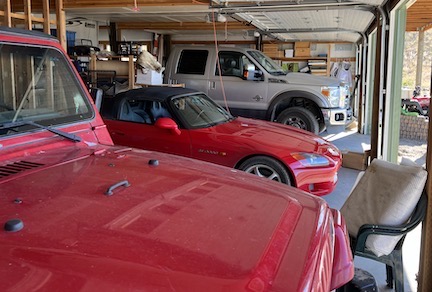
My “fleet” of vehicles in the four-car garage on the north side of my home. My little 17′ Sea Ray jet boat is hiding behind the truck; it needs to be sold. If you look closely, you can see my 1999 Yamaha Grizzly ATV parked outside; I bought that new, too.
My Jeep is still packed with art show gear and, frankly, with another show later this month, I’m willing to let it stay packed so I don’t have repack it. My truck is a pain in the butt to park and I didn’t really need to haul anything. So when I went to a meeting with my tax accountant and down into Wenatchee to run some errands, I took my Honda.
It’s a 2003 Honda S2000 and I bought it new. It has about 69,000 miles on it and I drove it for most of those miles.
The Joy Machine
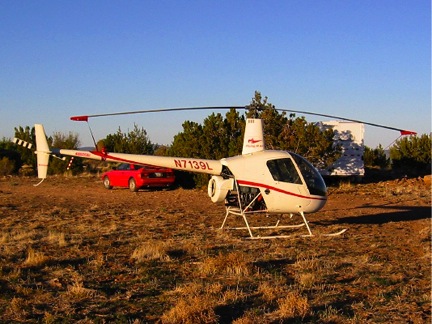
 This might be the only photo I have of my Honda and Toyota parked side by side. For years, the Toyota lived at whatever airport I flew my helicopter to most often: Prescott, Scottsdale, and, in this photo, at Phoenix Deer Valley.
Now I know most folks say it’s dumb to buy new cars when used cars are so much cheaper. I think I’ve heard the “drops $5000 in value as you drive it away” claim about a million times. But when you keep your cars for 20+ years, depreciation is not something you really need to worry about. You really do get your money’s worth, even if the car is a total junker when you dispose of it — like my 1987 Toyota MR-2 was.
This car turned on to be a classic because Honda only made them for a few years. So after normal depreciation for the first 10+ years, the car has started to appreciate. It’s “desirable.” It certainly does turn a lot of heads and get a lot of complements.
I don’t drive it very often, but when I do, I remember why I call it my Joy Machine. I swear that if I had the worst day of my life and was totally miserable, I could get in this car, take it for a drive in the mountains, and be totally joyful within 30 minutes. It’s a blast to drive, with fast engine, six-speed transmission, nearly zero body roll, grippy tires, and good brakes. Top down is the way to go, of course. Replacing the stock stereo with a modern, more powerful one a few years ago — why did I wait so long? — makes it perfect for any road trip, provided you don’t need to take much luggage. In no reality could this be called a “practical” car, but hell, that’s what the Jeep and truck are for.
The Car Dealer
So I drive the Honda into Wenatchee the other day, all the way to the north end of town, and pull into the Home Depot parking lot. I need to return some irrigation stuff and get different irrigation stuff. (Don’t get me started on irrigation and careless landscapers with lawnmowers.) As I’m walking away from the car, a guy pulls up next to me in an SUV.
“I want to buy your car,” he says to me.
“It’s not for sale,” I say to him.
He then proceeds to tell me that he’s with a car dealer up the road and that the car is very desirable and worth a lot of money.
I tell him that I know exactly how much Kelly Blue Book says its worth because I looked it up the day before, out of curiosity, when also looking up the value of a truck camper I want to sell.
“You’re selling a truck camper?” he says. “I just bought one of those the other day. We’re looking for another one. But I really want to buy that car.”
“Well, everything has its price,” I admit. “Come up with a big enough number and I’d consider selling it.” I didn’t tell him how big that number had to be, but it was pretty big. A lot bigger than KBB said it was worth. After all, it wasn’t just a car. It was a Joy Machine.
We exchanged numbers and he said he wanted to come up and look at both vehicles. He’d bring someone from his office.
I really do want to sell that camper — it’s a 2007 Lance 950 sized for a long bed — and if I could lure him up to my place by letting him have a closer look at the car, I was willing to do it. I had the JD Powers numbers for the camper and had discovered that it was worth a lot more than I thought it was. I was pretty flexible on price, though; I’d paid less than the current value for it. If he came near what I wanted and handed over cash, it would be his.
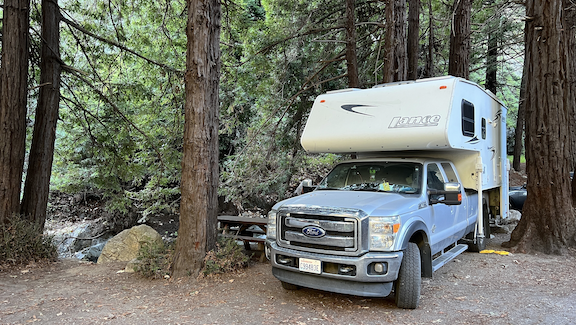
I had a lot of fun times in this truck camper and I sure hope it goes to a good home.
The Visit
True to his word, he contacted me later in the day to set up a meeting at my house the next day, Friday. 3 PM was the time. That gave me all day to finish clearing out the camper, washing road dirt off it, and vacuuming it. I did all the cleanup with it still in the garage — my garage has a drain so I often wash vehicles in there, in the shade. (It clears the dust off the garage floor at the same time.) Then I got the truck in there and lowered the camper onto it. I pulled out of the garage and closed the door.
I also pulled the Honda out into the shade just outside its garage bay and gave it a good washing, top down. (Yes, it is possible to wash a convertible with the top down.) I dried it off and it sparkled. I put the vinyl top cover over the folded top. It looked amazing. Seriously: when you take care of your stuff, it shows. (My 1999 Jeep — also bought new — has never been so lucky; I beat the crap out of it on a regular basis and it shows.) I closed that garage, too.
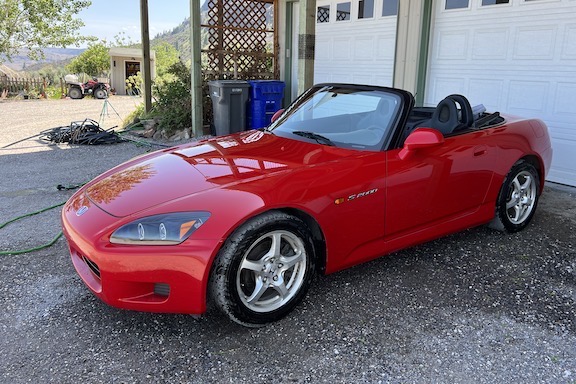
My Joy Machine after a quick wash.
Now you might think I’m nuts inviting a stranger who approached me up to my house, supposedly to look at vehicles. But I’m not a complete idiot. The garage and house was closed up so there was no way he’d see anything else that I owned. And I texted my neighbor Teri and asked if I could borrow one of her men — either her husband or his cousin who was visiting — for the occasion. They both rolled up in his side-by-side at about 2:45. They had a gun with them.
(I’d considered bringing my gun down from the house, but there was no place I could hide it on my person when I was wearing shorts and a t-shirt. So I had no problem with them bringing one that they kept in the side-by-side.)
So yes, I understood right from the get-go that this could be some scam to get me to reveal more about my possessions than just these two vehicles or even an opportunity to rob me or worse. And I took precautions. ‘Nuff said.
He showed up late. Very late. Almost 4 PM. He was alone. He looked at the camper and was impressed. I’ve only owned it since 2017 — six years — but during that time, it was always garaged when not in use. Yes, I did live in it for months at a time when I went south for the winter, but I kept everything in good condition and fixed problems as they cropped up. Here’s another news flash: when you take care of your stuff, it doesn’t break very often. So although the camper itself was 15 years old, it looked great and worked pretty much perfectly. I also had all kinds of extra gear for it, including vinyl room panels for under the sleeping area when it was off the truck and the tie-down equipment the next owner would need to secure it to his truck. That stuff alone was probably worth at least $1500 if bought new.
Then he wanted to see the car. I walked him over to the other side of the house where it was still parked in front of its closed garage door. He might have been drooling. He told me he wanted it and he wanted to hand it down to his daughter, who is now six years old. He said his boss also wanted it because they could sell it. They’re opening a new location in Arizona and I suspect he was imagining driving it down there. Heck, I was imagining it, too — and I’d already driven it between Arizona and Washington state three times.
He wanted me to give him a price on the car but I wouldn’t. I told him he needs to give me a price. In the meantime, I’d already given him the JD Powers printout for the camper, along with my price, which was the “average retail” on that page. (Again, I’d take less, but he didn’t need to know that yet.)
The whole time we chatted, my neighbor and his cousin just hung around. My neighbor, who has some physical disabilities, stayed in his side-by-side. His cousin trimmed the sagebrush along my driveway, which I had on my list of things to do. My neighbor’s wife drove in with their dog and table scraps for my chickens and her husband left.
The car dealer and I finished out chat and he left. On the way out, he told me I had a great gardener. We all had a good laugh about that when he was gone.
The Offer
The offer came the next day, Saturday, via phone call.
It was disappointing. He told me that they wanted to buy both vehicles. They offered me slightly more than the JD Powers number for the camper but the exact Kelly Blue Book number for my Joy Machine. They said it was a package offer — both or neither.
I laughed at him. I told him that I didn’t care what KBB said it was worth. It was worth a lot more to me. I told him it was my Joy Machine and explained what I meant. He understood. But he said his boss wouldn’t buy one without the other.
So I told him that he was out of luck because I was definitely not selling the car at that price or even anything slightly above it. He tried to reason with me, but I was firm.
He said he’d talk to his boss. (Does that statement come pre-programmed into car dealers?) We hung up. That was yesterday and I haven’t heard another word from him.
Meanwhile, I listed the truck camper on Craig’s List. If the guy they supposedly had in the office looking for a truck camper really exists, I hope he sees it.

 I don’t know why I own a decibel meter. I just do.
 Yesterday, during the brief time I was in the Jeep running errands in town, I caught part of an NPR interview with someone about the current fuel price situation. His take was that the fuel companies are gouging us — they’re obviously charging far more than it costs them to produce and deliver fuel.