You can do it if you try hard enough and stop making excuses.
Yesterday evening, when I got home from a charter flight, it was a wee bit too windy to land on the platform I use to roll the helicopter into the garage. The platform sits in a rather confined area and there’s little room for error. A gusty tailwind could make for an ugly landing and I simply didn’t want to deal with it. So I did what I’ve done on a few other occasions: I landed in the side yard.
The wind didn’t die down before nightfall, so I left the helicopter out there overnight. It was supposed to rain today anyway and I figured I’d just put it on the platform after any cherry drying flights I had to do. I do my best to limit the number of times I have to start or shut down the helicopter on my property so as not to bother the few petulant neighbors who, in the past, have complained — to others; not me — about it.
But this morning dawned bright and mostly sunny. I checked the forecast and, sure enough, it had changed. Apparently, the big rain would be on Sunday — unless the forecast changed again.
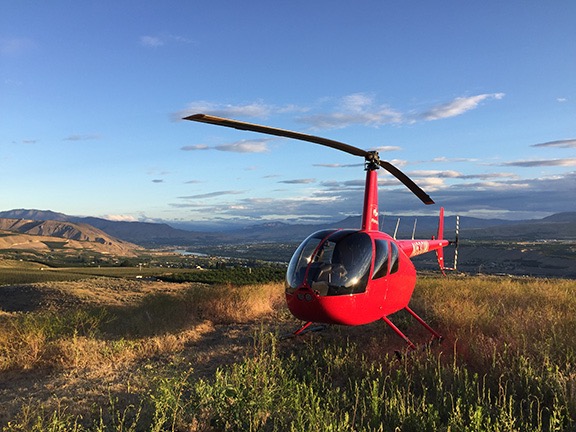
Of course, the beautiful — and I really do mean beautiful — morning light gave me an excellent opportunity to take a few new pictures of the helicopter. If you’re a regular reader of this blog, you likely know how much I value Golden Hour light. And I never get tired of the view from my property.

Flashy lawn ornament at first light.
My Prized Possession — for a Reason
As you might imagine, my helicopter is one of my prized possessions. (My new home is the other one.) Not only did it cost a huge amount of money to buy — and yes, I do own it outright — but it represents a series of achievements in my life:
- writing a few best-selling computer books that eventually funded its purchase,
- building skills to fly it safely as needed for the kinds of flying I do,
- jumping hurdles set up by the FAA to operate it for Part 135 charter flights,
- winning the right to keep it and my other business assets in my ugly divorce,
- building a solid business around agricultural contracts in Washington and California, and
- continuing to operate it as a primary source of income in my third career as a helicopter pilot.
It’s been a long road that started way back in 1997 when I took my first helicopter lesson and won’t end until I retire from flying and sell it to its next owner.
I often think about an airline pilot I was once friends with. He questioned why I would even bother learning to fly helicopters at my age — I was 36 when I started. “You’ll never make any money as a helicopter pilot,” he told me. Although I didn’t intend to make a living as a pilot back then, he turned out to be dead wrong. And I’m glad that I no longer have negative people like him in my life.
But think about how easy it would have been to accept his “expert opinion” and not try to move forward with any kind of career as a pilot. It was a built-in excuse for failure. Why try if this guy who knows the industry better than me says it’s impossible?
How many people do that? How many people simply don’t try because they think the odds are stacked up too high against them?
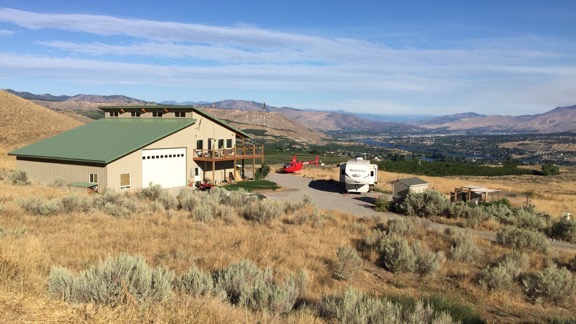
Anyway, as I snapped a few photos from every angle in that amazing first light of the day, I was thinking about this, thinking about what the helicopter means to me. Thinking about what it represents. Thinking about the series of actions I took to get from a 36-year-old who had only been in a helicopter twice to a 55-year-old — unlike other women, I don’t lie about my age — who makes a nice living as a pilot and has a helicopter parked in her side yard with that beautiful view behind it.
I’ve written about a lot of it here in my blog, and I don’t want to repeat it here. This blog has over 2,400 posts from the past 13 years. No shortage of things to read if you want to spend the time.
What I do want to touch on briefly here is the fact that just about all of us have it within our power to make things happen for ourselves.
I’m living proof of that. I’m from a lower middle class family where college wasn’t likely to be an option and got my first job — a paper route — when I was 13. I’ve been working pretty much nonstop since then — although my idea of work these days has little resemblance to the 9 to 5 grind most people deal with daily. (Hey, I was there for eight years and I know what you’re going through. The commute, the office politics, the meetings, the feeling that all you’re really doing is pushing paper. Ugh. Hope yours is better than mine was.)
Everyone dreams of doing or learning something special that’s important to them, but how many people do it? Some try but fail because they don’t realize from the get-go that achieving a difficult goal is a lot of hard work with very long hours and no guarantee of success. It takes planning, it takes funding, it takes the ability to work smart and have Plan B (or C or D) ready when things don’t work out as you expected. It’s easier to not try and to simply keep dreaming.
But do you really want to wake up one day when you’re 56 years old and realize that your life is more than half over and you haven’t achieved what you wanted to? (I think that’s what happened to my wasband; it pretty much caused him to lose his mind in a midlife crisis that went horribly wrong.) We only have one life. Why would you let it go by without at least trying to achieve your dreams?
The Psychology of “Success”
I was in college, in a Marketing class, when I first learned about Maslow’s Hierarchy of Needs. From SimplyPsychology:
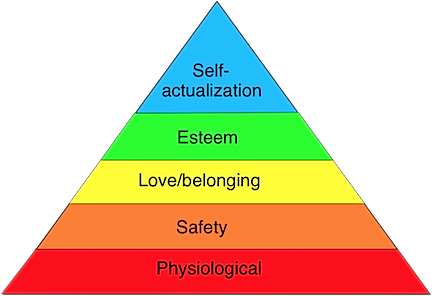
Maslow (1943) stated that people are motivated to achieve certain needs. When one need is fulfilled a person seeks to fulfill the next one, and so on.
The earliest and most widespread version of Maslow’s (1943, 1954) hierarchy of needs includes five motivational needs, often depicted as hierarchical levels within a pyramid.
This five stage model can be divided into basic and psychological needs which ensure survival (e.g. physiological, safety, love, and esteem) and growth needs (self-actualization).
The deficiency, or basic needs are said to motivate people when they are unmet. Also, the need to fulfil [sic] such needs will become stronger the longer the duration they are denied. For example, the longer a person goes without food the more hungry they will become.
One must satisfy lower level basic needs before progressing on to meet higher level growth needs. Once these needs have been reasonably satisfied, one may be able to reach the highest level called self-actualization.
The SimplyPsychology page about Maslow goes on at some length, making it difficult to decide when to end the quote. If this interests you, I highly recommend that you read it for yourself. It’s in plain English and a lot easier to decipher than the Wikipedia entry.
Maslow’s Hierarchy stuck with me since I first learned it. It made so much sense. It almost provides a blueprint for a good and fulfilling life. We are motivated for obvious reasons to take care of our basic needs like food, water, shelter, rest, and safety. Once those have been dealt with, we can move on to psychological needs like friends, relationships, prestige, and a feeling of accomplishment. Once we feel secure psychologically, we can move on to the need for self-actualization: achieving our full potential and realizing our dreams.
I admit that I was a bit put out when I learned this — keeping in mind that I was only 17 at the time — by the notion my professor suggested that once we’d found self-actualization, there was nothing left to motivate us. But since then I’ve realized that self-actualization isn’t the achievement of one thing. It’s the achievement of as many things as we like.
Here’s an example from my life. Since I was a kid, I always wanted to write a book (and have it published). When I was 31, I achieved that goal. So what does that mean for me? Game over? Call it quits? No. There was another goal waiting in the wings to step forward when that had been achieved: to make a good living as a writer. And I had other goals throughout my 20s and 30s and beyond: learn to ride a motorcycle, visit all 50 states (still working on it; haven’t been to Minnesota yet), learn to fly helicopters, manage rental properties (what a mistake that was!) — the list goes on and on. As it should.
Some people think of these goals as “bucket lists.” I’m not a fan of that. I don’t believe in check lists of things that we put off until we’re ready to “kick the bucket.” I believe in doing things now, while we can really enjoy them and learn from them and possibly let them change our lives.
Flying is a good example. I wanted to learn how to fly helicopters since my first ride at age 7. I never dreamed I’d be able to do it, but when I had the time and money to learn, I did. Then I got hooked on flying. I bought a helicopter. I dreamed of being a Grand Canyon pilot and built the experience (measured in flight hours) to qualify. I did that for a season. And before I knew it, I had bought a bigger helicopter and was doing what had to be done with the FAA to build a charter business. Now flying is my primary source of income. Yet when I took my first lesson back in 1997, I never thought I’d fly for a living.
Good thing I didn’t wait until I was collecting social security to take that first lesson, huh?
A side note here: 36 is older than usual to start flying, but not too old. Two of the helicopter pilots who flew with me this season also got late starts as pilots. One of them co-owns a helicopter flight school that has two locations and a bunch of helicopters and employees. The other works for him and just this week has built the 1,000 hours of flight time he needs to get his first commercial pilot job. Both men are in their 40s and have been flying for less than 10 years.
Make It Happen
As usual, I’ve wandered away from my original point. I have so much to say that it’s difficult sometimes to stay focused.
My point is this: we all have the power within us to make it happen.

Back in March 2015, I was interviewed for the Inspired Pilot podcast. This is the brainchild of Marvyn Robinson, a UK-based pilot and IT guy, who interviews pilots with the goal of having them provide inspirational thoughts and information for people who want to learn to fly. It was a real pleasure to share my story. If you’re interested in the path other pilots took, I highly recommend it.
Take care of the needs at the bottom of Maslow’s Hierarchy. Don’t piss away your money trying to satisfy higher level needs until the lower-level ones are satisfied. (Do you really need a Mercedes when a used Honda will do? Prestige is better earned through actions than flashy, expensive possessions, despite what advertisers tell us.) Get and stay out of debt so you don’t need to be a slave to a job or lifestyle you hate. Think about what you really want in your life: a skill, a dream job, a business doing something you love? Do your homework — find out what it takes to meet your goals.
And then turn off the television, get your head out of your phone, and stop wasting time whining and complaining and making excuses for why you can’t succeed. Work hard and smart, keep your eyes on the goal and what you need to do to reach it. You can do it.
The Video
I started this post by explaining why my helicopter was parked in my side yard and what I was thinking and feeling about it as I photographed it from various angles. What I didn’t mention is that I made a video, too.
I tried to put into words what I was thinking and feeling. I always feel a bit awkward about showing off the helicopter. It’s one thing to put a picture of it in action or parked at a landing zone online, but it’s another to actively brag about it and what it means to me. I know that owning a helicopter is beyond the wildest dreams of most people. But I also know that it was once beyond my wildest dreams — go figure, huh? Maybe anything is possible.
The video does get a little personal. I mention my wasband and how sorry I feel for him. I wish I could have done a better job motivating him to achieve his goals, but in all honesty, I could never understand why he would need motivation from me. Remember Maslow’s Hierarchy? I’ve come to realize that I’m more driven than the average person to reach the top of his pyramid, but I didn’t know it back then. To me, the man I spent more than half my life with was intelligent and had or could build the skills he needed to succeed in one or more of his many life goals. I could never understand why he didn’t even try — or why he gave up so quickly when he did. Instead, when I prodded him to work toward a goal — for example, flying more often so he could get the hours he needed to achieve his goal of becoming a flight instructor — he countered with excuses. After a while, I gave up with frustration. I now realize that not everyone is as driven as I am. He definitely isn’t.
Hindsight is 20-20.
Yes, I know that this blog post is addressing a first world problem. Here in the United States, most people don’t have to worry about getting food or shelter or meeting other basic needs. Unfortunately, there is nothing I can do to help those in other nations who are less fortunate than we are. I can only recognize that they are struggling and hope that things get better for them.
That said, please don’t lecture me (or others) here about insensitivity to those less fortunate than we are. Read the Site Comment Policy for more advice about sharing your thoughts here.
The video also assures viewers that we all have it within ourselves to achieve our goals. Maybe I’m being too optimistic? I heard on the radio just yesterday that people in Argentina are starving right now because they can’t get food. And what of the millions of refugees in the Middle East and Africa? Can these unfortunate people ever achieve their dreams? I don’t know. They need to take care of the bottom of the pyramid first. So many people in today’s crazy world do.
But for the rest of us — like the dozens of people who have told me, during flights, that they’ve always wanted to be a pilot but never learned — what are you waiting for? Make it happen!
I did — and I continue to do it every day.