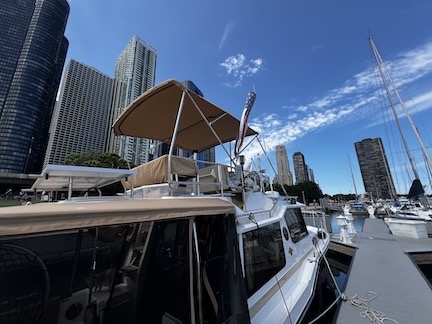
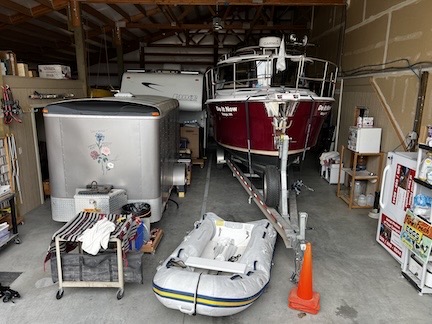
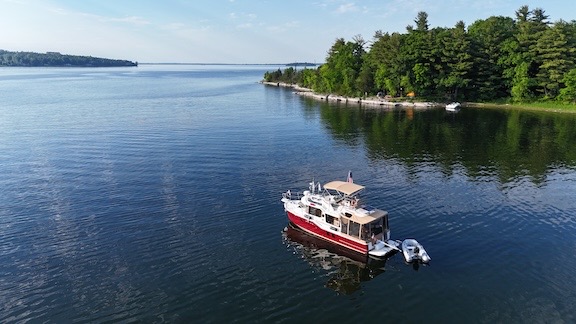
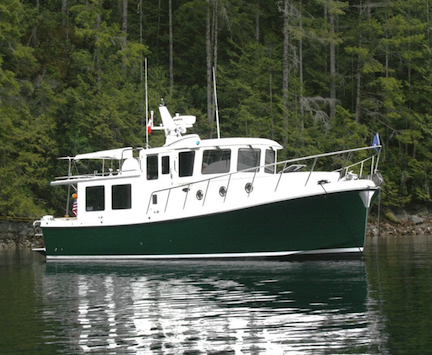
I try to try a new (to me) boat yard recommended by a friend and wind up right where I was last year.
As some readers might know, I’ve been planning to take most of the month of April off from boating. I’ll be driving with my friend Jason to Texas to see the eclipse (if the weather cooperates; it’s not looking good as I write this) and then on to my home in Washington state. We’re driving mostly because I need to get a bunch of stuff I don’t need off the boat, including my Honda portable generator, which I’ve never used on the boat.
The idea was to bring the boat to a yard where they could haul it out of the water, power wash the bottom, and evaluate it for painting. In general, a boat’s bottom needs to be painted every two or so years; the previous owner did it in April 2022 and it has spent 3/4 of the time since then in the water. I like the boat to be pulled at least once a year to check for damage to the hull, prop, rudder, trim tabs, and anything else under the waterline. I’m not expecting to find any damage, but who knows?

Here’s a photo of last year’s haul out. I really love to watch them do this. The boat lift is an amazing piece of equipment.
Plan A
Since Jason was going to join me, it made sense to have the work done someplace near where he lives (in Washington DC) so it would be convenient for him to pick me up. So he recommended the yard he uses, which I won’t name here. In early February, I contacted the owner by email and told him about the work I wanted done which included that haul out and a possible upgrade to my solar power setup to bring my panel wattage from the 160 watts that came standard on the boat to 400 watts. I also mentioned regular Volvo maintenance other than an oil change, which I’ve been doing on my own.
My contact there — we’ll call him John — seemed very friendly and assured me they’d get the work done. He asked me for photos of my current solar setup so he could get his electrical guy to work up a proposal. I waited about a month to send them — there really wasn’t any hurry — and I included more specifics about what I wanted.
I got no response.
I waited a whole week and sent them again. Still no response.
Now the clock was ticking. I’d be arriving in a little less than two weeks. I wanted to make sure he’d gotten the photos. So I called his office on Monday morning. He wasn’t in that day. I left a message with the woman who answered the phone. I didn’t get a callback.
I called again on Thursday morning. Now it was about a week until my arrival. He was out for the morning but would be back in the afternoon. I left my name and number.
John called back at a bad time. I was dealing with an unexpected bad weather situation near the mouth of the Elizabeth River on my way to Hampton. The seas were so bad that I’d decided to turn around and was hunting for a place to duck into for the night. I answered the phone but told him I’d have to call back.
I called back around 5 PM when I was settled into a marina in much calmer water. Had he gotten the photos? He said he had. He said his electrician would be in the next day — Friday — and they’d go over them. I told him that I’d planned to arrive the following week, on Tuesday or Wednesday. I told him I needed the boat hauled out before Friday when I had to leave.
And that’s when the trouble began.
“Well, you know it’s our busy season now,” John told me. “Summer’s coming and everyone wants their boat back in the water. And we probably don’t have room to put yours up on the hard now anyway. So we can put you in a covered slip and get you out of the water when we have an opening in the lift schedule and a place to put you. But I can’t guarantee that it’ll be before Friday.”
I told him that I needed to see the bottom after it was cleaned.
“Well, I’ll send you pictures,” he said. “And then we can get it painted and get the other stuff done.”
He seemed to think that I was going to approve a bottom painting without actually seeing the boat bottom with my own eyes.
I should add something here. I don’t know what kind of paint the previous owner used on the boat bottom. There are some very good paints out there that can last up to 5 years. The boat bottom looked great when we pulled it out last April and it looked just as good when they put it back in the water in October. There’s probably a 50% chance that it won’t need to be painted at all. Could I trust this guy to give me an accurate evaluation of the boat bottom instead of just painting it and charging me for that work?
As a friend of mine used to say, “I was born at night, but it wasn’t last night.”
I was walking a fine line here and I knew it. I didn’t want to piss him off by being “a pushy woman from New York.” And at that point, he was my only option. So I said, “I really thought we’d be able to get the boat hauled out while I was there. I got in touch with you about dates back in February so you knew I was coming next week. Jason speaks very highly of your organization.”
And then he said, with a little laugh, what I suspect he thought was funny: “Well, we have a lot of people fooled. Our yard has 200 boats belonging to people who use our services.”
“I can see that you’re very busy then,” I said, not knowing what else to say.
“Why don’t you call me when you know exactly what date you’ll arrive?” he suggested. “I’ll see what we can do. But at this point, I can’t guarantee the boat will be hauled before you leave.”
We ended the conversation there. I put down my phone and started working on Plan B.
Plan B

By the time my plans were set, I’d traveled nearly the entire length of Chesapeake Bay, from the mouth of the Elizabeth River near Hampton and Norfolk, VA to Kent Island near Annapolis, MD. In three days.
I had to go through Deltaville, VA on my way north. My friends Kenny and Rhonda had their boat hauled out at a yard in Deltaville back in October. In fact, I’d been in Deltaville when they were there, staying at a marina nearby. I’d stopped by to visit them. Their enormous Katy Krogan was sitting on blocks in the yard with Kenny bustling around under it to prepare for a bottom painting.
Kenny and Rhonda are full-timers who live on their boat. They spend the winter at a marina they like in Jacksonville — I visited with them there in February — and spend the rest of the year cruising. I met them in autumn 2022 when I started the Loop; they were Looping that year. Last summer, they cruised to Canada and back through the Champlain Canal and down the Atlantic coast and ICW.
They love that boat yard in Deltaville and that’s where they always bring their boat when it needs work. So I texted them and asked them about it. I got the marina name and called on Friday, the day after I spoke to John.
I spoke to a woman named Stephanie who was very helpful but not sure they could meet my time constraints. Maybe on Thursday or Friday, but she wasn’t sure. She’d have to talk to the guy who ran the shop, but he was out at the moment. She’d get back to me.
She didn’t call back that day.
The next day was Saturday. I called in the morning, after 9 AM, and wasn’t surprised that it went to voicemail. Most of these boatyards are closed on weekends. I left a message.
I was in Hampton, VA that day. I had a good weather window the next day, Sunday, to start my trip up Chesapeake Bay. I made reservations at that same Deltaville marina I’d stopped at in October. I arrived midday on Easter Sunday.
I couldn’t do anything, of course. The clock was ticking. By midday Friday, I needed to be in Jason’s truck heading to Texas. That gave me less than 5 days to make arrangements with the yard, get the things I wanted off the boat packed, clean the boat, get it hauled out, get the bottom cleaned, and get a knowledgeable person to look at the bottom paint and condition with me. I was running out of time.
And that’s when I started thinking about Plan C.
Plan C
Plan C was radical. It meant taking my boat all the way up to Kent Island near Annapolis, which is where I’d had it hauled out last April. It was 100 nautical miles from Deltaville. On Chesapeake Bay. Last year, it had taken me three days to get there from Deltaville. Could I do it in just two?
And could they satisfy my time constraints?
At 8 AM on Monday morning, I was on the phone with another Stephanie, this time at Seven Seas Yachting Services. Of course she remembered me. I told her what I had in mind. Could they haul out the boat, wash the bottom, and take a look with me before midday Friday? And, if it needed painting, get that done sometime during April? She looked at her schedule. Yes. I told her I’d get back to her.
I spent an hour thinking about it. I talked to Jason. He said to do whatever I thought worked best. I talked to the guy who ran the marina where I was parked. He seemed to think I should use the local guy.
In the end, it all came down to me.
The easy, lazy way was to make sure the Deltaville yard could handle my time constraints and just stay there. I’d have a few days to prep the boat at a nice marina where I could also do laundry and get miscellaneous chores done. A dog-friendly place where my pups could run around. It was easy. But it was also a much longer drive for Jason and we’d probably have to start our trip to Texas on Friday right from there.
The trip to Kent Island would not be easy. Weather was moving in. It would be iffy for the next two days and then bad on Wednesday. Chesapeake Bay is a large body of water that can get mean. My boat can handle more than I can, which is nice, but I really don’t like long days of cruising with the waves tossing me and my dogs and everything in my cabin around.
But the other benefits of Kent Island were this:
- I knew the yard and I knew the level of service I could expect. They would treat me like a valued customer. I also really liked their Volvo guy and liked the idea of him doing work on my engine.
- I was a much shorter drive for Jason (although it was in the opposite direction of Texas). But I knew Jason wanted me to come back to DC with him and it would be possible from Kent Island.
- I would have a networking opportunity with the folks at Pocket Yacht. I’m hoping to work with them as a licensed boat captain to train new Ranger Tug owners and help them move boats.
- I would have a networking opportunity, with Jason, to reconnect with Sam, another boat captain I’d met in Belhaven in April 2023. I was hoping Jason could get some boat captain work with him moving larger boats. And I owed Sam and his wife dinner.
- I would be 2-4 days closer to Baltimore, where I had a potential three day training gig with a new Ranger Tug owner. He was hoping to get training as soon as possible and wasn’t happy about having to wait until I returned to the boat in May.
Another benefit popped up later that day when I realized that the AIS transmit feature of my Garmin Black Box 800 unit was not functioning. I’d had that installed by the Pocket Yacht guys at Kent Island and could probably have them fix it while I was there.
As you might imagine, I decided to go to Kent Island.
Going the Long Distance
I got under way from Deltaville at 9 AM on Monday morning, leaving that nice comfy marina behind. I called Stephanie at Deltaville to tell her I’d made other arrangements right after getting the boat on course. She sounded surprised; maybe she’d forgotten all about me?
I covered about 50 miles before the Bay decided to toss me around a little more than I wanted to be tossed around. The weather also kept me in fog with 1/4 to 1 mile visibility so I had no sight of land for about three hours. Solomons, MD was the only real option for relief, so I ducked in there and spent the night at a marina.
I emailed John to tell him I’d made other arrangements and would not be bringing my boat after all. I told him it was important for me to see the bottom of the boat before I approved any work on it. I also told him that his comment about having lots of people fooled did not instill confidence about his organization in a new customer. He sent me a rather haughty reply that I deleted. I was done with him.
I got under way again at about 7 AM today. I’m not even sure the sun was up. It was totally overcast with enough of a breeze to keep the Bay choppy and the fog off the water for most of the trip. I stopped for fuel and a pump out at Knapps Narrows, which required me to navigate two narrow, shallow channels, get through a drawbridge, and dock with (instead of against) a current. Wind-driven waves made the last 15 miles to Kent Island pretty rough — rough enough that I had to zigzag into the channel to Crab Alley just to keep the 2-foot waves off my beam.
At Kent Island
It was about 11:30 AM when I was safely and securely tied up at the dock.
I went in to talk to Stephanie, who looked genuinely glad to see me. “Did you want to be hauled out today?” she asked, looking uncertain.
“I need a day to prep and pack the boat,” I told her. “Thursday would be my perfect world date.
She looked at her schedule. “Thursday would be perfect for us, too,” she told me. “We’re putting some boats in the water that morning so we can haul you out in the afternoon. And then there would be room to get your boat into the yard.”
It was exactly what I wanted.
After spending the past week stressing over my haul out plans and traveling in sometimes rough conditions, I could finally relax. I was in good hands.