Photo/Video Flight: Parker 250

A last minute gig turns out to be a fun little adventure — that pays.

I was sitting at my computer at 1:15 PM on Friday, scanning and shredding documents for my paperless filling system, when the phone rang. Caller ID said it was Barry. I couldn’t remember who Barry was, but knew we’d been in touch in the past — hence his number in my phone’s address book — so I answered it with my professional voice: “Flying M, Maria speaking.”

Barry had the foresight to remind me who he was when he identified himself. He’s another helicopter operator out of Falcon Field in Mesa. I’d done a video gig for one of his clients back in 2009. He was supposed to use his Bell 206B JetRanger to do a video flight with a regular client out at the Parker 250 off-road race the next morning. Unfortunately, the JetRanger was due for scheduled maintenance and his 206L LongRanger was just not right for the job. Was I available to go out there today for a shoot starting at dawn?

The first time I flew the Parker 425 was in 2008. All of the aerial footage in this video was shot from my helicopter.

I’d been to Parker to shoot the Parker 425 several times in the past. It’s a weird little town at the edge of the Colorado River Indian Tribes (CRIT) reservation that attracts mostly snowbirds. There isn’t much there beyond a Casino resort and a Walmart. The airport is owned and operated by CRIT. Hotel accommodations in the area are limited, especially when there’s a race in town.

Lodging was my first concern. I’d stayed in some pretty crappy places there. Places so bad, I told myself that a sleeping bag in the airport terminal would be better.

“It depends on if I can get a place to stay,” I told him.

He laughed almost nervously. “Well, the clients have rented a house. They were going to give me and the pilot our own room to share. You can have that room.” He hesitated and then added: “It would be private.”

“Ground transportation?”

“Call them when you get to the airport and they’ll pick you up. The only thing is, you need to get there by 5 PM because that’s when the airport closes for fuel.”

I consulted my watch and did some quick calculations. If I left my house at 3 PM, I’d have plenty of time to load and prep the helicopter and get to Parker before 5. I thought about what was going on at home: nothing. With my soon-to-be ex-husband out of the picture, I wouldn’t have to deal with his disapproving glare and whining complaints when I told him I had accepted an overnight flying gig. (Even if I invited him to come along, he’d use it as an example of how I always do what I want — ignoring the fact that flying for hire was how I earned my living and I needed to take jobs when they came up.) The only question was Penny the Tiny Dog, and I did have several options for dealing with her.

“Sure,” I told him. “I can do it.”

“Great,” he said, sounding relieved. “Let me get them on the phone and confirm that it’ll work for them. I’ll call you back as soon as I get a green light.”

Prepping for the Trip

I hung up and called Bar S Animal Hospital. They’re our local vet and they do animal boarding. Penny’s stayed there twice. Yes, no problem. They could take her. I told them I’d be there by 3.

Then I pulled out my overnight bag and packed a change of clothes, including warm layers for the dawn flight. It would be around 31°F in Parker at dawn and although I planned to have just the door behind me off, I knew it would get cold in the helicopter. I didn’t want to repeat the previous week’s shivering cold flights.

I gathered together Penny’s stuff: her bed, a toy, and a bone. She knew something was up, but I played it cool and she lost interest.

Barry called again. He said he’d left messages for the clients. We talked money. He told me what to charge; it was slightly more than my regular rate. He didn’t want a cut. He was just glad I could do the work. He didn’t want to let the client down. I told him I was going to jump in the shower but I’d be expecting the launch call.

The call came after I was showered and dressed. It was one of the clients. He told me to come on out and give him a call when I got to the airport. As easy as that.

The Flight to Parker

A while later, around 3 PM, I was at Wickenburg Airport, prepping the helicopter. I’d dropped Penny off and prepaid for her stay. I preflighted the helicopter in the hangar, out of the cold wind that was blowing across the airport. I loaded my Bruce’s Custom Covers door storage bag and the rock climbing harness I offer photographers who want better range of motion than a seat belt allows. Then I tossed in my overnight bag and leather jacket, closed everything up, and dragged the helicopter out to the ramp.

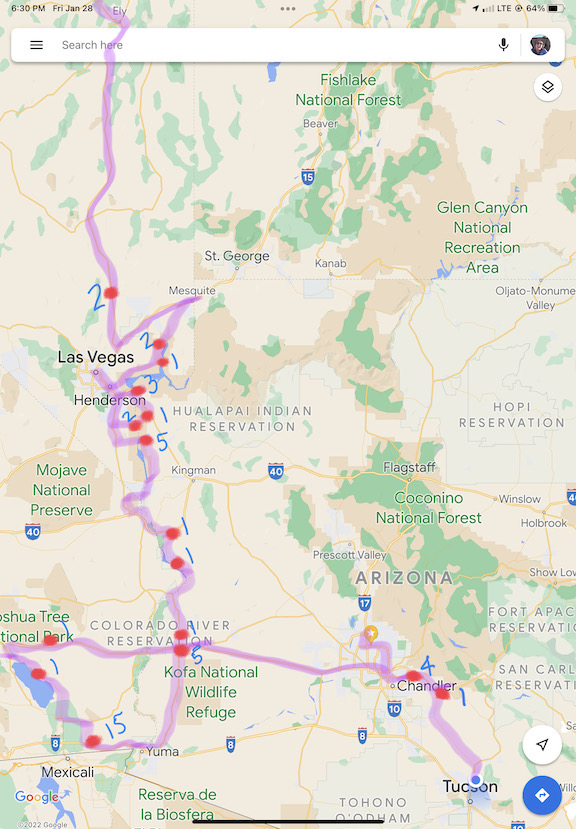
My route to Parker
My route here to Parker. Click here to access an interactive map.

By 3:35, the hangar was locked up and I was airborne, heading due west. Despite the wind, the flight was quite smooth. I headed toward Cunningham Pass, which cut through the Harcuvar Mountains, and then made a beeline to Parker. There was a whole lot of empty desert along the way — I flew over only 2 paved roads on the 74 NM flight. My only detour was to drop into the dry wash along the race route where folks had set up RVs to observe the race. I flew low level past them, returning their waves and smelling the burning wood of their campfires.

Typical Parker 250 Campsite
A typical Parker 250 campsite out in the desert. This was shot on raceday; the track is on the right, down in the wash.

There was a plane turning final as I crossed the runway at Parker and set down on the ramp. I shut down and pulled out my step stool and blade tie-downs. It was about 4:30 PM. I figured it would probably be a good idea to place a fuel order before I settled down.

Fuel Woes

P20toHII
Although it’s tempting to follow the river, the fastest route between Parker and Lake Havasu City is over the mountains.

And that’s when I was reminded how badly the FBO at Parker airport is managed. There was just one person in the office: a woman who claimed to be a secretary. She told me that everyone else had gone home with the flu. There was no one to drive the fuel truck. No, I couldn’t drive it for her. And no, I couldn’t use the self-serve island. If I wanted fuel, I’d have to go to Lake Havasu City.

Lake Havasu City was a 26NM flight that would take me about 15 minutes. Each way. I called my client and told him what was up. I needed fuel for the next day; there was no doubt about that. I told him I’d be back in 45 minutes. Then I re-stowed all my gear, started up, and headed north.

Mountains South of Havasu
A shot of the mountains I had to cross on a direct path between Parker and Lake Havasu City. I shot this with my iPhone from inside the helicopter; pardon the glare.

Lake Havasu
Lake Havasu City, shot from the air south of town; pardon the glare.

My route took me over some pretty rugged mountain terrain that was beautifully lit in the late afternoon sun. Once over the mountains, I had a clear view of Lake Havasu and the city beyond it. Compared to Parker, it was a thriving metropolis. I sped past London Bridge and covered the distance between town and the airport quickly. Since it was getting close to 5 PM, I called ahead to make sure a fuel truck would be available. Desert Skies, the excellent FBO there, told me to look for the truck. When I got close to the ramp, I saw it and landed nearby.

The fuel guy must have sensed my urgency, because he pulled into position as soon as my blades stopped. I helped him by grounding the aircraft and moving his stepladder for him. He gave me a ride back to the terminal to pay and I took the opportunity to use the ladies room. Then I was done, heading back to the helicopter, winding it back up, and heading south to Parker again.

No Fuel
This sign was on the Pilot Lounge door when I returned to Parker from Havasu.

I touched down exactly 45 minutes after talking to my client. The sun would set in about 10 minutes.

I figured I had 2-1/2 hours of fuel on board before I’d have to go back to Havasu for more. And when I saw the sign on the pilot lounge door, I realized that CRIT would not be providing fuel the next day.

The Frat House

N630ML in Last Light
Here’s my helicopter parked on the ramp at Parker just as the sun was setting.

I had the blades tied down and was waiting outside the airport fence with my overnight bag, leather jacket, and bottle of oil (to keep warm overnight for easier pouring in the morning) when my client pulled up in a big, black van with vanity plates. I climbed in back with three members of the video crew, including the videographer I’d be flying with the next day. They all introduced themselves and I almost immediately forgot their names. (I am so bad with names and faces.) We drove to the house they’d rented in a small gated community on the Colorado River upriver from Parker, making one stop along the way.

The house was on a little canal with access to the river. It had four bedrooms, one bathroom, and a great room. A patio out back on the canal had a barbecue grill, table, chairs, and stairs down to the water. I asked where I’d be sleeping and was offered a small bedroom with a large — maybe California King? — bed, large closet, and television. There were teddy bears on the night tables. The bed was rumbled and I suspected someone else had slept in it the night before.

Turns out the house was owned by snowbirds who, for $2100/weekend, would vacate and rent to groups. Apparently most of the homes in the neighborhood were handled the same way; at least five of the race crews were camped out in nearby homes. Although the owners cleaned out most of their personal possessions, possibly locking them up in the garage and behind one locked door, there were still a few weird items around — like the teddy bears.

The group quickly expanded to eight guys ranging in age from around 20 to 50. They all wore black shirts, most of which had the company logo on it. They were nice guys and all introduced themselves to me. After a quick discussion about dinner, four of them took off in the van to pick up groceries. The rest of us sat around drinking beer or bottled water and eating Fritos and Ruffles chips.

No need to go into details on the evening, but I do recall thinking that this was the closest I’d ever get to living in a frat house. Somehow groceries got organized and beer got put away in the fridge. Burgers and brats got cooked, buns got toasted, and tubs of macaroni and potato salad got served out. My contribution was slicing the tomatoes and a red onion. I had a bratwurst with lots of mustard and some macaroni salad. I also polished off half a bottle of wine.

More guys showed up — this time from my client’s client — and I could tell they were trying to figure out where the only woman fit into the puzzle. When I introduced myself to one of the race team guys as the pilot, he nodded thoughtfully and looked around for the pilot, obviously thinking I said that I was with the pilot. Then his eyebrows rose and he looked at me. “You’re the pilot?” he asked. “The helicopter pilot?” I nodded and admitted that I was.

The Frat House
Here’s an iPhone 5 panorama of the “frat house” with most of the folks who showed up for dinner.

There was a lot of chatter about the next day’s plan. I’d be working with the videographer, who worked with a handheld RED camera, and a still photographer. When I told them I preferred the videographer to sit behind me so that I could see the car we were chasing, they agreed it was the best way to go. The photographer would sit on the opposite side of the helicopter and get his shots after the videographer was satisfied. We agreed to leave the house at 6:30 so we could be in the air by the race start time of 7:15 AM.

Somewhere along the line, they let me know that they might need me on Sunday, too. It all depended on whether their main target vehicle survived Saturday’s race. Was that okay with me? Although I was hoping to get home on Saturday early enough to rescue Penny from boarding, I was certainly not opposed to making a few extra bucks on a second day of flying. (Again, it was great not to have to call a hostile spouse to get approval.) So I told them it was fine with me.

I disappeared into my bedroom at around 10 PM. The guys were still talking loudly and the walls were paper thin. I was lying in bed, reading before shutting off the light when the crowd started thinning out. The house was quiet when I went to sleep.

The bed was comfortable and I slept well.

In the middle of the night, I woke to hear someone snoring next door. The walls were very thin.

Rise and Shine

I was up at 5 AM and figured I’d take the opportunity to use the bathroom before it became in high demand. It was weird to see an empty beer bottle on the vanity.

Frat house.

By 5:30 AM everyone was awake and stirring. About half of the guys had slept in the living room, sprawled out on sofas and an inflatable bed. Without blankets. But they were in remarkably good spirits. I suspect they’d dealt with worse conditions in the past.

I spent about 10 minutes cleaning up beer bottles, plates, and other garbage from the day before. I filled two trash bags. I considered loading the dishwasher but decided that would be too much like being a den mother. Let them deal with that.

They had excellent instant oatmeal cups with nuts and fruit and a coffee maker that I couldn’t get to work. I used the coffee maker that came with the house to brew a pot of Folgers. Only three of us drank it. There was no milk. By 6:10 AM, everyone was out of the house except the three of us who’d be in the helicopter.

I packed up all my things. I wasn’t sure whether they’d need me Sunday and I didn’t want to leave anything behind in case they didn’t. After all, while the race was going on, there was no way for me to get back to the house. Best to have my overnight bag with me.

It was dark when we stepped out of the house at 6:30 AM. Sunrise wasn’t until about 7:45. We weren’t sure why they expected us to be in the air when the race started a full half hour before sunrise. Although the RED camera could handle low light, our six target UTVs wouldn’t be starting until after all the motorcycles and ATVs had left. Still, we went to the airport and I prepped the helicopter for flight.

It was also cold. About 30°F.

I took care of the oil first, worried that it would get cold and thicken back up. Then removed the blade tie-downs. Then did a preflight inspection with a flashlight. Then removed two doors and put them away. And finally set up my GoPro nosecam.

I was disappointed about having to use the nosecam instead of the skidcam, but that was my fault. Although I put the RAM mount piece on the skid, I left the remaining mount components, including the GoPro housing, at home. So I couldn’t assemble the skidcam, which would have given me the same view as the videographer. Instead, I hooked up the nosecam with the remote back and set it up to turn it on/off with my iPhone in the cockpit. I’d shoot 1080p video until the SD card filled or the battery died.

The Flights

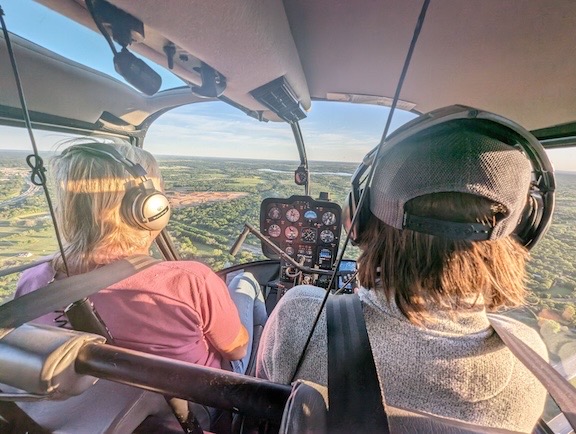
We were airborne by 7:15, with the videographer behind me and the still photographer beside me. The starting line was less than a mile from the airport, so we were there within seconds. I circled and we looked down at the action. The motorcycles were leaving, 30 seconds apart. It would be at least 15 minutes before our target vehicles left. We went back to the airport and sat idling on the ramp for a while.

When we took off to check again, the motorcycles were almost done starting, but the ATVs were behind them. We went back to the airport and shut down. No sense burning fuel we’d need later.

Barry called. We chatted about the job. I told him about the fuel situation and the possibility of a second day. He was as bugged as I was about the fuel and apologetic about the second day. “No worries,” I told him. Everything was under control.

One of the video crew members advised us that the target vehicles would likely be off the line in 30 minutes. We all got out to stretch our legs. The local medevac guy showed up and chatted with us. The King Air they fly turned up a while later and he got busy. By that time, we figured it was worth another try so I started back up and we launched again.

We spent about 10 minutes circling the starting line, waiting for them to launch the UTVs. They apparently waited more than just 30 seconds between the last ATV and the first UTV. The two camera guys got shots of the non-action.

Starting Line
The starting line with the UTVs lined up and waiting to go.

Our main target was about 10 cars back, but another target was first in line. When they released him, we took off after them. It was finally showtime.

Chasing desert racers is my absolute favorite kind of flying. I’m out over the mostly empty desert so I don’t have to worry about low flying causing a hazard to people or property on the ground. Although there are wires in the area, I quickly learn where they are. I focus on the vehicle and the instructions from my client. My goal is to get the helicopter into position for whatever kind of shot the videographer needs — without doing anything that could get us killed.

And when the vehicles are moving fast, I can get a pretty good rush.

We began in a 200-foot hover beside the starting line with the car on the videographer’s side of the aircraft and his camera focused on it. Then, when it was released, I pivoted while it made the first turn and then pushed the cyclic forward gently to get some forward movement. Without adjusting the collective, we began a descent, gathering speed along the way. When we were about 100 feet off the ground, I pulled pitch to arrest the descent while maintaining speed. And then I just chased the car, matching its speed, pulling in front of it or behind it as instructed and crabbing, if necessary, to give the videographer the best shot.

My focus was absolute; I was the autopilot. I wasn’t thinking about all the divorce crap that has been fucking up my brain for the past eight months. I was just thinking about the vehicle I was chasing, the instructions from the videographer, and the wires I knew were up ahead. The helicopter was an extension of my mind and body. It did exactly what I needed it to, without me having to give it much thought at all.

I was in the zone.

We chased that car for a while with it on our right side. Then, when the videographer was done, I popped over the top of the track and put the car on our left side for the still photographer. He got a bunch of shots. When he was done, I pulled up and around to go back for the next target.

Chasing Cars
We’re chasing the car behind the one in this nosecam image. You can see the dust kicked up by the motorcycles and ATVs ahead of us on the track hanging low over the desert.

Turning
It’s not unusual to bank 45° to 60° at 50 knots or more while turning to pick up the next target. This is really aggressive flying, but done with smooth control inputs, the R44 handles it admirably. In this shot, we were probably 50 to 100 feet off the desert floor.

We did this repeatedly, one target after another. We found the first four targets without trouble and spent most of the time with the main target, shooting it from all kinds of angles. My clients really liked the look of the shots toward the sun where the dust was really illuminated. I did a lot of crabbing, hovering, and pivoting. The wind was calm and the air was cool so performance was not an issue at all — even with three of us on board and nearly full tanks of fuel. The same flying on a 90° day would have been impossible with our load.

Down in the Wash
Again, we’re chasing the car behind these. A good portion of the track runs in dry washes like this one.

Little by little, we made our way down the 80-miles of the track: flat desert, dry wash, more flat desert, powerline road, more flat desert, deep canyon, and more flat desert. The GoPro battery died less than an hour into the flight — I think that remote backpack drains the main battery because I know it was fully charged when I put it on the helicopter — so I don’t have any footage from the more interesting segments of the track.

Wires
I did mention the wires, right? The track follows these powerlines to the edge of a wash and then dives down into the wash. It’s tempting to follow the vehicles down, but the wires don’t go down at the same angle, so you need to stay high to clear them when making the right hand turn.

Track Log on a Map
Here’s the actual GPS track from our flight. You can also view an interactive version of this with photos.

We hopped from one vehicle to the next, back and forth on the track. Our main target vehicle broke an axle or something while we were videoing it; we got footage of the team getting out to check the damage. Another one of our targets got a flat tire; we captured one team member changing it. We picked up the last two targets on the return side of the track. We followed one of our targets — which turned out to be the leader — all the way into “the python,” a segment of track that winds around a sandy area near the airport, complete with banked curves and jumps.

And then we were done. The Hobbs meter showed I’d flown exactly 2.5 hours.

Warming Up, Heading Out

I flew back to the airport, which was only about a mile away, and landed. We fetched the doors and my overnight bag from my clients’ car and they prepped to move on to their ground base somewhere along the track. I locked up the helicopter and they dropped me off at McDonalds on their way out.

I got the last breakfast order in and took my food and orange juice to a booth in a sunny window to warm up. I made a few phone calls. I relaxed. Then I went back to the helicopter, which was parked facing south, and relaxed in the pilot seat, reading on my iPad. The cockpit was warm and cozy.

I realized how nice it was to just take it easy without having to be anywhere or answer to anyone.

A jet came in. The jet pilots came by to chat with me. Their passengers arrived at 1 PM — the same time I got a text from the client decision maker. They would not need me on Sunday. I was released.

I didn’t waste any time getting the helicopter started. A few minutes later, I was heading northeast along the Colorado River to Lake Havasu City. I’d have to refuel before heading back to Wickenburg.

While I waited for the line guy to fuel, I went into the BBQ place next to the FBO and got some ribs to go. I settled my bill at the FBO and walked back to the helicopter, swinging my take out bag beside me.

It was then that I suddenly realized that I really love my life. That’s something I need to blog about soon.

I checked the oil and the fuel caps, then climbed into the helicopter and started up. I was munching fried okra and sipping iced tea when I pointed the nose east for the 86NM flight back to Wickenburg. It was a long flight over remote terrain — I’d only cross two paved roads and one tiny settlement (the Wayside Inn) along the way. I’d be there 50 minutes later.

I put the helicopter away and pulled all my gear out of it. I totaled the billable flight time: 5.2 hours. Not bad for an unexpected, spur-of-the-moment gig.

I stopped at a friends hangar and spent some time chatting with a few people there. Then I fetched Penny and we went home. It felt good to get a hot shower and relax with a glass of wine in front of the fire.

Return to Lake Powell

On what’s likely to be my last aerial photo gig here.

Penny wearing Earplugs
Penny with makeshift earplugs. They lasted about five minutes before falling out.

I flew my helicopter up to Lake Powell late this morning. With me for the ride (and the few days to follow) were a friend and Penny the Tiny Dog.

The Backstory

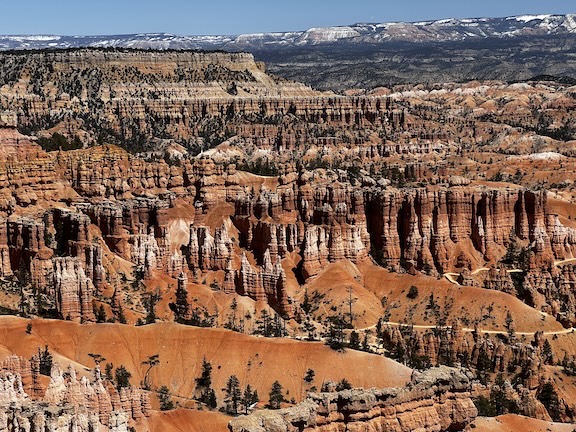
Way back in June, one of my good clients, Mike Reyfman, had booked three days of aerial photo flights with me starting January 1. He leads photo excursions for Russian photographers in various places throughout the world. I’m his Arizona/Utah helicopter pilot. I’ve flown for him on about a half dozen gigs since 2004: Lake Powell, Horseshoe Bend, Monument Valley, Goosenecks, Shiprock, and Bryce Canyon. Jobs last 2 to 7 days and involve 8 to 20 hours of flying. It’s good work not only because of the number of revenue hours I can fly, but because it takes me to some of the most incredible scenery in the southwest.

I had mixed feelings about the job. I wanted to go to Lake Powell again; it had been over a year since the last time I was up there. I own a hangar at the airport — purchased back when it looked as if I might do seasonal tour or charter work there — and I wanted to sell it. I needed to take a peek inside to see what the tenant had in there and then meet with a Realtor to get it listed. I also wanted to see the lake again. Over the past eight years — since buying my R44, in fact, I’d flown at least 200 hours at the lake, covering its length from the Dam to Hite at least a dozen times and even going as far as Canyonlands National Park two or three times. I’d worked with a video crew to make an aerial tour of the lake and was ripped off by the filmmaker, who disappeared with $26K of my money, leaving me with a hard disk of mediocre raw video and a hard lesson learned. (And no, I’m not interested in discussing this.) There’s no arguing that Lake Powell is one of the most beautiful places in the Southwest and the best way to appreciate that beauty is from the air.

But, at the same time, I was leery of winter photo shoots. Back in February 2011, I’d gone to Bryce Canyon for a 360° Panoramic photo shoot with this same client. A snow storm and cold weather had delayed our flight and made it damn near impossible to get the helicopter started when we were ready for the shoot. It required a gas-heater and generator under the helicopter’s engine compartment to warm the engine enough to crank it. The delay meant we couldn’t get out at first light as originally intended. When I checked the weather and saw freezing temperatures forecasted for dawn and dusk at Lake Powell, I remembered the Bryce Canyon problems and began worrying about a replay. Although my helicopter has a primer, no amount of priming will start that engine if it’s too cold. I also remembered another January photo gig up there and how cold it had been in flight. Those guys had kept me flying for about 3 hours — I even had to land for fuel at Cal Black Memorial halfway up the lake from Page. It was so cold that the back seat photographer had given up shooting and was leaning away from his open door as far as he could in an effort to keep warm. I never did like cold weather.

All of these thoughts were going through my head when I contemplated the job. But a revenue flight is a revenue flight and I had the possibility of being paid for 10 hours or more of flight time over four days at one of my favorite destinations. After losing at least $10K of revenue in Washington due to my early return, my inability to concentrate enough for writing jobs, and the huge sums of money I was paying my legal team to help me protect my business assets from the greedy, cheating liar I’d married six years before, I could really use the cash. So I convinced myself that I was glad about the work and prepped to make the trip.

Getting There

We flew up there around midday on New Year’s Day. The conditions were remarkably good. I’d flown through unforecasted low visibility and snowstorms on my way from Wickenburg to Winslow the day before, but there was none of that on Tuesday. The flight went well and I got a chance to show my companion even more of Arizona’s remote scenery from the air. This post with video gives you an idea of what we saw, although we weren’t flying from Phoenix so the actual route and views differ. (We got to see Sedona on our flight the day before.)

After a brief tour of Horseshoe Bend, the Glen Canyon Dam, and Wahweap Marina for my friend, we touched down at Page Municipal Airport. The folks from American Aviation were out to the helicopter with a van before my blades had even stopped spinning.

Penny Lounges in the SunPenny lounges in the sun under the desk in our hotel room.

We grabbed the rental car I’d arranged for, stopped at Stromboli’s restaurant for a huge calzone to share, and checked into the Days Inn hotel. The pet-friendly room was clean and well appointed with a king-sized bed, refrigerator, desk, free (and fast) wifi, and a sliding door that made it easy to take Penny outside. Best of all, it was on the south (sunny) side of the hotel, so the afternoon sunlight streamed in through the window, giving Penny that patch of sunlight she always seems to enjoy.

First Flight

A while later, I was back at the airport. I had to prep the helicopter for the afternoon flight. That meant removing the two passenger side doors, adding a quart of oil, and laying out the life jackets. I make all my passengers wear flotation devices during photo flights over the lake. In more than a few places I fly there, an engine failure means a swim. I didn’t want anyone drowning because they couldn’t find or put on their life jacket.

Back in the terminal, Mike arrived with his group. He took one look at me and said he was seeing only 2/3 of me. I told him I’d lost only 20% of my body weight, not a third. I had already told him in email that the reason I had to lose weight was because he kept gaining it.

I gave his group a safety briefing. After each topic, Mike translated what I’d said into Russian. About half the group spoke some English and about half of those spoke it well.

I took the first group out to the helicopter: two photographers and a passenger. Normally, I won’t do a photo flight with three passengers on board, but the helicopter performs magnificently in cold weather, so it wasn’t an issue — even with nearly full tanks of fuel. They all climbed on board and I made sure they were strapped in. Then I started up the engine, warmed up, checked their seat belts one more time, and took off.

Mike’s instructions had been specific: start with Horseshoe Bend, which is near the airport. Then head uplake to Reflection Canyon, the San Juan Confluence, and an odd canyon I call “Canyon X” because of the way it looks from the air. Then back down lake to Padre Bay and Alstrom Point for a look at Gunsite Butte. So that’s what I did.

Oddly, when I first took off, I felt a bit hazy about the locations of all these points. It wasn’t until we were heading uplake, past Tower Butte that it all started coming back to me. Mostly it was the reporting points the tour pilots used. I’d learned these points so I understood where they were when they made their calls. I also used them so I could tell them where I was. Tower Butte, Padre Butte, Gregory Butte, Rock Creek, Dangling Rope, Rainbow Canyon. That’s as far as most of the tour planes went. I went a little farther, to the confluence.

Boundary Butte
At 3:56 PM, we were just passing the north end of Boundary Butte, heading uplake.

I flew uplake at about 5500 feet staying mostly over the river channel. The air was mostly calm and the water was glassy smooth in more than a few places, creating amazing reflections of the red sandstone cliffs. Just past Gregory Butte, the wind picked up a bit, ruining any chance of reflections on the lake surface.

I reached Reflection Canyon — poorly named, in my opinion, because I’ve overflown it at least 100 times and have seldom seen any reflections there — at 5500 feet. I began a slow climb as I flew a racetrack pattern around the canyon, spiraling up in altitude. Our next destination was the twisting course of the San Juan River near its confluence with the Colorado and that was best viewed from 7000 feet or higher. When my photographers were finished with Reflection, I moved on to the San Juan and began circling it, spiraling up to 8500 feet as I circled it twice. Off in the distance, I could see the buttes in Monument Valley.

It was cold. The outside air temperature (OAT) gauge said -9. That’s -9°C, of course, or 15°F. I was wearing a pair of jeans and a long sleeved shirt under my leather jacket. I had a scarf and thin wool gloves on. Every part of me was cold. I hunched over the controls, trying to use my body to keep my body warm. I wasn’t succeeding. At times, my teeth chattered.

After the San Juan, I took them around Canyon X. Then we headed back toward Padre Butte. I was flying almost directly into the sun. I had a baseball cap on to offer some protection from the sun’s glare, but it didn’t help much. I kept at 6000 feet so I wouldn’t have to worry about flying into any buttes or canyon walls along the way.

East Side of Padre Bay
The east side of Padre Bay, shot from my helicopter’s nose cam from the south.

My passengers wanted to see the northeast side of Padre Bay, so we flew there first. I took them past Cookie Jar and the pockmarked rocks around it. There were some nice views of the canyon walls on the east side; my nose cam even got a nice shot. By the time we got to Gunsite, the sun was very low and the light had faded. The view wasn’t much to get excited about. My passengers had enough and we headed back.

We touched down at 5:20. The fuel truck was waiting.

Thawing Out

I was frozen solid. Or at least I felt as if I was. My right hand, which had been clutching the cyclic in a death grip, was probably the worst. I was shivering almost uncontrollably. I threw the doors back on the helicopter, locked it up, and headed back to the hotel.

It took me nearly an hour to warm back up.

Dinner with Russians
Mexican dinner with 11 Russians.

We went out to dinner at a Mexican place. If you ever want a weird experience, watch 11 Russians try to order Mexican food in English from a Mexican waiter. Dinner was good, but the portions were too large. Seriously: who needs that much food in a tourist town when you can’t even bring leftovers home? The bowls of soup looked as if they held a half gallon of the stuff.

Afterward, I went to Walmart to see if I could buy a pair of long johns and a turtleneck. I found a pair of leggings — the only pair in my size was brown. (Walmart offered all kinds of color options in sizes 2X and 3X.) I bought a few turtleneck shirts for the next few days.

Dawn Flight

The next morning, I layered my clothes: leggings under jeans and turtleneck under sweater under jacket. That should keep me warm, I reasoned.

I was out at the helicopter by about 6:45 AM. It was still dark, although I could see the sky brightening beyond the Navajo Generating Station. I took the doors back off and did a preflight with a flashlight. The quart of oil I’d brought into my hotel room overnight poured easily. I hooked up my GoPro with my skid mount so it would point the same general direction my passengers would be shooting. I drove the car back to the terminal building and parked it out back.

Ski Clothes
My passengers knew how to dress for freezing weather.

I greeted my passengers when they arrived at 7:20, got their life jackets on, and buckled them in. There were just two men. I realized that they were wearing ski clothes. They were Russians, accustomed to cold weather. And they were wearing ski clothes. You think that would have told me something.

I primed the engine a good ten seconds, pushed the starter button, and was surprised that the engine caught almost immediately. I fed it a little more fuel as I flicked the strobe, clutch, and alternator switches on. It sounded rough at first, but soon smoothed out. When the clutch light went out, I brought the RPM up to 68% and began the long wait for the engine to warm up.

While I waited, I used my laminated startup check list to scrape the frost off the cockpit bubble. I suspected that even in full sunlight, at 17°F and 90 knots for a wind chill factor of -14°F, it was unlikely to melt off.

When I was ready to go, I made my radio call and started pulling up on the collective to pick up. Immediately noticed that the collective was heavy. When I got it into a hover, I realized that the cyclic was extremely stiff. Almost — but not quite — as if they hydraulics weren’t working. I checked the switch; it was in the correct position. Circuit breaker was fine, too. I hovered a tiny bit hack and forth over the helipad. Stiff but not too stiff to fly. I assumed the hydraulic fluid was cold and that the situation would improve as it warmed.

Dawn Light
Padre Bay, by the dawn’s early light.

We took off just as dawn was breaking behind the power plant. We headed uplake at 5000 feet. As I flew, I admired the way the early morning light seemed to kiss the tops of the buttes and cliff faces.

Of course it was another perfectly clear morning. Some people might think that’s nice, but for photography, it sucks. The light gets harsh quickly and, without clouds and shadows, there’s little depth to the scenery. Besides all that, a clear blue sky is downright boring. But that’s part of life when doing photography in the desert southwest.

So we were racing uplake to the three target areas, hoping to get there and back to Padre Bay before the light got too bright.

Gregory Butte
Gregory Butte at first light with a view up Last Chance Bay.

It was another beautiful flight — and I can prove that with hundreds of photos. Honestly, I’ve seen so much of Lake Powell from the air during the “golden hours” that none of the photos really impress me anymore. It has to be one of the most beautiful places on earth and there’s no better view than from a helicopter at dawn.

My passengers wanted me flying higher, so I climbed to 6000 feet. I was freezing cold again before we got to the San Juan Confluence. I started doubting the wisdom of doing these flights. And started wondering how many layers of clothes I needed to wear to keep warm. My hand on the cyclic seemed frozen solid. And my feet were freezing, too. But I kept flying, knowing that when the light got too harsh, we’d be done.

I circled each target area two to three times as instructed. My photographers snapped dozens of photos. I’d glance at them occasionally and see them moving their cameras in every direction, framing up their shots. Occasionally, the one who spoke English — and he spoke it very well — would give me instructions. But in general, they let me do what I liked.

When they were finished with the uplake target areas, we headed back down the lake. Along the way, they stopped me to photograph several other places where the light was hitting just right. All I could think about was how cold I was and how much I wanted to be on the ground.

Horseshoe Bend
Horseshoe Bend from the south. The narrow canyon is usually full of deep shadows.

We finished up with Horseshoe Bend, which is best photographed when the sun is high. News flash: the winter sun is never quite high enough to photograph Horseshoe Bend without deep shadows.

Warming Up Again

We were on the ground by 9:20 AM. Shutdown went quickly; the engine had cooled considerably on my approach. I felt frozen and was shivering badly when the fuel truck pulled up to fuel us. My feet felt like stumps as I joined my passengers for the walk back to the terminal.

I left the doors off the helicopter and drove back to the hotel, stopping at McDonalds for a quick bite to eat and a more important glass of orange juice. I was shivering the whole time. In fact, it took me a full hour and a half to stop shivering. Then I stretched out on the bed and fell asleep. I didn’t wake up until after 1 PM. That had me really worried — I never sleep like that in the middle of the day. I was certain I was coming down with a cold.

With at least two flights left to do, I needed warmer clothes.

Armoured
My “armour” against the cold.

I headed out to a sporting goods store I found near Safeway. The saleswoman there set me up with some Under Armour. I didn’t care what it cost. I bought a shirt, a pair of pants, and a pair of gloves and left $180 with her. Then I headed back to Walmart and found a pair of thermal socks in the sporting goods department.

We hit Sonic for lunch and had another big glass of orange juice. We had a nice little walk with Penny while we waited for the food.

Then I went back to my room to dress all over again. Three layers of shirts under my leather jacket, 2 layers of pants, the thermal socks. I’d put the new gloves on before taking off.

I made it back to the airport by 3 PM, in time to prep for my afternoon flight.

Third Flight

My passengers were late and slow about getting on board. As a result, we didn’t take off until after 4 PM. This turned out to be very unfortunate for them.

Navajo Canyon
Navajo Canyon, from the south. Although the canyon walls are not very high here (compared to Horseshoe, anyway), there were already deep shadows.

Like the previous afternoon’s flight, these folks wanted to start with Horseshoe Bend. I thought it was a waste of time, but doubted whether they’d believe me so I kept quiet. We circled Horseshoe Bend twice, then headed uplake. Along the way, they caught sight of the pair of islands in the middle of Navajo Canyon and instructed me to circle them. I did that twice. It wasn’t until 4:28 that we continued heading uplake.

I was cold. Still. I realized that the gloves I’d spent $25 on weren’t much better than the junky gloves I’d worn on the previous two flights. I tried to put another glove over the one on my right hand, but couldn’t manage it while holding the cyclic. I was able to jam my left hand under my leg or between my legs to keep it warm. Occasionally, I’d wrap my left hand around my right hand on the cyclic in an attempt to warm my right hand. I don’t think it worked. My body was warm enough but my legs were not. My feet were nice and toasty — at least my $6 Walmart socks were doing their job. Overall, however, I was definitely warmer than I had been on the previous two flights.

Canyon X and Reflection Canyon were already in deep shadows when we got there 15 minutes later. Even the twisting course of the San Juan River was in shadow — although there were some decent reflections there. I circled and climbed and circled and descended. When I got the word, I headed back down lake.

By this time, it was after 5 PM. Sunset was 5:20. It would take at least 15 minutes to get all the way down to Padre Bay, the next target location. But I’d noticed on the previous day’s flight that the sunlight was already too soft to really show off the red rock glow by 5:10. My passengers were running out of light and there was nothing I could do.

Mouth of Rock Creek
The cliff faces across from the mouth of Rock Creek were nicely illuminated in the last light of the day.

Of course, since we were flying into the sun, my passengers could see it just as well as I could. I think they realized that we wouldn’t reach Padre Bay in time. So they had me circle a few areas that were still illuminated, like the cliffs across from the mouth of Rock Creek.
“Very dramatic,” my front seat passenger said. I couldn’t argue.

West Canyon
By the time we reached West Canyon, only the highest points — like Navajo Mountain — were still in sunlight.

After that, we tried to check out the area south of West Canyon. This area is normally outrageously beautiful in last light, but often overlooked by photographers who concentrate on the cliffs and buttes around the lake. But by that time, only the highest points still had light on them. I watched the sun’s orange globe sink below the horizon in the west.

“Go back?” I asked my clients?

“What is our choice?” the English speaker replied glumly.

I didn’t tell them that another photographer had once kept me out nearly an hour past sunset at the lake — so late that I needed my landing light to find the helipad. Instead, I just headed back.

Back on the ground, I walked them to the terminal. It was locked. The fuel guy was gone and my doors were inside the building. I helped them get through the gate, then drove around to the front of the building. A few people were still inside, so I was able to retrieve my doors. But no chance of getting fuel. Unless I was willing to pay a $50 after-hours callout fee — which I was not — the next morning’s flight might be a lot shorter than desired.

Talking My Client Out of Flying

I buttoned up the helicopter, grabbed a quart of oil to heat in my room overnight, and went back to the hotel.

I was cold and I didn’t want to fly any more than I had to. I was worried about getting sick.

I called Mike and told him about the fuel situation. I told him I thought we had enough for about an hour and a half in the morning. Then I talked to him about the second part of our photo gig: the Goosenecks of the San Juan, which is near Mexican Hat, UT. I had two logistical problems.

First, I didn’t have a landing zone less than 15 minutes flight time from Goosenecks. The only good landing zone was at Goulding’s Lodge, a private runway. That means that each flight would likely take 45 minutes to an hour.

Second, the closest fuel was at Cal Black Memorial Airport on Lake Powell, about 20 minutes flight time from Gouldings or Goosenecks. That meant a 40-minute refueling run.

Mike, of course, had to pay for all of my flight time. He could do the math as well as I could. It would likely add 4 to 5 hours of flight time if he decided to move forward on the Goosenecks flights. He said he’d talk to the photographers and see what they wanted to do. We hung up and I crossed my frozen fingers that they’d pass.

Fourth Flight

I was back at the airport at 7 AM the next morning, prepping for my flight. Since the fuelers for Classic Aviation were already there, I ordered fuel from them, topping off the tanks.

Frost on the Bubble
Frost on the bubble.

I repeated the previous morning’s routine, although I did scrape the frost off the bubble before my passengers arrived. There was a lot more of it. Later, when I returned, I’d still see tiny piles of the stuff on my helipad, where it had stuck to the ground but failed to melt.

I had three passengers: two photographers and an observer. They were all women.

I lifted off at 7:50 AM, 11 minutes after sunrise. The controls were so stiff that I was almost certain the hydraulics had failed. I set it back down, tested the controls, and realized that it was just the cold again. Worse than the day before. I decided to give it a go; I could always turn around and come back. Fortunately it was operating normally within 5 minutes.

Canyon X
An early morning view of what I call Canyon X, from the air.

San Juan River
An aerial view of the San Juan River near its confluence with the Colorado at Lake Powell.

Reflection Canyon
Reflection Canyon from the air.

In my opinion, this flight had the best light along the way. The sun was high enough to illuminate the rock faces, but low enough to cast shadows that added depth to the scenery. And the light was soft and red — just perfect (in my opinion) for photographing the lake. Indeed, my uplake skidcam images are better from this fight than any other.

And because we’d gotten a later start than the previous morning, there was also better light on our target areas. Canyon X, for example, had lots of interesting light and shadows. The twisting course of the San Juan River seemed to glow in the morning light. Even Reflection Canyon was more interesting than in previous flights. There were even some reflections down there.

Because we weren’t racing to beat the sunset, the flight was more relaxed, too. Sure, the light wouldn’t be as “good” later on in the flight, but it wasn’t as if we’d run out of light. So we took our time and circled each point as many times as necessary. Stress free.

I was still cold, of course. I’d layered up a little better and was wearing two pairs of gloves. My hands and legs were still cold. I was not looking forward to the prospect of more flights that afternoon out near Monument Valley.

After finishing up near the Confluence, we headed back toward Padre Bay. We did a few circles in the area. The light was nice, but the golden hour was nearly over. They wisely decided to skip Horseshoe Bend.

We were on the ground by 9 AM. I didn’t hang around. I got into the rental car and headed back to the hotel to pack.

Finishing Up and Heading Out

Mike called when I was halfway finished packing and sucking down yet another orange juice. He came by the hotel to pay for the flights. Fortunately, he’d decided to skip the Goosenecks flights. I was relieved. I’d pretty much decided to say no and was wondering how I’d tell him. Now I didn’t have to.

Mike paid for the flight time and we said our goodbyes with a hug. It would likely be the last time we worked together. I was moving to Washington State and, unless he wanted aerial tours of the Palouse (another one of his destinations), he’d have no need for a helicopter in my area. I was sad to see him go.

Later, I met with a Realtor at the hangar I need to sell. We discussed terms and I was not happy to learn that an agreement with them would require me to pay them a commission even if I sold the hangar on my own. I still don’t get the logic in that.

We were loaded up — with the doors on! — and ready to depart by 12:45. I was really looking forward to getting home.

Little Colorado River Gorge
The Little Colorado River Gorge from about 200 feet above the rim.

The flight back was uneventful. I did a straight line to the Little Colorado River Gorge, which I flew over rather low to get a dramatic shot with the skidcam. Then I straight-lined it to my Howard Mesa property, which I always fly over when I’m in the area. From there, a straight line to the west side of Granite Mountain near Prescott and then a straight line to Wickenburg Municipal.

As I was coming in, a friend of mine from my Papillon days back in 2004 was leaving on a Game and Fish survey job. We spoke briefly on the radio; he’d join us for dinner later that evening.

I was glad to get the helicopter tucked away into the hangar and even gladder to be in my truck heading home. I was looking forward to at least a few days without travel — and even longer without freezing cold.

Hiking the Horse Trails

Bringing back — and adding — memories.

The house I own with my soon-to-be ex-husband in Wickenburg, AZ sits on 2-1/2 acres of horse property on the very edge of town. The area is hilly and the house, which sits on the side of a hill, has plenty of privacy — indeed, there’s no real reason to close curtains or blinds. Beyond our neighbor’s 10-acre lot are more rolling hills in state and BLM (Bureau of Land Management) public land. The land is crisscrossed with dozens of horse trails that are in regular use during winter months by Rancho de los Caballeros wranglers and trail riders, as well as local horse owners.

When we first moved there, I distinctly remember hitting the trails with my dog, Spot. We hiked up the road to the trailhead just beyond my neighbor’s driveway, followed the trail to the fence, opened the gate, and slipped through. Then we hiked through the wash and up and down the hillsides past tall saguaro cacti and other desert vegetation planted and cared for by Mother Nature.

I remember climbing a trail out of the wash to a hilltop where a tall saguaro stood. Sometime in the distant past, its top had been broken off, possibly from strong wind or a lightning strike, about 3 to 4 feet off the ground. Three big cactus arms had grown up just below the break point, rising another 15 to 20 feet into the air. To me, the cactus looked like a hand reaching up with a thumb and two fingers pointing up to the sky. I have a picture of me there with my dog — I suppose my soon-to-be ex-husband must have taken it — with that big cactus behind us.

At that point, I got an idea of how vast the desert was and how many miles of trails there were to cover. And that’s when I realized I needed a horse.

The Horse Trails

I’d been riding with a friend on the other side of town, on the horse trails she rode from her house. The horse I always rode was a retired barrel racer named Misty. Misty had navicular disease, a malady caused by the constant pounding on her front feet as she raced. My friend eased her pain before and during rides with a dose of Phenylbutazone (“bute”). She was fine for trail riding and seemed to love getting out. I bought her from my friend for $500.

(I should mention here that within a year, I took Misty to a Scottsdale equine surgeon for a Palmar Digital Neurectomy, which pretty much ended the pain. Unfortunately, a few years later she suffered a bowed tendon in one front leg and an abscess in the opposite front foot. The combination of these two problems at the same time eventually led to her death. I replaced her with a beautiful paint horse named Cherokee.)

We set up a horse corral with a shade on our property and brought Misty over. We had a shed built to store hay and other feed and her saddle and other tack. And I started riding on those trails.

My soon-to-be ex-husband also wanted to ride. For a while, we took turns taking Misty out. But I wanted us to be able to ride together, so I bought him a horse, too. His name was Jake and he was a retired ranch horse. We added a fenced in area down in the wash below our house so the two horses would have more room to move around. During the rainy season, we’d bring them back up to the original corral just in case heavy rain caused the wash to flood.

In the years that followed, we’d take Misty and Jake out to explore the miles of trails, saddling up at the house and then just riding out. When my dog, Spot, died and was subsequently replaced with a Border Collie/Australian Shepherd mix named Jack, we’d all go out together, with Jack and sometimes even my neighbor’s dogs in tow.

We’d do this a few times a week just about every week. In the warm months, we’d do it early in the morning, before it got hot out. In the cooler months, we do it in the afternoon. My soon-to-be ex-husband said our life was like “living on vacation.” I couldn’t argue.

We did this for years and learned just about every trail within 5 air miles of the house.

Golf Course TrailWe gave the trails names. The Golf Course Trail was the one that went from the gate to Rancho de los Caballeros’ golf course. Deer Valley Trail was the one that rode through a valley where we almost always saw deer on a morning ride. Danny’s Trail was the one our neighbor, Danny, showed us on the only time he went riding with us. The Ridge Ride was the one that stretched along a high ridge overlooking the golf course and points north on one side and the big, empty desert and points south on the other side. Yucca Valley was the strip of sandy wash filled with an unusually large number of yucca plants.

Places had names, too. The Ball Field, for example, was a flat area of mostly cleared desert roughly the shape of a baseball diamond. For a week or two in the spring, it would be carpeted with California poppies.

We’d plan a ride using these names — for example, “let’s take the Golf Course Trail to Yucca Valley and up to the Ridge Ride and come back through the Ball Field.” We both knew exactly where we were going to go.

The horses knew the trails, too. Every time we came to an intersection, they’d try to get us to turn in the direction of home. But if we wanted to keep riding out, we’d stubbornly pull them the other way. At the next intersection, the same thing would happen.

We’d gauge the length of our rides by the number of gates we had to pass through. An average ride was two gates: the first gate and a second one about two trail miles away. A long ride was three gates.

As the years went by, however, we began riding less and less frequently. I developed an interest in flying and began building a business around it. My soon-to-be ex-husband took a job in Phoenix and, after buying a condo down there, was gone most of the week. Jake eventually got too old to ride, got sick, and had to be put down. With me gone all summer and my soon-to-be ex gone all week, it seemed silly to replace him. So we found a home for Cherokee (Misty’s replacement), gave away the remaining horse feed, and closed up the tack shed.

In all, we’d been horse owners for about 10 years.

Hiking the Horse Trails

Although our horses were gone, the horse trails remained, maintained by the wranglers at Rancho de los Caballeros. I just didn’t get any opportunity to see them.

Time passed. I went away this past summer and lost 45 pounds. Hiking became an important part of my life, a way to get exercise and enjoy the outdoors with my dog and friends. I began hiking regularly with a Meetup group (and others). When the hiking host of the Meetup group mentioned that he wanted to do a hike in Wickenburg, I volunteered to lead a hike on the horse trails behind my house.

Of course, to do that, I had to make sure I remembered the horse trails. And I had to make sure I could put together an interesting route 3 to 4 miles in length, something we could cover at a slow to medium pace in a few hours. That means I had to hike the trails myself in advance.

I called my friend, Alta, and invited her to join me on a hike. We went out at 9 AM on a Thursday morning — just me, Alta, and Penny the Tiny Dog. I wanted to take the group through the slot canyon accessible from about a half mile down the wash from our house, so that’s the way we went. I soon realized that a half mile in sandy wash followed by a mile snaking up a narrow, rocky canyon didn’t make for a good hike. So after climbing out of the canyon, I extended the hike to familiarize myself with the trails I had once known so well.

And that’s when the memories started kicking in. You see, the only times I’d been on all those trails were with my horse and usually with my soon-to-be ex-husband and long-gone dog. Although the memories of all those trail rides were good ones, they were tainted by the events of the past six months — namely, my husband’s lies and betrayals. I remembered the rides, I remembered the great times we’d had out there on horseback. But none of that jived with the way my husband had discarded me, after 29 years together, for a woman he’d met only weeks before on the Internet. All those good memories became painful. More than a few times, hiking with Alta that day, I found myself in tears.

Vulture PeakAs we reached the highest point on the Ridge Ride trail and stopped to look out over the desert, I remembered toasting the new year with my husband and friends on New Year’s Day rides. I began to regret volunteering to take my new friends on these trails. Would I be able to keep it together that day? Would the pain I felt so intensely be noticed by my companions?

I didn’t have much time to think about it. The day after our trial hike, I was caught up in more divorce bullshit. First, returning the truck that my soon-to-be ex had assured me several times I’d be able to keep in the settlement. Then, the next day, going to our Phoenix condo to beg him to allow me to take home my things so I could pack them. Later the same day, watching him retrieve random belongings from our Wickenburg house during an “inspection” he’d demanded by using lies to convince the court that his possessions were in danger of damage or theft. By the woman he’d lived with for 29 years. He apparently trusted me even less than I now trusted him. The difference: I’d done nothing to earn that mistrust. He’d been lying to me for months, if not years.

More pain, more tears.

I spent Sunday hiking with my Meetup friends again and flying Santa Claus to an appearance at Deer Valley Airport Restaurant. It did a world of good to help keep my mind off my divorce ordeal.

On Sunday, the hike host reminded me that he needed a description and photos of the hike. When I emailed the description and two photos to him on Monday, he said he’d try to get them online quickly. They appeared Tuesday and folks started signing up for the hike.

In the end, on Sunday morning, we had just eight hikers and seven (!) dogs.

Atheist HikersI led the group out onto the trail, feeling a weird mix of emotions. But as we hiked and as I talked about the things we were seeing, the ghosts from the past stayed away. Although I thought about those long ago horseback rides, I was more focused on sharing the trails — my trails — with my friends, pointing out plants and rocks and other items of interest. I realized, as we made the final ascent to the highest point on the Ridge Ride trail, that bringing my friends along helped me make new memories of the trails, fresh memories that helped the old ones — and the pain they conjured — fade away.

Cactus PortraitThe only time I got teary-eyed is when I stopped at that “three-finger cactus” and asked one of my friends to take a picture of me with my dog. Even then, I don’t think anyone noticed the tears behind my sunglasses.

My companions enjoyed the hike. It was the right difficulty (relatively easy) and right length (4-1/2 miles) for the group. And the pot luck lunch at my house afterward really completed the day.

But what I got out of the hike is something far more valuable than a day out with friends: I got a chance to reclaim the horse trails with new memories.

A California Thanksgiving with Friends

Something different, something fun.

As Thanksgiving approached this year, I was faced with the prospect of not having anyone to spend it with for the first time in my life.

Past Thanksgivings

When I was a kid, it was a big family event that often involved my grandparents, aunt and uncle, and cousins. I can remember more than a few Thanksgiving dinners in the tiny dining room of our house in Cresskill, NJ. For at least part of that time, the dining room table was a pool table with a piece of plywood on top and a nice linen tablecloth on top of that. (Not quite Beverly Hillbillies.) I distinctly remember being able to fool around with the pool balls while siting at the table. Of course, my grandmother always insisted on taking photos of the table all set with my mom’s best china. And a closeup of the turkey before carving. I wonder where all those photos are today?

Later, after Mike and I began living together, we’d occasionally host Thanksgiving dinner at our Harrington Park, NJ house. It was a big deal for everyone to travel out our way — most of his family and even some of mine were in New York and had to deal with the horrendous traffic. But we tried hard to make it worth the drive. Thanksgiving 1996Thanksgiving 1996 was probably the best ever. By that point, we’d discovered the U.S. Southwest and were in love with it. I’d gotten a cookbook filled with southwest recipes and we decided to make the entire meal from it. I whipped up a fancy menu with funky fonts and southwest style borders and printed it out for our guests’ reference. Mike set up our dining room table to seat all 14 guests together. I don’t know quite how we pulled it off, but we managed to serve every single dish piping hot. It was the absolute best Thanksgiving dinner I ever had and I’m so proud to have been one of the two people who prepared it. I still occasionally make more than a few items from that menu. (I would have made some this year, but the cookbook was already packed.)

My FamilyLater, when we moved to Arizona, we didn’t spend many Thanksgivings with family — although I do recall my mom, stepdad, sister, brother, and sister in law coming out to stay with us for Thanksgiving 2004. That was the first — and I believe only — time that I got to use my good china for a big dinner. My mom had been buying me place settings over the years and I added a few right before they arrived so we had enough to go around. I don’t remember the dinner itself being that special, but I do recall the trip to Torrance, CA, that my sister, brother, and sister-in-law made a few days before to tour the Robinson Helicopter factory. Assembly LineOddly enough, that’s the day they put the shell of my helicopter on the assembly line. And, of course, the visit also gave us the opportunity to get a group photo outside, in front of our house.

Other Thanksgivings in our Wickenburg home included friends who weren’t fortunate enough to have someone else to spend Thanksgiving with. I remember one Thanksgiving when we invited a friend, his girlfriend, and his dad to join us for dinner. I think it was just the five of us, but our guest brought a dozen bottles of wine. No, we didn’t drink them all — but it sure was a fun meal.

Howard Mesa KitchenIn later years, once our camping shed at Howard Mesa was fully set up for simple living, we had Thanksgiving there at least once, in 2008. It was a bit of a challenge preparing a large meal in the tiny kitchen and we had to be sure to buy a turkey small enough to fit in the apartment-sized oven. I’d planned to make mango chutney (in addition to cranberries with Mike’s mom’s recipe) but had forgotten to bring the mangos. So I used the same recipe to make apple chutney with the apples we’d brought along. Not a bad substitution. It was a quiet Thanksgiving with just the two of us and our dog, Jack. The horses, Jake and Cherokee, roamed around outside. And the sunset was beautiful.
Howard Mesa Sunset

Dealing with the Prospect of Having Thanksgiving Alone

Although I’d hoped to have the divorce settled long before Thanksgiving so I could get on with my life, by October, I realized that was not going to happen. Apparently, my soon-to-be ex-husband and I had different ideas of what the word “fair” meant. So I slowed down on my high-speed packing and prepared to stay, probably through Christmas (and maybe as long as through March). And that’s when I realized that I might not have anyone to spend Thanksgiving with.

I was going to be like one of those unfortunate people that we’d taken in for Thanksgiving in the past.

All of my friends without family in the area were traveling. Some were skipping dinner altogether. As the day came closer and closer, it seemed more and more likely that I’d have Thanksgiving dinner alone — just me and Penny the Tiny Dog. At first, I was okay with that — after all, I’d lived mostly alone every summer for the past five years. And I’d spent plenty of time alone when my soon-to-be ex was spending weeks in New Jersey or weekdays in Phoenix. But for some reason, Thanksgiving was different.

I realized that it bugged me that I’d be alone on Thanksgiving for the first time in my entire life — especially after 29 consecutive years spending it with the man who would be spending his day with my replacement instead of me.

The emotional pain from that realization was fierce.

Meanwhile, I’d gotten two Thanksgiving invitations that required travel. One was to my brother’s house in New Jersey. I really didn’t want to take that long trip for such a short stay. The other was to my friends Rod and Liz’s house in Georgetown, CA. I gave the situation a lot of thought. And on the Monday before Thanksgiving, I finally decided and bought my round-trip tickets for Sacramento.

Flying Commercial with Penny the Tiny Dog

I’d planned a six-day trip, arriving on Wednesday before Thanksgiving and departing on Monday, after the holiday crowd had gone home. I decided to keep things simple and pack a big bag, which I would check. I’d carry Penny on board in her travel box.

Penny in a BoxPenny is an excellent flyer. Not only is she perfectly at ease in any seat — front or back — of the helicopter, but she doesn’t mind curling up for a nap in her travel box when its tucked away under the seat in front of me on an airliner.

I usually keep her on her leash until just before boarding time. We’ll walk through the terminal and she’ll wait patiently while I grab a latte. Then we’ll hang out by the gate until they start boarding. Everyone loves her — she’s cute and funny to watch, especially when she’s playing with her toys. When we’re ready to board, I’ll coax her — admittedly, sometimes forcefully — into her box and close the door. Then we get in line, board the plane, and I tuck her under the seat. I don’t usually even check on her in flight. She really does just curl up and go to sleep.

When we get off the plane, I carry her out in her box and then get her on her leash as soon as we’re clear of the crowds getting off the plane. Occasionally, after a long flight, she finds a place in the terminal to take a leak or a poop. You can’t really blame her — it’s not as if they have restrooms for dogs. (SEATAC has a pet area that is so stinky, even Penny wouldn’t go in.) I’m prepared for that eventuality with paper shop towels and poop bags, so it isn’t a huge deal. Arriving from Phoenix in Sacramento was accident-free. While waiting for my luggage, I took her outside to a grassy area where she was able to take care of business before my friends arrived to pick us up.

In case you’re wondering, the airlines do charge a fee for carry-on pets. Alaska Airlines charges $100 each way; US AIrways, which is what I took to Sacramento, charges $125 each way. The pet case counts as your carry-on bag, so unless you travel very light, you’ll likely have to spend another $25 to check your bag, too. I think this is outrageous. In fact, Penny’s return fare cost more than my seat on the plane for that flight. According to the check-in folks, I could buy a seat for her. I suspect that’s bullshit, but I’ll try on our next trip.

Although I prefer a mid-sized dog — I sorely miss my border collie, Charlie, and his border collie/Australian shepherd mix predecessor, Jack — I admit that it’s a lot easier to travel with a tiny dog. And she really does seem to like to travel with me. A real adventurer!

Our California Stay

The weather was just clearing out when I arrived — low clouds after some morning rain were burning off. The weather turned perfect and stayed that way straight through our departure on Monday.

My friends picked us up in their old but meticulously maintained Land Rover and whisked us away for a late breakfast. It was great to see them and we talked about all kinds of things. I brought them up to date on the divorce bullshit, even though I’d purposely neglected to read the latest correspondence from opposing counsel. (I didn’t want more bullshit to ruin my weekend and it turned out to be an excellent decision.) Then we climbed back into the car where Penny was waited and headed up to Georgetown, in the foothills of the Sierra Nevada Mountains.

Rod and Liz live in a great little house on a big piece of land south of Georgetown. Georgetown is a tiny town with even fewer services than Wickenburg, so they do most of their shopping and dining out in either Placerville or Auburn. Their area is quiet and the huge front lawn — which, by the way, is large enough to land a helicopter on — is shielded from the main road by a barrier of tall trees and a creek.

Zoe and PennyThey’d done a lot of work to their house since my last visit and the guest room was completely redone and very comfortable. I set up camp in there for me and Penny. Penny, in the meantime, got to meet their dogs: Emma (a pit bull), Bentley (a hound), and Zoe (a border collie). Of the three, Bentley is the oldest and wasn’t very interested in his tiny house guest. Emma wasn’t really, either. But Zoe and Penny soon became fast friends, sharing the few toys I’d brought along for Penny. Whenever we just hung around the house, they’d play together. In the evenings, when Zoe stretched out on her big bed, Penny would curl up beside her.

Red TreeAutumn was in full swing in the Georgetown area and trees were turning color everywhere. The best I saw, however, was right in my friend’s front yard: a small maple tree brilliant with shades of red and orange. Every morning, the sun would come through the other trees, sprinkling this little tree with splotches of golden light. Day after day, I pulled out my camera, attempting to capture the glorious colors. I think this shot came out the best.

We had Thanksgiving Dinner at Liz’s mom’s house. She lives in a 55+ park in Placerville. A friend of hers had made the stuffing and she’d started the turkey. When we arrived in the afternoon, Liz made a few other things and put the finishing touches on what had already been prepared or started. A friend of Liz’s mom, John, joined us and we had a nice dinner for five around her dining table with the four dogs lounging around the little house and Liz’s mom’s cat hiding out in a bedroom. The food was good and, as you might expect, I ate a lot more than I should have. (I fully expected to gain a few pounds during this trip because of the sheer quantity of food I ate and was pleasantly surprised when the scale at home on Tuesday morning registered roughly what it had a week before.)

We spent the next few days just getting out and around in the area.

On Friday, Rod and Liz needed to run some errands down in the Folsom area, so we took the Land Rover down. We had lunch at the excellent Sutter Street Grill in Folsom, which serves breakfast all day. I had a great omelet and took half home for the next day. We fetched Penny out of the car and walked around town. I bought a[nother] scarf — blue with fish on it — and let Liz treat me to some gelato. We made our way back to the car, past a skating rink full of kids. It was a great place, a great day. I felt really alive to be out and about in a new place with friends.

Rod and Liz

Maria and Penny

On Saturday, we went for a short hike close to their home. It was a nice spot, with several creeks coming together on their way to the American River. Although most of the leaves were gone, it was pleasant to be in the woods, especially after months in the Arizona desert. There was a little bridge across the creek and we took the opportunity to take photos of each other. Here’s Rod and Liz in one shot and me and Penny in the other.

On Saturday night, we were invited a burn party at a friend’s house. Let me explain. In this area, folks have lots of trees and brush. To get rid of this stuff, they burn it. They’re allowed to do this with a permit on certain days and under certain conditions. Unfortunately, our host discovered after inviting everyone that she wasn’t allowed to burn that day. But the party went on anyway, on the back patio of a wonderful little rental house she owns on the American River. There was a fireplace back there and we kept feeding it logs. Lots of food: shrimp cocktail, sausages, salads, dips, and chips. Our host was a part owner of a 100+ year old winery in either Napa or Sonoma valley (I can’t remember which) and served up the best cabernet and zinfandel (no, not the pink kind), making me feel a bit embarrassed about bringing along some of the white wine from Washington that my husband had left behind in our house. Later, when the fire was good and hot, we took turns roasting marshmallows. I was thrilled when our host offered me a bottle of her winery’s award-winning Zinfandel to take home. (I’m saving it to share it with someone special who will really appreciate it.)

Fire Good Roasting Marshmallows

Sutters Mill MapOn Sunday, Rod took us in his Volkswagen Thing for a more strenuous hike without the dogs. We started near the site of Sutter’s Mill — where the California Gold Rush began in 1849, in case you’re not familiar with this bit of history — and hiked up the trail in the Marshall Gold Discover State History Park. The trail was steep and Rod set a good, fast pace that had me huffing and puffing. Funny, but in my fat days, I never would have been able to keep up. On that day I worked up a good sweat but never really lagged behind. At the top of the mountain were some nice view points. We found a picnic area and stopped for a rest and a snack. That’s where I set up my camera and timer for a fun shot of our three heads between two tree boughs and a few more portraits.

Three Heads are Better than One Rod and Liz

Walnut TreeAfterward, we headed down to where Liz works, the Wakamatsu Tea and Silk Colony Farm. This interesting historic site is the location of the first Japanese settlement in the United States. It’s also where the first child to Japanese immigrants was born and the site of the first Japanese immigrant’s death. Today, the farm has trails, the gravesite, and other farm buildings more recent to the area. We walked among the black walnut trees, picking up and munching on walnuts that had fallen from the trees. I’d never had fresh walnuts before and really enjoyed the experience. We hiked past a big pond, followed by the farm dog who bugged Rod to throw sticks for him. We went as far as the gravesite before turning around and going back to the car. The moon had risen in the east and flocks of Canada Geese were flying.

Moon and Geese

We took it easy on Monday morning. I helped Liz clean up some debris from a tree removal job while Rod took his other Land Rover down to Placerville to get something checked on it. By the time he got back, I was packed up and ready to go. We made a leisurely trip down to Sacramento, stopping for lunch at the excellent Newcastle Produce for a sandwich and other treats. Liz bought a big bag of seedless mandarin oranges and gave me 8 of them to take home. (I shared three of them with my seat mates on the flight home.)

We said goodbye at the airport and I admit that I was very sad to go. It had been a great weekend with friends, doing lots of fun, new things.

My New Life: It’s All about Getting Out and Experiencing New Things

I feel, in a way, that I missed out on a lot of things over the past few years of my life.

Over the past few years, I was stuck in a rut with someone who either couldn’t or didn’t want to get out more. Although I felt that something wasn’t quite right during those years, I now realize that I felt sort of “trapped,” with most of my time spent either at the cavelike Phoenix condo or at our Wickenburg home. Day trips with my “life partner” were only possible on weekends, and even that was limited to places we had already been. He used all of his vacation time traveling back east to be with his family — people who never made me feel welcome or comfortable. More often than not, especially in the last year of our relationship, I felt as if my presence and desire to get out and do different things was an inconvenience to him.

He solved the problem for me, although the way he did it was neither kind nor honorable. That’s something his conscience needs to deal with — if he still has a conscience.

In the meantime, I’m making a special effort to get out more and do more things. The past three months have been among the most active in my entire life, with several trips out of state to visit friends as well as lots of day trips with new people.

But among all the things I’ve done recently, this Thanksgiving trip was the best. Many thanks for Rod and Liz for making me feel so welcome and keeping me busy!

A Weekend in Wenatchee, a Helicopter Flight Home

Cramming a lot into three days.

Last weekend, I took Alaska Air/Horizon from Phoenix to Wenatchee, WA. I left on a Friday morning with the goal of being back in Wickenburg with my helicopter on Sunday night.

Friday: The Travel Day

Pilot Don
Don at the controls, over Peoria, AZ.

My day started early at Wickenburg Airport. My friend, Don, came to pick me up in his helicopter at about 8:30 AM. After topping off his tanks with fuel — which was cheaper at Wickenburg than his winter base in Deer Valley — we headed southeast.

Don is one of my good friends. Like me, he lives in Washington in the summer and Arizona in the winter. But unlike me, his main home is in Washington; mine is in Arizona. The past two winter seasons, we shared hangar space — at least part time — at Deer Valley Airport. That’s where we met. Don owns an R44 like mine but blue. He’s retired and likes any excuse to fly. On Friday morning, I was his excuse. He came up to Wickenburg, picked me up, and flew me down to Sky Harbor.

What most folks don’t know is that Sky Harbor Airport in Phoenix has a public helipad on the top of the Terminal 3 parking structure. (Don’t believe me? Next time you’re at the airport, take your car up there to the roof and see for yourself.) The helipad doesn’t get much use. In fact, I’m willing to bet that Don is one of the top 10 users with me in the top 20 during the winter months. I blogged about the helipad here and here and even put a video online here.

Don Flies Away
Don’s departure to the north.

Don dropped me off with my limited luggage, waited until I was clear of the helipad, and flew away to the north. I had just two small bags: an overnight bag that contained primarily camera equipment and my Bose headset bag. My A20 headset had been repaired under warranty and shipped back to my Wickenburg home; I wanted to use it on my upcoming long distance flight.

I took the elevator down to the baggage claim level, went out to the curb, and waited for the airport shuttle bus. I was at Terminal 3 and needed to be at Terminal 2. If it wasn’t so damn hot out already — at 9 AM! — I would have walked it. Instead, I waited for the bus, consulting my watch every 30 seconds.

Fortunately, the security lines at Terminal 2 were short and they didn’t ask me to go through the naked x-ray machine — which I won’t go through. So I was walking to my gate with time to spare before my 10:20 AM flight. Enough time to get a shoeshine and spend most of my time in the chair helping the shoeshine guy attract his next customer.

Grand Canyon from Airliner
This is what the Grand Canyon looks like from an airliner. And yes, I’ll admit it: I actually took this photo on the way home from Seattle in September.

The flight was uneventful. The only item of note is the pilot or first officer who acted as a tour guide throughout various portions of the flight. I’ve never heard a pilot provide so much information about what was out the windows. We flew near or over the Grand Canyon, Bryce National Park, and, of course, the mountains south of Seattle: Rainier, St. Helens, Adams, Hood. I was on the right side of the plane and felt a surge of homesickness when I spotted the Columbia River basin near Quincy. I also caught sight of the smoke from the fires that were still burning between Wenatchee, Cashmere, and Ellensburg. The air over the Columbia, however, was much clearer than it had been on the day I’d left three weeks before.

At SeaTac, I needed to meet up with my co-pilot for the return trip, Ronnie. Ronnie is a pilot who used to live in Arizona but now lives in Colorado. She’s a flight instructor who mostly flies Schweizers these days, but she’s checked out and endorsed in R44s. I’d asked her to join me on the return flight to Phoenix because I was worried that I might be too tired to make the flight alone. I haven’t been sleeping well for the past few months and would likely be doing a lot of flying on Saturday, before our planned afternoon departure. Her flight landed right after mine. We texted back and forth and finally met up near her gate. We’d take the same flight together to Wenatchee.

We arrived in Wenatchee on time at about 3:30 PM. We walked to the general aviation terminal, where the truck I used all summer was parked and waiting for my return — with the luggage I’d packed three weeks before for my return trip. It started right up. We stowed our bags and drove it out onto the ramp. Then I peeled off the helicopter’s blade hail cover and cockpit cover and tossed them into the back of the truck. We unloaded all the gear I’d left in the helicopter and stowed it in the truck, moved the truck off the ramp, and went back out to the helicopter. I wanted to make sure it started — I hadn’t flown it in over three weeks — and top off the tanks with fuel. It seemed like a good idea to take Ronnie for a quick flight around the area.

I preflighted, we climbed aboard, and I primed the engine. When I pushed the starter button, the helicopter roared to life as if to say, “Where the hell have you been? Let’s go flying!” A few minutes later we were airborne, heading southwest.

I showed Ronnie the orchard I’d been based at for the end of the season and the now-empty RV pad my host had built for me near his home. Then we popped over Wenatchee Heights and headed out to Malaga. I showed her my friend Al’s winery and the 10 acres of view property I hope to buy in January for my new home. Then we crossed the river, hovered momentarily near the tasting room for Mike and Judy’s winery, and went in for landing at the pumps at Wenatchee Airport. As we were coming in, another helicopter pilot got on the radio and welcomed me back.

(I should mention here that I was supposed to stay in Washington until October. I’d been working on a video project for another one of my winemaker friends. In April, when I brought my RV up from Arizona, I’d videoed the bottling process. I was supposed to video the late September pick and crush at several of the wineries. But things back home had become so uncertain that I simply had to return to check things out. And although I had every intention of coming back to Washington to do the video work I planned, what I found at home convinced me to stay. Thus, I missed out not only on getting the video work done, but I also had to turn down at least a dozen charter flights and winery tours that probably would have been good for about $10K in revenue.)

We fueled up the helicopter and I repositioned it on the ramp. By that time, my friend Jim was about 20 minutes out with his helicopter. Jim also flies an R44. He’s based in Coeur d’Alene, ID and operates Big Country Helicopters there. Like me, he’s a cherry drying pilot. During the summer, we’d arranged to work together at the Wenatchee Wings and Wheels event at the airport on Saturday, October 6. We’d be doing helicopter rides for $35/person. Jim had brought along his wife and another ground crew person. Ronnie would also help out during the event.

Jim arrived and parked beside me on the ramp. We then set about stowing all the helicopter gear from the truck in the general aviation hangar so I could squeeze the five of us in the truck for the trip into Wenatchee.

We got rooms at the Coast Wenatchee Center Hotel, which was quite nice. Ronnie and I shared a room, not only to save a few dollars but because it was the last available room in the hotel. Jim had reservations; we didn’t. We were pretty lucky to find a room at all because of a big event going on in Leavenworth, about 20 miles away.

At the Rivertop
I think this sign says it all about the Rivertop Bar and Grill.

We had dinner at the Wok About Grill. Jim and I are still dieting; Mongolian Barbecue makes it easy for us to pick and choose exactly what we eat. Later, we went up to the top floor bar in our hotel for drinks. While we were there, a DJ came in, started playing a weird mix of music, and turned on one of those disco balls. We left before the Karaoke began.

Saturday: The Big Event

Of course, I slept like crap. It’s difficult to deal with insomnia when you’re sharing a room with someone else. There are limits to what you can do without waking the other person. I spent a lot of time reading and doing social networking on my iPad. By the time 6 AM rolled along, I’d had about four hours of sleep. I hopped in the shower, dressed, and put on some makeup. By that time, Ronnie was half awake. I left her at 7 AM with a promise to be back my 9:00 to take everyone back to the airport. I had things to do and people to see.

My first stop was up in Wenatchee Heights, at the house where I’d parked my RV in late August and early September. The house belonged to my friend Mike, who had agreed to store my motorcycle for the season in his garage. I needed to retrieve my Moitek video camera mount. I wanted to bring it back to Arizona with me so I could do video flights while I was home during the winter months. I unlocked the house and dragged the two Pelican cases to the garage door where the truck was parked and waiting. But I could not lift the larger of the two boxes by myself. I needed help.

So I called Steve, the next door neighbor. He’s building a garage with an apartment on top for retirement and he was there and awake. A while later, he was helping me lift the two boxes into the back of the truck.

Next, we needed to make sure that the truck fit in Steve’s garage. I’d made arrangements with him to store the truck there over the winter. His garage has three bays and solar heat. He’d graciously agreed to let me park the truck there, out of the elements. In return, I told him he could use the truck for any Home Depot runs he needed to do. After measuring the garage bay and the truck, I drove it in. It fit with about 3 feet of space to spare.

Steve gave me a cup of coffee and we chatted for a while. His upstairs apartment is coming along nicely. He’s a really nice guy — hell, all of the people I’ve met in Washington are really nice — and I really appreciated him helping me out with the truck.

Then I was off to my next meeting: a visit with Alex the Bird and the folks who have agreed to take her for the winter.

When I knew I had to leave early to check on things back home, I arranged with Leah and Freddy, who live on the orchard, to watch Alex the Bird. Even though I planned to return, I suspected that bringing Alex home with me would not be a good idea. It would complicate matters that were already likely out of control. So I asked them if they’d take her for the winter. Not only did they say yes, but they were excited about it. With two kids, a dog, and a cat, I knew their home would be a great environment for Alex. I also suspected that Alex would entertain them.

I rang the bell at 8 AM, as scheduled. Alex was in her cage in the kitchen where she could watch everything going on. She looked happy — but cautious — about seeing me. Our past year together — which included living in my husband’s Phoenix condo — had not been good. Alex hated the condo, maybe even more than I did. Not only was her space there dark with nothing going on to keep her entertained, but I spent long hours in my office, working on various books. Her winter molt had lasted far longer than it should have — an indication to me that she wasn’t happy. Even when we got back to Washington and she was staying in her favorite cage, I could tell that things were different with her.

In talking with Leah, I got the impression that she was happier with Leah’s family than she had been with me over the past year. It made me both happy and sad. And Leah was still enthusiastic about watching her. She told me about how much Alex kept them entertained. And she apologized about Alex learning the word “crap” from her son. I left them after a half-hour visit that included filling Leah in on what had gone on at home in the past three weeks. She, like everyone else, was extremely sympathetic and supportive.

I was back at the hotel at 9:15. Everyone climbed aboard and we headed up to the airport. The event was just beginning, starting with a pancake breakfast. We went out to the helicopters, removed the tie-downs, and preflighted. We already had several people waiting to fly. Because of the cold overnight temperatures, Jim needed a little help from the local mechanics to get his helicopter started. So I started up and started doing rides. I was just coming back from my second ride when Jim was spinning and ready to take on his passengers.

Waiting Passengers
The view from my seat as I waited for the ground crew to load passengers. The orrange-red plane in the photo is operated by the Spirit of Wenatchee. It’s a reproduction of the Miss Veedol, the plane Clyde Pangborn and Hugh
Herndon Jr. used to cross the Pacific Ocean in 1931.

We flew from 8:30 AM on. Our ground crew was excellent — no whining! Jim’s wife took the money and kept track of how many each of us flew. Ronnie did the safety briefings, using one of my safety briefing cards. Then Ronnie and Marshall loaded and unloaded the passengers. Jim and I worked hard to time the flight so only one of us was on the ground at a time. It was a constant flow of passengers for our 6- to 8-minute flights. The only time we stopped was for fuel: Jim first, then me a while later, and then Jim again.

Time flew. The event was supposed to end at 3 PM, but people were still lined up for flights. When Jim went for fuel around that time, I told him I’d keep flying until he was ready to fly again. Then Ronnie and I needed to leave. The plan was to top off the tanks, reload the gear, and get down to John Day Airport in Oregon before nightfall. But as time ticked on, that seemed less and less likely. Even when the tanks were topped off and we started loading our gear, I was doubtful about reaching John Day before dark. Sunset was just after 6 PM and it was already after 4 PM in Wenatchee.

Honey Crisp Rules!
The remaining apples, once I got them home. I’ve been eating them every day since and have given away a bunch more. Thanks, West!

Meanwhile, my favorite Wenatchee area client stopped by with a 40-pound box of Honey Crisp apples, picked only days before at one of the orchards we’d landed at quite often during the summer. I realized immediately that the box would take up too much space in the helicopter. So I gave away about half the apples to the mechanics at Wenatchee airport and to Jim and his crew, then cut the box down to half size to get the remaining 20 pounds home. The box was still a lot bigger than I needed it to be, but there was no way I was going to part with any more of those apples.

We struggled to get the Moitek boxes into the helicopter. Although we managed to get the big one in, it left very little room for the rest of the things we needed to take. I started getting stressed, probably because of the long day of flying and my general lack of sleep. I made two big decisions: (1) leave the Moitek behind and (2) start the flight home in the morning. Ronnie agreed.

In the meantime, Jim was just finishing up. He planned to fly back to Coeur d’Alene that night. It was about a 90-minute flight for him and he knew the area well. We repacked my helicopter and repositioned it for the night. Then we saw Jim and his party off and headed back up to Wenatchee Heights to store the Moitek back in Mike’s house.

Ronnie and I were both exhausted from the full day. We knew we’d have to leave Wenatchee very early in the morning to make it to Phoenix in time for Ronnie’s 5:55 PM flight to Denver. We got a room at an East Wenatchee hotel I’d stayed at before and tried to grab a quick meal in the restaurant behind it. Service sucked and we spent way too long there. Ronnie got a sandwich and I took the other half of my salad to go for the next day. We wouldn’t have time to stop for lunch; there would be in-flight meal service on our helicopter flight.

We were in bed and asleep by 9 PM.

Sunday: The Cross-Country Flight

It should come as no surprise that I slept like crap. I was up for hours in the middle of the night with my brain operating at light speed. My biggest worry: what was going on at home with me gone. My husband had become an irrational stranger over the summer and I honestly didn’t know what he was capable of anymore. Of course, I fell back to sleep around 4 AM. So when Ronnie’s alarm went off, it woke me up, too.

I grabbed a quick shower, dressed, and was ready to go within 30 minutes. It was still dark out with no sign of dawn when we got to the airport at 5:30 AM. It was cold, too. I’d dressed in a long-sleeved shirt and one of my Flying M Air denim shirts and a jacket and was still chilled. I preflighted with the help of a flashlight while Ronnie installed the dual controls. We lifted off at 5:50 AM as the sky began to brighten in the east.

Our Route
The actual track from our route, plotted on a map. The kinks in the route were to fly around restricted or otherwise controlled airspace.

We were going the most direct route, which should be about 9 hours of flight time. We needed three fuel stops: Burns, OR; Elko, NV; and Mesquite, NV. Although I wanted to land in Wickenburg and drive Ronnie to the airport, it didn’t look as if we’d have enough time to do that. I’d evaluate the situation when we got to Mesquite; I was prepared to land her at Sky Harbor, just as Don had done for me two days before.

Ronnie at the Controls
Ronnie at the controls over Oregon or maybe Nevada.

The sun came up when we were just south of Hanford. We crossed the Columbia River near Hermiston to voice the restricted area west of there. From there, it was a straight shot to Burns. Ronnie did most of the flying, but I landed us at Burns because I knew where the fuel island was. We got there in good time. The place was deserted, but fuel was self-serve. I had the grounding strap connected before the blades had even stopped spinning. I don’t think we were on the ground more than 15 minutes. Then we started up and took off to the next stop.

The stretch between Burns and Elko crosses over some of the most remote, empty desert I’ve ever flown over. In the spring, the area is home to many large herds of wild horses. But in the fall, with most of the grass gone, there isn’t much life at all. We didn’t see a single horse — and believe me, I looked.

Fall Foliage from the Air
Fall foliage near Elko, NV from the air.

Again, Ronnie did most of the flying. I had my Nikon out and took a few pictures. Just a few because I really hate photos with glare in them and it’s nearly impossible to get glare-free photos through Plexiglas. We saw some pockets of fall color along the way. In some areas, it was quite beautiful.

We landed at Elko, where they have a great FBO. The line guy fueled us from a truck while we went inside to use the restroom. I also bought some oil — I’d been adding at least a half-quart at each stop — and bottled water. We were on the ground less than 30 minutes. Then we were airborne again, continuing southeast. It was about 11 AM. We were doing excellent time.

We ate our lunches, one at a time, just after leaving Elko. Ronnie went first while I flew. Then I went. Yes: I admit that I stole a fork from the restaurant. We’d kept the food cold in a little cooler I’d left in the helicopter just for that purpose; my salad was even better the second day.

We may have been doing good time, but it wasn’t good enough to land at Wickenburg and drive to Phoenix. That became clear as we neared Mesquite, NV. Even though we were on the ground there less than 20 minutes, we had at least 2 hours of flight time ahead of us. While it might be possible to land and drive to Sky Harbor in time for Ronnie to make her flight to Denver, there wouldn’t be time to stow the helicopter in the hangar before that. And with things as weird as they were back in Wickenburg, there was no way I would leave my helicopter out in the open without keeping an eye on it.

We skirted around the Grand Canyon airspace south of Mesquite, listening to the tour pilots on the radio talking about reporting points we didn’t know. I made a few position calls in relation to Meadview. As we climbed over the cliffs near Grand Canyon West airport, just when I thought we were clear of the tour traffic, Ronnie spotted another helicopter a little too close to our location for comfort. The other pilot must have seen us, too, because he took evasive action before we could.

Later, near the Weaver Mountains, I took control from Ronnie again and gave her a low-level thrill ride through the canyons that led to Lake Pleasant. It’s something that I usually do alone, but since Ronnie had commented on canyon flying earlier in our flight, I thought I’d give her a taste of what I do when I know the terrain very well. I admit that I’m spoiled: being able to fly where I like is something that most pilots who work for someone else don’t get to do.

It was around 4 PM when I made my radio call to Phoenix Tower. Ronnie used her camera to video our approach and landing on the helipad. (She put it on Facebook but I think access is restricted to her friends.) She climbed out and grabbed her bags. I watched her clear the helipad, then called for departure and headed north to Deer Valley. I’d need to buy fuel to get back to Wickenburg.

I took a nice rest at Atlantic Aviation, had some cold water, and chatted with the girl working the desk. Although I’d been shedding layers of clothing on every stop, I was still wearing jeans and a long-sleeved shirt in 90+° weather. But I felt remarkably refreshed when I headed out for the final leg of my trip to Wickenburg. Once I cleared the subdivisions and the power lines near Lake Pleasant, I dropped down low over the desert, speeding northeast. It felt good to be back in familiar territory.

But I also felt sad. I knew my days in Arizona were numbered. How many more times would I cross that familiar stretch of desert between Phoenix and Wickenburg? I didn’t know. One thing is for sure: I’m determined to enjoy every single flight.

I touched down at Wickenburg at 5 PM. By 5:30 PM, the helicopter was secured back in its hangar and I was heading home.

We’d shattered my previous record for the flight, completing it in about 9 hours of total flight time.