Jack the Dog

The best dog.

Our first exposure to Jack was in mid 2001. The year before, we’d put our 14-year-old Dalmation to rest after a life of controllable health problems became uncontrollable with age. He was my third dog — my family always had dogs — and my husband’s first. His loss was shattering and we took some time off to see if we could live without a dog in our lives.

Nine months later, we were thinking of trying again. We’d decided that we wanted a smart dog. While Spot had been smart enough to fetch the newspaper from the curb, fetch my slippers, and distinguish one toy from another by name, he wasn’t quite smart enough to stay out of the Arizona sun or avoid the back end of a protective mare when a newborn filly was in the area. I didn’t think Dalmatians could fly, but ours did. He was never quite the same after that, either.

Jack in the PaperWe’d been talking to people about dogs and learning about different breeds well-suited for ranches. I’d decided that something like a border collie or Australian shepherd would be a good breed. So when the newspaper mentioned a border collie/Australian shepherd mix up for adoption, we decided to take a look.

Understand that Wickenburg is a small town and nothing much happens. In order to fill the pages of the local weekly rag they call a newspaper, they’d often show photos of pets up for adoption. (I don’t know if they still do this. We stopped reading the crap they printed when they became the propaganda arm for a corrupt mayor and Chamber of Commerce.) The town didn’t have a Humane Society back then, so all unwanted pets were brought to Bar S Animal Clinic, which happened to be the vet we used for Spot and our horses.

The story we got about the dog — who was already named Jack — was that he’d been owned by a family that neglected him. He was frequently out loose and had been picked up by the local dog catcher at least three times. The first few times, the family paid the fee and picked him up. But the last time, they’d decided not to. He was up for grabs. They figured he was 9 to 12 months old.

The newspaper clipping completely understated his personality. When they brought him out to the waiting area at Bar S for us to meet him, they practically had to drag him out on a leash. He was terrified. He didn’t want to come to either one of us.

Although he looked like a nice enough dog, I had doubts. I didn’t want a dog that was afraid of his own shadow. Mike and I talked it over and then talked to the folks at Bar S. I distinctly remember asking if we could bring him back if it didn’t work out. They told us we could, so we coaxed him outside to the car.

That’s when we noticed Jack was really different. He wouldn’t get in the car — it was like he didn’t know how. Finally, I sat in the front seat and Mike put him on my lap. He closed the door and we headed back to the office in town.

In those days, I owned a condo in downtown Wickenburg. After dealing with the last set of abusive and destructive tenants, I’d decided to turn the place into an office for us. I had the living room, Mike had the master bedroom. Our home was across town, about 5 miles away by car.

The condo was on the second floor. That’s when we discovered that Jack didn’t know how to climb steps.

His first gift to us was a big poop on the living room carpet.

He started coming around to us very quickly and that scaredy-dog personality faded away. He listened, came when we called him, and didn’t need to be on a leash around the yard. He also seemed to get along fine with the horses. And he understood what shade was.

Jack and MikeHe bonded to me — probably because he’d been sitting on my lap on that car ride. This was not ideal. I’d planned to get a parrot in a month or so and Jack was supposed to be mostly my husband’s dog. So for the first few days, I began ignoring him and Mike started lavishing him with attention. After a few days of that, he was Mike’s dog, although he responded to me equally well. But when we were together, it was always Mike that he went to first. That was fine with me.

We’d had him about a month when he fell out of the back of Mike’s pickup on the way to the office. It wasn’t light yet — Mike was telecommuting for a job on the east coast back then and would routinely get to the office around 6 AM local time. He wasn’t sure where Jack had fallen out, but he was able to narrow it down to a 1/2 mile stretch of road about a mile from our house.

We spent the entire day looking for him, calling the dog catcher, Bar S, and any other group that might know something about a found dog. I used my Jeep to drive up and down all the sandy washes in the area, calling him by name. We were convinced that he’d been injured and was hiding in the bushes somewhere, possibly dying.
When night fell, we knew the coyotes would get him. We were shattered. In just a month, we’d grown to love him.

At 3 AM, Mike climbed out of bed, unable to sleep. He came downstairs to get a glass of water. And who was at the back door, waiting to be let in? Jack. I don’t know how he spent his day, but he found his way home, safe and sound.

The next nine and a half years left indelible memories on my mind:

  • Jack and Mike at ParkerJack sitting on the edge of the back patio, watching the road that leads down to our house, racing around to the front when Mike’s car or truck rolled down.
  • Jack barking at the UPS truck or FedEx truck before it even came into sight, climbing into the open UPS truck door as I chatted with the driver and he fetched my package, accepting cookies from our mail carrier.
  • Jack at Howard MesaJack running around on our 40 acres in northern Arizona, chasing rabbits, crawling under the shed, looking for mice and rats.
  • Jack barking at the sound of coyotes, close or far, sometimes in the middle of the night.
  • Jack chasing lizards in the backyard and, more than once, catching them.
  • Jack riding in the back of my Jeep as we explored the old forest roads just south of the Grand Canyon or out in the desert along Constellation Road or up in the Bradshaw Mountains.
  • Jack “herding” the horses up the driveway at the end of the day, dodging Jake’s hoofs as he tried to kick him.
  • Jack in the ForestJack hiking with us up Vulture Peak, through the Hassayampa River bed, at Granite Mountain, inside Red Mountain, at the Grand Canyon, in the forest at Mount Humphreys, in countless other places.
  • Jack in the back of my helicopter, looking out the window as we flew over town.
  • Jack on the trail in the desert as we followed on horseback, watching him take off with high pitched yipping sounds as he closed in on a jackrabbit or cottontail.
  • Jack with Lee and Sharon PearsonJack riding in the back of the pickup, his head out in the slipstream as we drove around town. (He only fell out of the pickup that one time, although he did fall out of my Jeep twice.)
  • Jack playing with my neighbor’s dogs, who used to come visit for cookies and attention.
  • Jack racing around the side of the house when he knew we’d be coming out the front, looking at us with the “Can I please come?” face and racing to the truck when we said yes.
  • Jack whining when we prepared to leave and told him he’d have to stay in. It’s that whine that Alex the Bird picked up and mimics to this day.
  • Jack meeting us at the door as if he hadn’t seen us for years when we came home from a day out.
  • Jack ignoring Alex the Bird when he whistled Mike’s whistle or issued commands: “Hey, Jack!” “Go lie down!” “Go outside!”
  • Jack on his dog bed at the foot of the bed, or by the open french doors in our bedroom, or on a rug on the floor of our cabin or RV while we slept.
  • Jack trotting along ahead of us, on his extension leash, as we walked the few blocks from our Phoenix condo to Wildflower Bakery for morning coffee and breakfast croissant.

I could go on all day, listing the snapshots in my mind. Jack didn’t have a mean bone in his body. Everyone loved him.

He never seemed to slow down — until recently. In the 20-20 vision of hindsight, I should have realized there was a problem. I noticed about a month ago that he seemed to be breathing heavily, even at rest, once in a while. I mentioned it to Mike, but he didn’t notice.

Last weekend, he seemed a bit under the weather, spending more than the usual amount of time just lying around. We thought it had something to do with his food; Mike had bought something new. Jack had a sensitive digestive system and could only eat dog food. (People food literally made him sick — even good stuff like steak!) But by Sunday, he was back to his old self.

On Monday morning, Mike went on a business trip to Georgia.

Jack stopped eating on Tuesday. I took him to the local vet on Wednesday and Thursday mornings. He had blood work. He spent Thursday at the vet. His labored breathing prompted the vet to take an X-ray. That’s when he saw the fluid around his lungs.

I took him to another vet in Peoria for an ultrasound on Friday morning. By that time, he had to be carried everywhere. He was alert but weak, struggling to breathe.
The ultrasound picture made the problem obvious. The doctor was able to diagnose in less than a minute. Jack had a large tumor on his heart. It looked to be about 1/5 the size of his heart, so it had obviously been growing there for a while. The tumor was causing fluid to leak into the sac around his heart. That fluid was crowding out his lungs, making it difficult to breathe.

The tumor, because of its placement, was inoperable. Chemotherapy was not usually effective — although I admit that I don’t think we would have gone that route. Draining the fluid could buy him a few hours or days, but his condition would come right back to the way it was. There was even a chance that the fluid could fill as quickly as it was drained.

In other words, Jack was terminally ill and likely had a very short time to live.

Jack the Desert DogThe decision wasn’t hard. The worst thing you can do for an animal is try to keep it alive when it’s suffering. Jack, although maybe not in pain (yet), was laboring to breathe. It was taking everything he had. He couldn’t even walk anymore. He hadn’t eaten in more than three days. His condition was deteriorating quickly. I wasn’t even sure if he’d be alive when my husband came home that night.
After breaking the news to my husband, I did what I needed to do. The folks at Bar S Animal Clinic were unbelievably kind to both Jack and me. I cannot thank them enough.

Jack’s gone now and we’ll miss him. He was the best dog ever.

Note: I’ve closed the comments on this post in an effort to head off condolences, etc. While I appreciate any kind thoughts you might have in this difficult time, I believe that reading them will only prolong my grief. If you want to leave a comment, instead consider a small donation to your local Humane Society. And the next time you want to add a pet to your life, visit the local pound or Humane Society first. If you’re as lucky as we were, you’ll get to take home a pet as wonderful as Jack was.

The Cat on My Patio

Weird on so many levels.

Last night, my husband and I were sitting outside on our back patio. We have two back patios — one upstairs and one downstairs. We seldom sit downstairs in the evening, but that’s where we were last night at around 8 PM.

We were talking, looking out over the empty desert southwest of our house. We have 2-1/2 acres of land and our house is perched on the side of a hill on one corner of it. There are four houses “nearby,” one of which is vacant. None of them are within 500 yards of ours. It’s very private and that’s probably the best thing about our house.

All of a sudden, my husband said, “There’s a cat behind us.”

I looked and, in the darkness, saw a bit of white. I reached back, expecting the cat to run off, but it stayed in place, arching its back and pushing up against my hand as I stroked it.

This is weird on so many levels:

  • We live in the desert where common house cats are predators, but they’re also prey. The area is full of coyotes, which often travel in packs, and my husband saw a bobcat in our backyard this past summer.
  • Our dog was lying less than 5 feet away in his favorite spot on the patio, between two planters, where he can look out over the desert, keeping the house safe from small critters like…well, like house cats. He didn’t see or hear this cat either.
  • The cat was clean with soft fur. It was friendly. It was not at all like the feral cats we normally see from our patio, the ones that never get anywhere close.
  • If this cat belonged to a neighbor — which is possible — it walked a long way across empty desert to come visit us.

As Mike and I chatted about the weirdness, Jack the Dog happened to glance back. He caught sight of the cat and gave chase. The cat ditched him easily in the dark. While the dog jumped off the patio and chased him around the front of the house, the cat really ran around the back of the house. A moment later, it was on the wall around our backyard, not far from the barbecue grill. For a moment, I thought there were two cats — after all, what was the dog chasing? But no, it was the same cat. Our dog is just plain dumb.

Wondering if the cat was hungry, I fetched a small handful of dry dog food and put it on the wall in front of the cat. It sniffed the kibbles once, then went at them. It was hungry.

We retrieved the dog and went in for the night. I haven’t seen the cat since.

Back when we had horses and chickens — when we lived in our house full-time — we had a mouse problem in our shed where we kept the horse and chicken feed. Back then, I really wanted a barn cat — the kind of cat that could keep the mice out of the shed and fend for itself against predators. I never got one because I always assumed that some predator would get it in the end. Now I’m wondering.
I’m also wondering if the cat has begun hanging around because I’ve started putting out bird food again. While I haven’t seen it here during the day when the birds are around, I know mice must go after the seed after dark. Chances are, it comes around every night for a fresh mouse meal. But since last night was the first night we were downstairs, it was the first night we saw it.

I just hope it doesn’t start going after birds.

Reacting to Low Rotor RPM

Yeah, I know RPM = life, but think about it, guys!

I did my monthly perusal of the NTSB helicopter accident reports this morning and this one jumped out at me. It’s another instance of a pilot reacting badly to a low rotor RPM situation. (You can read my favorite example of a poor response to low rotor RPM here.)

The report is short and, for some reason, cut off before the end. (NTSB seems to be having trouble with its database lately.) Here’s the story:

The commercial helicopter pilot reported that he was on a Title 14, CFR Part 91 business flight transporting one passenger and seven dogs to a remote camp. He said as he approached the camp, which was at 3,800 feet msl on a snow-covered glacier, flat light conditions made it difficult to discern topographical features on the glacier, so he elected to land at an alternate landing site at 3,200 feet msl to wait for conditions to improve. During the approach to the alternate site, just before touchdown, the pilot said the low rotor annunciator horn sounded, and he lowered the collective to regain rotor rpm. The pilot said he was unable to initiate a go-around, so he brought the helicopter to a hover, but due to the prevailing flat light he was unable to discern his height above the site, and he unintentionally allowed the helicopter’s left skid to touchdown on the uneven, snow-covered terrain. He said that there was an “instantaneous dynamic rollover” as the helicopter rolled to the left, the main rotor blades struck the snow, and the helicopter came to rest inverted. The helicopter sustained substantial damage to the fuselage, tail boom and main rotor drive system.

Glacier Crash with Dogs

Coast Guard photo of crash site. We’re taught to keep the shiny side up. Note dogs.

The two human occupants were not injured. They don’t say anything about the dogs, but since they were likely crammed into the back seat area, they probably cushioned each other and are okay, too. (Seriously, who puts seven dogs in the back seat area of a 4-seat helicopter?)

About Low Rotor RPM

Helicopter pilots have a saying: RPM = life. It means that if your blades are spinning fast enough, you should be able to fly. But if you lose RPM, there’s a chance that you might drop out of the sky (yes, like a brick) and have a very ugly encounter with the ground. Why? Because the spinning of the rotor blades is what gives a helicopter lift. If they stop spinning, they’re not generating lift. If they’re not spinning fast enough, they’re not generating enough lift to keep the helicopter airborne.

Helicopters have low rotor RPM warning systems. In an R44, it consists of a light on the instrument panel and a “horn.” The sound of the horn is very annoying and impossible to miss. (See for yourself here.) Because RPM is so important, the full system — light and horn — are required for flight.

On a Robinson helicopter, the low rotor RPM warning system kicks in at 97% RPM. Since the helicopter is operating at 102% RPM, that’s just 5 units below normal operation. But as they teach in the Robinson Safety Course, the helicopter should be able to fly with RPM of 80% + 1% per 1,000 feet of density altitude. Using this accident altitude as an example and assuming that it wasn’t above the standard day temperature of 15°C at the “snow-covered glacier” landing zone, the helicopter should have been capable of flight with rotor RPM as low as 84% or 85% (see density altitude chart). I use the word should (and italicize it for emphasis) because this is a rule of thumb. I do not recommend flying a helicopter below normal operating RPM. This rule of thumb just helps pilots understand how critical a low rotor RPM situation might be.

What causes low rotor RPM? Engine malfunction is one cause. A bad magneto or stuck value could rob the engine of horsepower, thus preventing it from keeping the rotor RPM where it needs to be. Performance needs beyond what the engine can produce is another. For example, it takes more power to hover than to fly; attempting to hover with a heavy load at high density altitude could result in a loss of rotor RPM. That may have been the situation here; the pilot was in an R44 Raven I (or possibly an Astro) at more than 3,000 feet density altitude at or near max gross weight*.

Emergency!

During flight training, helicopter pilots are trained to react to low-rotor RPM situations. In fact, Robinson helicopter pilots get extra training every two years (per SFAR 73) because of the unusually high number of low RPM accidents in early Robinson helicopters. Although modern-day Robinsons have correlators and governors to help the pilot maintain proper RPM, this special training and endorsement is still required.

Low rotor RPM is treated as an “emergency.” That means it has an emergency procedure associated with it. Helicopter pilots are drilled on the procedure until it becomes second nature.

Page 3-10 (in the “Emergency Procedures” section of the R44 Raven II Pilot’s Operating Handbook) states:

A horn and an illuminated caution light indicate that rotor RPM may be below safe limits. To restore RPM, immediately roll throttle on, lower collective and, in forward flight, apply aft cyclic.

As a result, when we hear that low rotor RPM warning horn — which is directly related to the deterioration of life-giving RPM — we react quickly to recover lost RPM. That means increasing throttle (to add engine power) and lowering the collective (to reduce drag caused by the rotor blades). Pulling back on the cyclic, when moving forward, can also help recover lost RPM by transferring energy in the forward speed to rotor RPM (which is why RPM increases during a cyclic flare in an autorotation).

Lots of folks argue about which is more important and whether you need to do all three. I think rolling on the throttle is most important but will acknowledge that it doesn’t always resolve the problem. Lowering the collective usually helps.

Hold that Collective

While that is all well and good, I’d like to make this radical suggestion: is lowering the collective to recover RPM a good idea when you’re within 10 feet of the ground?

In this accident, the pilot heard the low rotor RPM horn “just before touchdown.” I’ll be generous and take that to mean anywhere within 10 feet of the ground. So he’s coming in for a landing. He’s already got his descent going and he’s either increasing power to bring it into a hover or he’s past that point and is reducing power gently to touch down. Either way, lowering the collective will cause him to descend faster than he already is. (It doesn’t say anything about rolling on the throttle; did he?) He’s less than 10 feet from the ground. The report goes on to state that he was able to bring it into a hover but was apparently lower than he thought (perhaps because of his collective work?) and touched a skid to the snow, causing dynamic rollover.
Low Rotor RPM Might Not Always be an Emergency

I’d like to argue that low rotor RPM is not an emergency situation when you’re very close to the ground.

After all, what’s the worst that can happen? At less than 10 feet, you don’t need the RPM to keep you alive. Even if the RPM dropped to 0 when you were only a few feet off the ground, you’re not going to die. You’ll drop like a brick — a few feet. Spread the skids a little. I don’t even think the belly would touch the ground. If it did, the seats would collapse as designed and (literally) save your ass. We’re talking less than 10 feet here.

Instead of dealing with low rotor RPM when you’re less than 10 feet from the ground, doesn’t it make sense to ignore the horn and just land?

Remember, in an R22 or R44, the horn sounds at 97% RPM. In this example, he could still remain in flight with the RPM all the way down to 85%.

Let’s review. The pilot is at a critical moment of flight: landing, just before touchdown. The low rotor horn goes off, zapping his concentration. Instead of completing the maneuver he was almost done with, a maneuver that would put him safely on the ground, he switches gears to handle the sudden “emergency.” That reaction just puts him closer to the ground with him focused more on the RPM situation than the ground he could very well make contact with. As a result, he botches the landing, possibly distracted by a non-emergency “emergency.”

A side note here: I have witnessed a low-time pilot literally freezing up when the low rotor RPM horn sounded on landing. I was sitting beside him, horn blaring, in a hover 3 feet off the ground at a very high density altitude airport — 10,000 feet. His brain simply shut off. I repeated the words, “Just set it down,” three times before he snapped out of it. There was no danger, but the damn horn sent him into some kind of mental seizure. If that happens in cruise flight, he’s definitely dead.
The horn is scary. We’re trained to react to it. But is low rotor RPM recovery always the answer? I’ll argue that any time you’re very close to the ground, you need to think about the consequences of all of your actions before making them. Don’t react to an emergency that doesn’t exist.


* Doing the math… I don’t have the details of the accident flight’s weight. But if you figure two grown men weighing at least 180 pounds each and seven 50-pound sled dogs in the back, you have 710 pounds for just the cabin occupants. A Raven I with minimal equipment weighs at least 1440 pounds. So that brings a total of 2150 pounds. Add half tanks of fuel for another 150 pounds; that’s a total of 2300 pounds. The max gross weight of a Raven I is only 2400 pounds. So with my guesstimates, he was pretty close to max gross weight.

Now because I know the mentality of the helicopter forum participants who often lurk here (and then share their opinions about me in the forums they troll), I feel compelled to defend my calculations here instead of in the comments thread. (I don’t waste my time in the forums anymore.)

The dogs were “sled dogs,” which you’d expect since that’s the kind of dog most useful at “remote camps” in Alaska. They were later rescued by the Coast Guard, which airlifted them off Godwin Glacier after the crash. I’m estimating 50 pounds each, but they could easily be larger. Here’s a photo of them. (Frankly, I’m having trouble imagining seven 50-pound dogs crammed into the back seat area of a helicopter like mine. I’m also cringing at the thought of vacuuming all the shedded fur out.)

And yes, both the pilot and the passenger could have been Weight Watchers graduates weighing in at 140 pounds or less each. And they could have been wearing shorts and sandals. Or nothing at all. And there might have been only 10 gallons of fuel on board.

But my guesstimates are based on what I’ve experienced in reality. People are fat and like to bring unclaimed baggage, pilots like to take as much fuel as they can for missions in remote areas. It’s far more likely that the passenger was even bigger and had gear with him and the pilot had his tanks much closer to full than empty. But until the FAA releases more info — which is not likely, since there was no fatality in this accident — guesstimates are the best we can do.

Jack the [Desert] Dog

Not exactly a “dog park” dog.

Wickenburg just put in a dog park. If you’re not familiar with the concept, it’s basically a fenced-in area where people can let their dogs run around. It’s especially nice for folks who live in apartments or trailers or don’t have fenced-in yards. Wickenburg’s dog park isn’t anything special — at least not yet. I hope they plant some trees and do some cross-fencing to spruce it up a bit. Right now, it’s just a big area adjacent to the airport that’s surrounded by chain link fence. There are two leaf-less trees, two cheap park benches, and a bunch of molded plastic patio chairs.

But it’s better than nothing and I’m glad whoever put it in did so.

Throughout the day, folks gather there with their dogs, letting them run around together. The dogs bark, the owners shout. The dogs play, the owners socialize. It’s a relatively pleasant scene. Since the dog park is right on the other side of the fence from my Wickenburg hangar, I see its dynamics each time I’m at the airport.

My dog, however, will never set foot inside the dog park. You see, Jack’s a desert dog. He — like my neighbors’ dogs — roams freely on our property on the outskirts of town. On a nice day, we open the back door and let him out. He chases rabbits and squirrels and, when it gets a bit warmer, lizards. We have 2-1/2 acres of property, but he occasionally wanders off to visit with my neighbors, too. Their dog comes to see us once in a while, so it all evens out.

Jack goes lots of places with us. When I head out to the airport or store in town, he rides in the back of my Jeep or pickup truck. He likes to bark when he’s in the back of the truck, as if to yell out “Look at me!” It’s actually pretty annoying and I have to break him of the habit again soon. (Stopping the truck suddenly and throwing a cup of water on him usually does the trick.) When he rides in the Jeep, he likes to sit in my seat while I’m in the store. I don’t have the back windows on the Jeep and he’s fallen out twice. Once was when I was parked at the supermarket. An announcement over the loud speaker said, “Will the owner of a black and white dog please come to the courtesy counter.” I went out to the parking lot to find him circling the Jeep excitedly. He was very glad to see me. A woman standing nearby said, “Is this your dog and Jeep? He’s been trying to get into it. I was going to let him in, but I wasn’t sure if it was his.” I opened the door and he jumped in. We all had a good laugh. He hasn’t fallen out since.

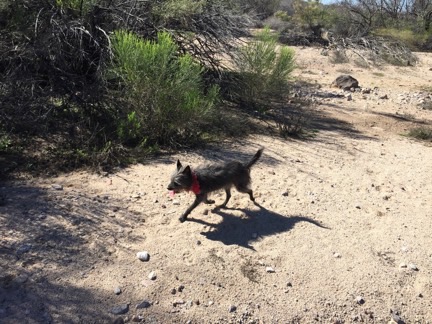
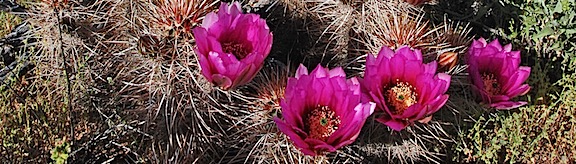
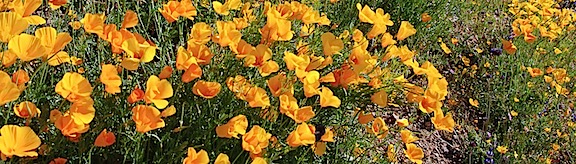
Jack the DogJack also goes hiking with us out in the desert. He’s well behaved on the trail and never bothers other hikers. He’s a bit of a nuisance when we go out to take photos, as we did the other day. He always seems to get into the shot. But now that he’s older — he turned nine this year — he’s starting to slow down and spends a lot more time just relaxing in the scant shade of a tree while we bend over wildflowers and lie prone to shoot up at cacti. It could also be his thick winter coat — which I’ll soon be vacuuming up off my floors and carpets — that keeps him too hot in the springtime to run around.

In answer to a commonly asked question, yes, Jack has flown in the helicopter. He’s been flying with me three times now. I think he considers the helicopter just another vehicle. The last time we flew together, he was very well behaved alone in the back seat.

Jack’s a good dog — the best I’ve had so far. Although he tends to get excited easily and seems to live to be petted, he’s smart and listens — unless, of course, he’s chasing a rabbit. We may spoil him by making him a part of our lives, but we don’t pamper him and don’t allow him to misbehave, especially when there are other people around. In other words, we don’t allow him to give people a reason to complain about him. If more people disciplined and trained their dogs properly, we wouldn’t need so many “No Dogs” signs and leash laws.

And we probably wouldn’t need dog parks, either.

Animals from the Air

Wild horses, antelope, and sheep — oh, my!

I flew from Grand Canyon Airport to Page Municipal Airport (at Lake Powell) again yesterday.

FlightPath.jpgEach time I make this trip, I follow pretty much the same route, hugging the southeast corner of the Grand Canyon Special Flight Rules Area (SFRA) until I get to the Little Colorado River Gorge and then heading pretty much due north. I wind up just outside the SFRA near Marble Canyon so I can show off Navajo Bridge and Lees Ferry before a quick flight past Horseshoe Bend, the Glen Canyon Dam, and Wahweap Marina. If the wind is in my favor, I can touch down at Page within an hour of departure from Grand Canyon. The same distance by car would take about 2-1/2 to 3 hours.

The terrain for most of this flight — from the Little Colorado River Gorge north, in fact — is high desert — technically the famous “Painted Desert” — and relatively barren. There are, however, some interesting features if you look hard for them. Since I’m always trying to point out interesting things for my passengers to see, I look very hard.

Ruins are relatively common. Round rock foundations are the remains of ancient hogans. (This area is on the Navajo reservation.) There are also the remains of animal enclosures, usually build with the same rock. There are complete hogans, some of which may still be occupied for at least part of the year, and ranches with hogans, sheds, outhouses, animal enclosures, and other buildings. All of these things are scattered across an immense landscape that takes more than 30 minutes to cross at 120 miles per hour.

There are also animals.

One of the questions I’m asked quite often by passengers is whether I see wildlife from the helicopter. I do, but not so often as to make it a common occurrence. It depends on where I’m flying, what time of day it is, and how hard I’m looking for wildlife.

Take antelope, for example. There are a few “prairies” north of I-40 and west of Mt. Kendricks in northern Arizona where, if I look hard enough, I can usually spot a herd of antelope. I know where to look and I remember to look. They’re hard to spot because their color matches the terrain so well. It usually takes movement to spot them. When I see them and point them out, my passengers never see them at first. I have to slow down, turn around, and drop a few hundred feet as we approach the herd. That gets them running a bit so my passengers can see them. As soon as they’re spotted — and photographed, if the passengers remember to whip out a camera — I move away. It’s not my goal to terrify the antelope population of northern arizona by buzzing them with a helicopter.

(When I flew at the Grand Canyon, I always saw at least one elk a day in the forest on one of my first or last flights for the day. My passengers never saw them and, since swooping around to show them wasn’t possible, I simply stopped pointing them out. It would be my own private treat.)

There are wild horses in numerous places throughout Arizona. I wrote a bit about them here. They’re also on the route I take from the Grand Canyon to Page. Today, my passengers and I spotted at least four herds of them — the most ever. They’re a lot easier to spot than antelope because of their size and color. But they’re also a lot easier to confuse with cattle. I look for long legs and long, thick tails.

There are domesticated sheep in various places throughout northern Arizona. We flew over a good-sized herd tended by four dogs today. They were a lot farther south than I expected — I usually see them farther north. This could be a different herd, of course. There were about 50 animals in that herd and the dogs did a pretty good job of keeping them together, even when my helicopter spooked them. (Yes, I had to do a circle for my passengers to see them; they were pretty small.)

In the past, I’ve also seen javelinas (pronounced have-a-leenas) from the air. They’re usually in herds of a dozen or more animals and I’ve only spotted them when I was alone, flying a lot lower than I do with passengers on board.

Of course, I don’t have photos of any of this. I’m flying and my hands are usually busy. My passengers never seem to remember to send me their shots. But one of these days, I’ll have some photos to share.