A summary, with photos, of my spring vacation.
If you’ve found this blog post while Googling for information about big cruise ships in the inside passage, I’m sorry to disappoint you. My cruise was on a 65-foot historic wooden boat. But don’t click away! Read a little more about it or at least look at the photos. And then consider a trip on the David B or another small ship like it instead of an impersonal floating city. It’ll be a trip you remember for the rest of your life.
The past nine or so months has been a crazy travel time for me. A 4-day trip to the Washington coast and Tacoma for a jewelry class in September. An 18-day trip to New York, Washington DC, and Vermont in September and October to visit family and friends and see the sights. A 3+-month trip to Arizona and California in December through March. And then a real vacation: 12 days aboard a small, historic ship called the David B as it cruised slowly up the Inside Passage from Bellingham, WA to Ketchikan, AK at the end of April and into May.
(A side note here: all this travel would not be possible if I were still married. Once again, I have to thank my wasband for freeing me from a boring life in his rut, waiting for him to get his shit together and start enjoying life. Thanks, honey!)
I’ve mentioned elsewhere why I booked Northwest Navigation‘s “Learn to Cruise – The Canadian Inside Passage to Alaska” trip late last year for this spring. It would be a learning experience, and I’ve come to realize that learning experiences are the best experiences because they stay with you the longest and can change your life.
And this trip did not disappoint me in the least. I learned a ton about navigation, small boat cruising, tidal impacts, salt water boat maintenance, customs requirements, and “camping” on the water — which is basically what we did. I see small boats like the David B and the Ranger Tug R-27 I’m considering for my own use to be seaworthy RVs — recreational vehicles for use on the water. Like a motorhome, a boat with living space is a vehicle you can use to travel from place to place with a degree of flexibility, privacy, and comfort. What makes the boat I want different from the David B (other than size: 65 feet vs. 27 feet) is that mine can be easily trailered from place to place giving it almost unlimited options for exploration in fresh and salt water. What I learned on the David B can easily be applied to any serious boating I do in the future.
Anyway, although I brought my old laptop with me on that trip with the idea of blogging daily, that didn’t happen. Who wants to bury their head in a computer when there’s so much going on outside and around you? So I’ll try to share some of my experiences now, along with photos and charts of where we went.
And don’t worry; I’ve split this into multiple parts. I hope you read them all. Lots of photos!
Getting to Bellingham
I won’t bore you with details of my pre-trip travel. The short version is that it involved a flight from Wenatchee to Seattle to Bellingham. I saw no reason to make the 4-hour drive to Bellingham when the trip wasn’t going to finish there. Instead, I bought plane tickets from Wenatchee to my starting point in Bellingham with return flights from my ending point in Ketchikan to Wenatchee.
I spent the night in an AirBnB room that was cheap and walking distance (barely) from the marina where I’d get the boat the next day. It was also the smallest room I’d ever slept in (which turned out to be good preparation for my cabin on the David B). I did a lot of walking on that Tuesday, making the trek down to Anthony’s restaurant where I ate oysters two ways and had wine and dessert — entirely too much food. I then walked along the marina until I found where the David B was parked before walking back to my lodging.
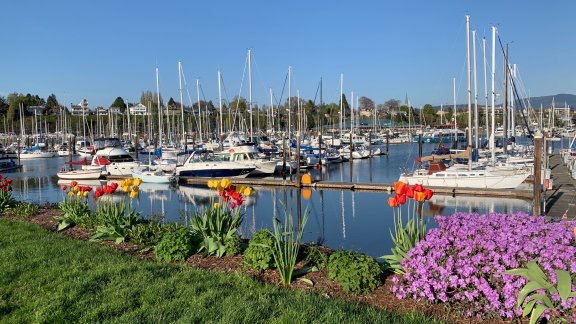
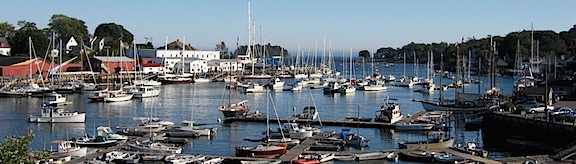
Bellingham’s marina was absolutely gorgeous that late April day.
Day 1: Bellingham to San Juan Island
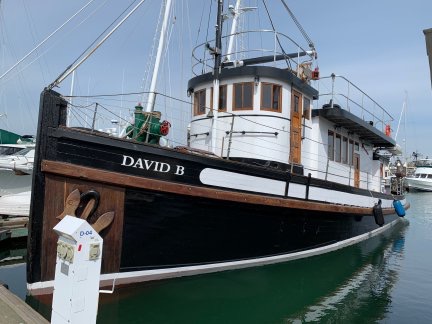
The David B when I arrived on Wednesday morning.
The next day, I took a Lyft to Bellingham’s art district with my giant rolling bag, had coffee in one restaurant, and breakfast in another. I then took a short walk, dragging the bag behind me, visiting a few antique stores to buy old sterling silver and silver plate tableware that I thought might be turned into nice rings. Finally, as the time to board got closer, I called another Lyft to take me the mile or so to the pier. If my bag wasn’t so damn big, I probably would have walked.
I was a half hour early but they let me board anyway. I wasn’t the first passenger to arrive. I met Sarah, who is in charge of reservations and other office stuff in Bellingham briefly before she left. Captain Jeffrey introduced himself and helped me wrestle my bag down the stairs to where the cabins were. There were five of them, including a crew cabin, and they were tiny. Mine had a queen sized bed, a head with toilet and sink, two portholes (one of which was in the head), and enough space for me to stand next to the bed. There was space under the bed for my bag, but about a third of it was occupied with manufactured logs, which I later learned were for the wood burning stove in the galley. They bring up a whole summer’s supply of logs and one of the other cabins was full of them. I had enough space, but it would have been challenging if I was a very large person or was traveling with a friend. Other cabins had different configurations and were better suited to couples. Mine was fine for me.
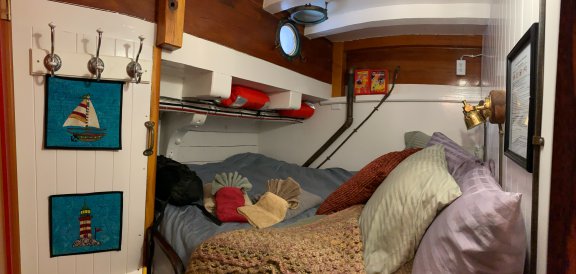
My cabin on the David B, as seen from the doorway with a panoramic photo. It was cosy!
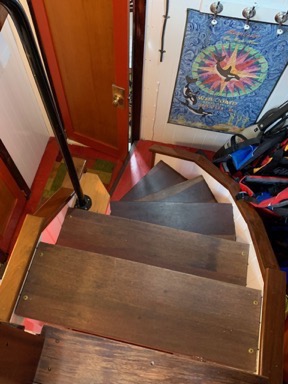
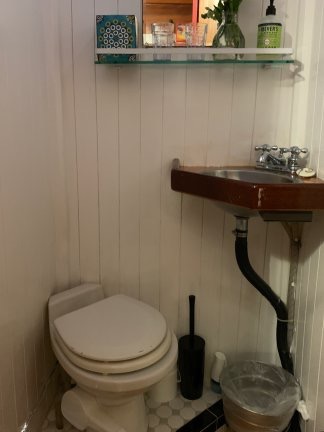
The stairs were steep and winding. The first door at the bottom was a spacious bathroom (head) with shower that we shared. My tiny head was so small that when I sat on the toilet seat, I had to put my left arm on the sink counter.
I went back upstairs to the saloon (not salon, as we later learned) and met co-captain/cook Christine, who was Jeffrey’s wife. We chatted for a while in the saloon and I told them about the boat I wanted to buy and what I hoped to learn. (They must have thought I was nuts.) Then I learned about the David B and a little about our trip.
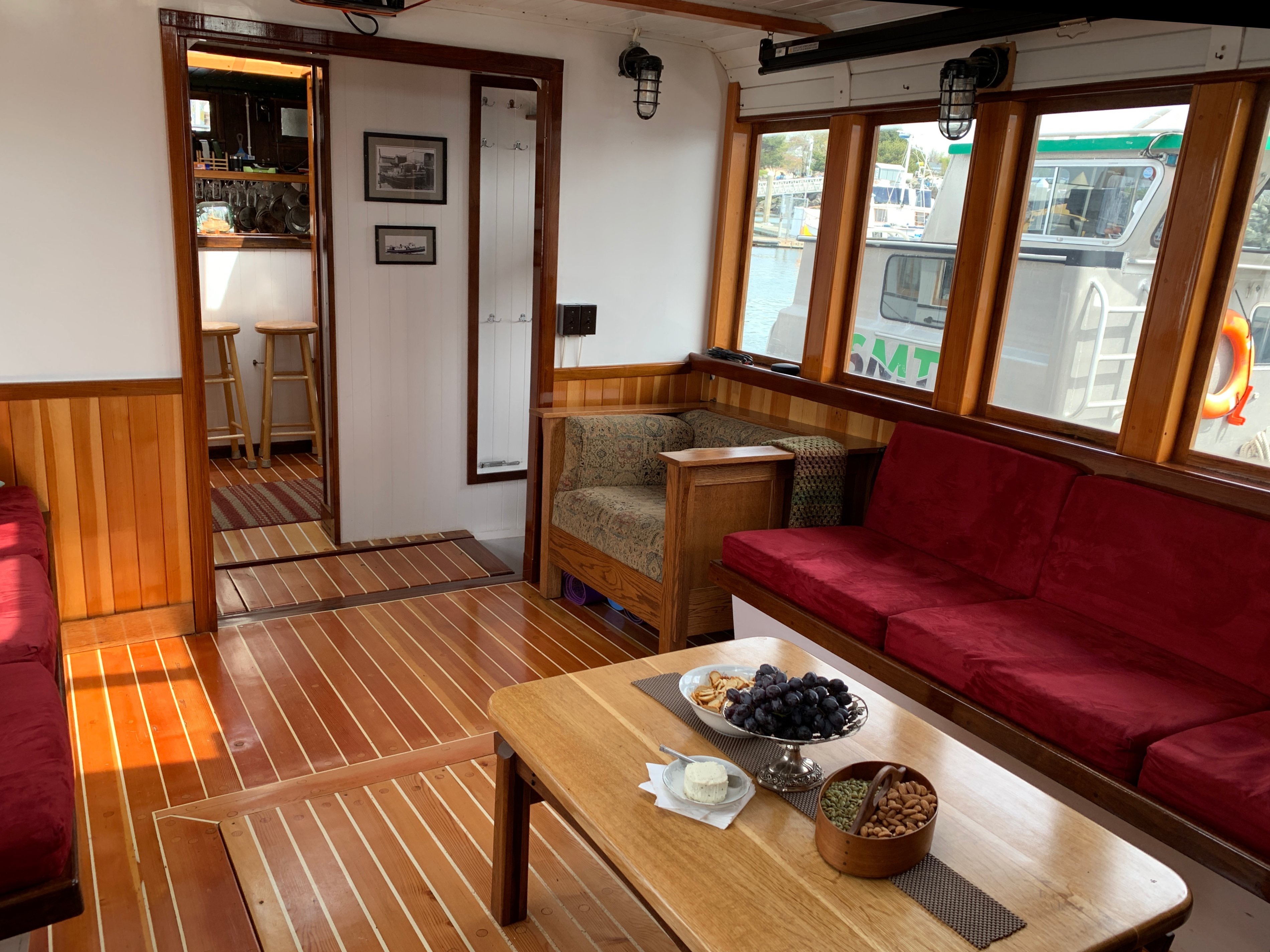
The saloon was our central gathering and lounging place on the David B. The snacks set out on that first afternoon should have warned me of the food to come.
Before long, I met my fellow passengers: Graeme from Australia and David and Leslie from Kettle Falls. Graeme was a wooden boat fan who had made the trip the centerpiece of a visit to the American northwest and Alaska. David and Leslie had just purchased a C-Dory 22 — coincidentally, the same boat my ex-friend at Lopez Island had that got me interested in small boat cruising two years before — and David was very interested in learning more about navigation since they’d just bought a home in Bellingham and I suspect he planned to move the boat there.
And that was it: only four passengers and two crew. I expected to be one of seven passengers, so this was a pleasant surprise.
We left port that afternoon.
I followed Captain Jeffrey down a ladder to the engine room and stood out of the way while he squirted oil into more places than I could count before doing a bunch of other things and then finally bringing the engine to life. I had questions but didn’t want to ask. He reminded me of a pilot preflighting an aircraft and if there’s one thing a serious pilot hates, it’s being interrupted doing a preflight. Then we both climbed back up and I told him I’d watch again, which I did the next morning.
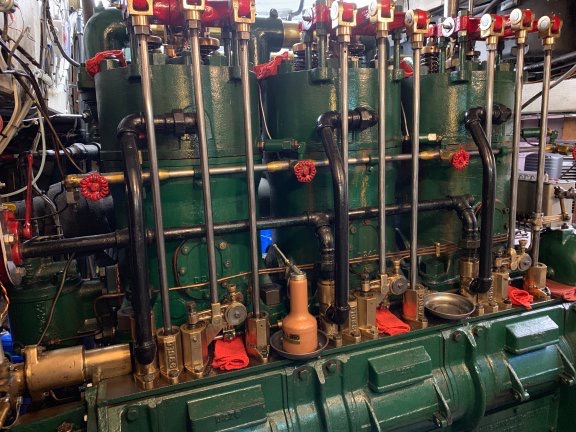
The David B’s three-cylinder engine.
Backing the David B out of its slip was probably the most challenging job; those of us who wanted to help were given big bumpers to separate the boat from other boats or dock parts if we drifted too close to something. But Captain Jeffrey had it covered. Backwards and forwards and backwards and forwards, he inched the 65 feet of wooden boat out and into the space between the slips. Then we were on our way while various friends and family members waved us off from the dock.
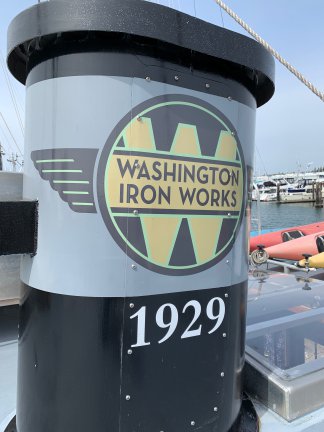
The Washington Iron Works logo adorns the David B’s smokestack atop the ship. The boat was built in 1929 and had just celebrated its 90th birthday.
The day had started to cloud over and get a bit chilly, but there wasn’t much wind and the San Juan Islands area we wound through was only a bit choppy. (I had my Sea Bands on for a while, just in case.) We were all excited about starting off and, after a lunch of hearty chicken soup and salad, spent a lot of time out on the deck or in the pilot house watching the San Juan Islands drift by and chatting about the homes we saw on shore. The David B literally chugged along under the power of its 90-year-old 3 cylinder engine, averaging about 6 to 7 knots of speed. We saw a few other boats, including some large tankers and freighters when we crossed the Rosario Strait. And there were ferry boats, of course.
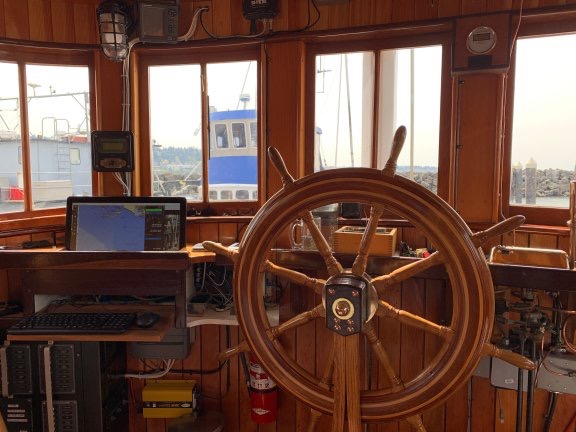
The pilot house is a neat compilation of early 20th century and 21st century technology. For example, the computer ran a navigation application that actually turned the big wooden steering wheel. We all spent a lot of time in this room, which had enough seating for all four passengers.
I’d prepared for the trip by downloading, installing, and subscribing to an iPad app called Time Zero (TZ) iBoat. Throughout the trip, I had tracking turned on so it kept track of our exact route. (Yes, I know I’m a geek.) Looking back at that track now, I can tell you that we passed south of Eliza, Lummi, and Sinclair Islands; between Obstruction and Cypress Island through Peavine Pass; between Orcas and Shaw Islands in Harney Channel; north of Crane Island; south of Jones Island; and then into Roche Harbor on San Juan Island. We passed the main harbor and wound through some channels before finally settling for the night at the mouth of Garrison Bay, which was named for nearby English Camp.
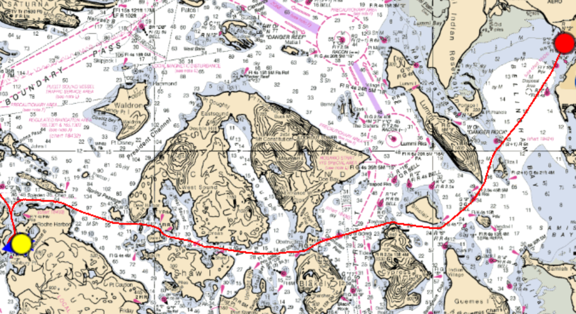
Here’s the view of our first day’s track as it appeared zoom-to-view on my iPad.
Captain Jeffrey slowed the boat until it was almost stopped and Christine worked some equipment on the bow to drop one of the two large anchors with enough chain to hold us in place. Then he shut down the engine and the sound we’d been listening to for the past few hours stopped.
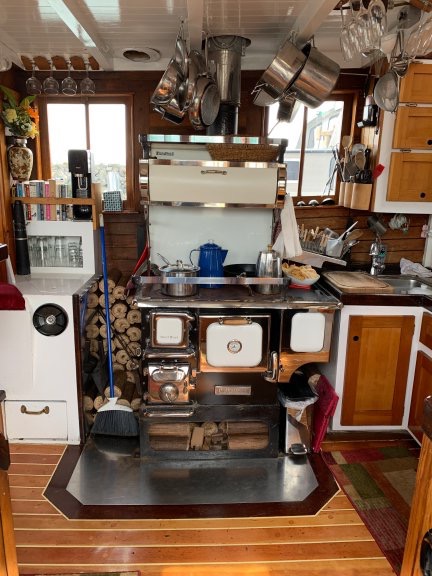
A fully-functional replica wood-burning stove was the centerpiece of Christine’s galley.
By this time, Christine was cooking dinner in the amazing galley. I say “amazing” because she was using a wood-fired stove and I personally can’t imagine dealing with the intricacies of such a device after a lifetime of gas, electric, and microwave cooking power. Because the boat had a generator and inverter, she had all the usual appliances — mixer, blender, ice cream maker. There were several refrigerators and freezers. The only thing she didn’t have was a dishwasher, but we all took turns washing the dishes after meals.
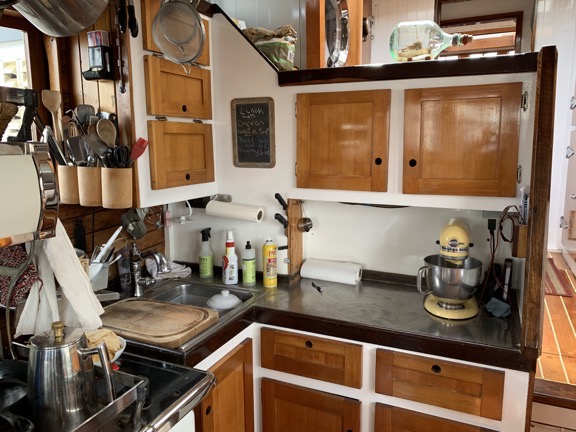
David B’s galley.
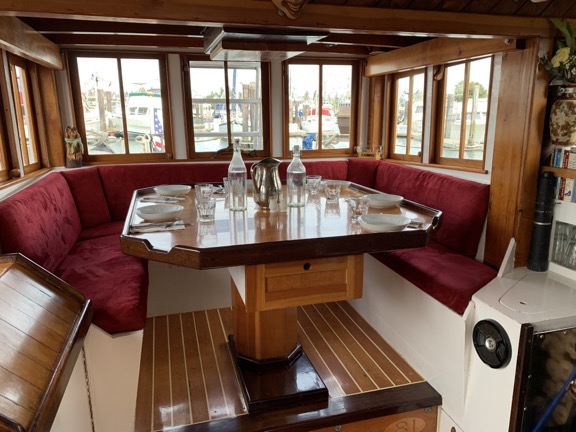
Here’s where we sat for meals. Although Christine plated dinners, breakfast and lunch was usually family style.
We had baked salmon, asparagus, and black rice for dinner. The “bread course” — which became a sort of running joke because every meal had some kind of freshly baked bread — was sourdough. I ate more bread on that trip than I had eaten in the previous year but I simply couldn’t resist.
After dinner, we spent some time discussing the next day’s cruise, which would take us into Canada. Part of the trip was a passage through Dodd Narrows, a narrow space between Mudge and Vancouver Islands that was well known for dangerous eddies during tidal flows. We had to plan our arrival at slack tide, a narrow window when the eddies were minimized. If we arrived too early or late, we’d have to wait on the south side of the narrows. An early arrival wasn’t a big deal but a late one would have us waiting for hours until the next safe time to pass through. This was my first introduction to the concept of tidal currents and it came with a lesson on how to use various reference guides to calculate when slack tide would occur.
Not long afterward, we all turned in for the night. I quickly realized that the walls were paper thin and I could hear everything Leslie and David said to each other. They didn’t say anything embarrassing, but I made some noise so they knew how thin the walls were. I suspect they figured it out — probably from hearing me snore! — because they didn’t talk much on subsequent nights.
Day 2: Bellingham to Nanaimo
I woke up early, as I usually do, but with a very sore throat that got me very worried. I’ve been on two vacations where I was sick with a cold and it really sucks. If I was taken down with a cold on this trip, I’d be very upset.
I spent some time lounging in bed with my iPad, which is what I do at home, too. I still had Internet access — heck, we were in the San Juan Islands. Around 5:30, I heard movement upstairs and went up in my pajamas to see what was going on. Christine had stoked up the stove and made coffee. I hung around in the kitchen for a while with my coffee, then went down to put real clothes on. The other passengers appeared one by one. Christine made us a frittata with asparagus (leftover from the previous night), fruit, granola, and yogurt. (The last three would be at every breakfast.) She didn’t have any orange juice, but I did have an orange to start pumping Vitamin C into my system.
The day was beautiful and the water was glassy smooth. I launched my drone for the first time to get some aerial views of the boat. I was a little skittish about flying it over water after my Lopez Island crash, but I faced my fears. There was a big clear area on the roof of the saloon and that’s where I launched from. I did not rely on auto-land to bring it back.
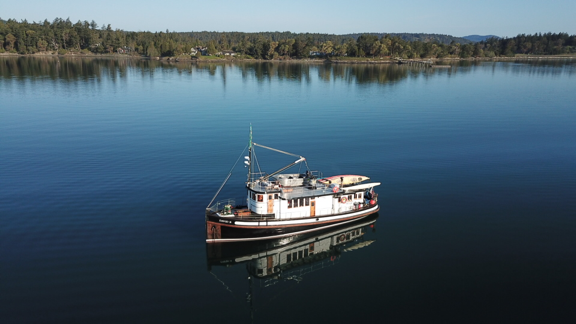
The David B at anchor in Garrison Bay.
Curious about what a 3 cylinder, 90-year-old ship’s engine looks like when starting up? Check this out. pic.twitter.com/hCZu7nU761
— Maria Langer 🚁 (@mlanger) April 26, 2019
Afterwards, I went back down into the engine room to get a narrated view of the engine start. I tweeted it.
Captain Jeffrey engaged the windlass and Christine started pulling up the anchor. Once it was stowed, we were ready to go. It was about 9 AM.
We left San Juan Island behind and headed out into Haro Strait. Somewhere northwest of Stuart Island, we crossed into Canada. I spent some time trying to find a good place to sit outside while cruising. The two lounge chairs above the pilot house were windy and chilly. I finally settled — at least for a while — into one of the back facing seats on the stern which was sheltered and in the sun.
It wasn’t long before I realized that the David B was cruising slowly because the David B cruises slow. The engine, which required oiling and other attention every two hours while it was running, was set to a six knot cruise speed. We were going to cruise over 700 nautical miles at 6 knots.
No wonder the trip took 12 days.
My notes for the second day mention a lot of boats on the water in Canada, including a Canadian Coast Guard boat, tug boats, and a tug boat pulling a barge of oddly loaded logs. I took some pictures, but not many. Everything was big and far away and didn’t look very impressive in photos.
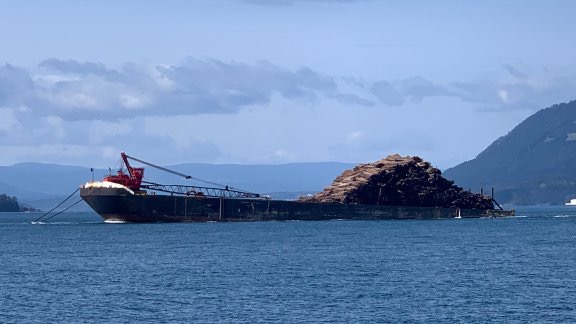
I guess this is one way to load logs on a barge. What’s interesting to me is that in the Pacific Northwest they use chain to attach the tug to the barge and the chain dips way down into the water. This is very different from the barges I remember on the Hudson River when I was a kid; they used cables that were taught when the barge was being towed.
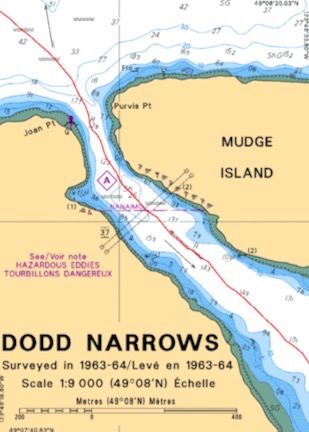
The chart for Dodd Narrows. The red line is our path through it.
We arrived at Dodd Narrows about 30 minutes early. During our slow approach, we could see several boats waiting to enter the narrows, including a tugboat towing a bunch of floating logs tied together. Captain Jeffrey liked the way it looked so he didn’t wait and kept going. A sailboat under engine power pulled in behind us. There was current in there, but it wasn’t bad enough to cause any problems for us. I was glad there weren’t any boats coming through from the opposite direction.
We got into Nanaimo, a port city that’s commonly used by American on private boats to clear Customs into Canada, at about 4 PM. Captain Jeffrey went to shore to deal with the paperwork for himself, Christine, and their four passengers.
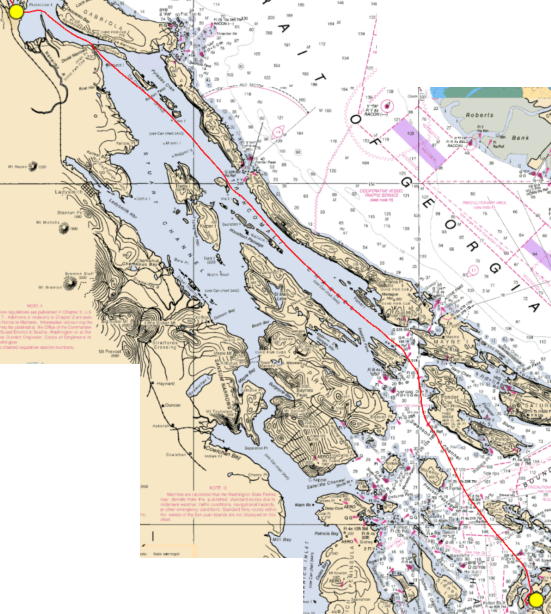
Day 2’s track from San Juan Island to Nanaimo in British Columbia.
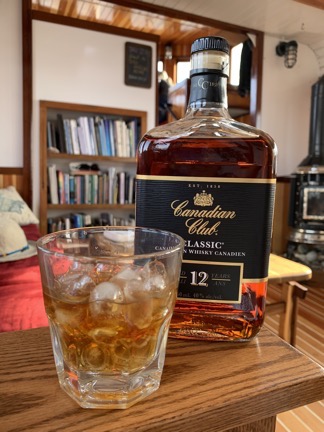
When in Canada, drink Canadian Club.
I was told that there was a supermarket nearby, so I set off alone in search of orange juice and vitamin C tablets. I had $40 in Canadian money with me and the goal of not being identified as an American. I found the supermarket and accomplished my mission with a credit card so I could save the cash for someplace that didn’t take credit cards, also returning to the boat with a bottle of Canadian Club whiskey and a reusable shopping bag.
Christine made us another amazing dinner with fresh bread. She was feeding us very well. Too well, I think. I’d brought along some snacks in case I got hungry between meals but (1) I didn’t get hungry and (2) there were always snacks available (which is probably why I didn’t get hungry).
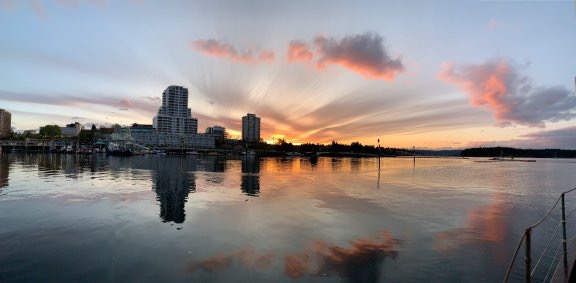
Mother nature treated us to an amazing sunset.
Day 3: Nanaimo
The wind kicked up overnight and was blowing hard by 8 AM. Captain Jeffrey decided to delay departure by 2 hours. When that time had gone by, he delayed departure again. After lunch, he announced another delay.
I really couldn’t blame him. The wind was howling and the seas that we could see through a gap in the islands nearby was full of whitecaps. A big cargo ship anchored there drifted 90° or more at anchor. Even the seaplanes based near us at the harbor weren’t flying most of the day.
I spent most of the day reading and wasting time on Twitter. I wanted to go see Avengers Endgame at a theater in town, but the only showing I could see was at 3 PM and we might leave.
In the afternoon there was some excitement when a kayaker capsized about 30 feet from the boat. He couldn’t right the boat and he was hanging on in water that had to be icy cold. We got a line to throw to him while Christine called the coast guard. One of his companions paddled back and helped him to the dock in front of the boat. Fortunately, he’d been wearing a wet suit so he wasn’t that cold. But they went into a panic when they realized another kayaker was missing. They later found him back at their starting point at a nearby island; he’d turned around when he realized the seas were too rough for him.
At 4 PM, Captain Jeffrey announced that we’d be spending another night. He went ashore to pay for our space on the dock.
I walked into town with Leslie. We stopped at a tea shop where she had him make a custom blend of Earl Grey and lavender. We also went into a very nice gift shop. I would have visited more shops — including a chart shop Jeffrey had told us about — but I think Leslie was done so I walked back with her.
Back at the boat, we did more waiting. Then dinner. I think all of us were ready to move on.
The wind started to let up before bedtime.
(More to come…)