Almost surreal.
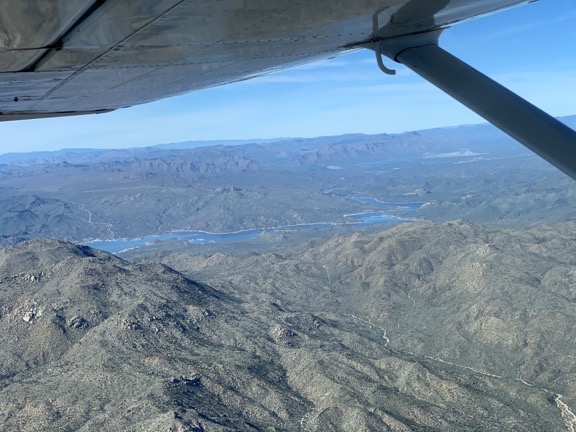
This past Monday, I headed out for a six day trip to California and back. The goal was to deliver my helicopter to a friend in the Los Angeles area. He’ll be leasing it for the next two months and I’ll get it back in mid May. I flew my helicopter down, accompanied part of the way by my friend, and took an airliner home. It was the first time I’ve been in an airliner in about two years.
I thought I’d blog briefly about the hotels, restaurants, and airports I stopped in along the way, mostly because the experiences were so unlike what I’ve had in the past.
The Hotels
The trip required a total of five nights in hotels. Across the board, all hotels required masks in the lobby and other public areas.
The first two nights were in McMinnville, Oregon, where I had stopped to get the helicopter an annual inspection prior to delivering it in Los Angeles. I stayed at a Comfort Inn for about $100/night. The room was comfortable, with everything I needed to get some work done while I waited.
On one full day of my stay in the area, I went to the Evergreen Aviation Museum, which I hope to blog about elsewhere. Afterwards, I went into town to grab a bite to eat — more on that later.

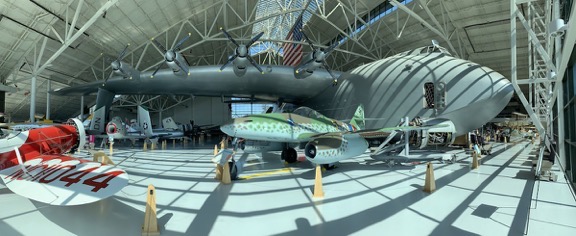
The Spruce Goose at Evergreen Aviation Museum was one of the highlights of my trip.
When I got back to my room, I was surprised to see that it had not been freshened by housekeeping. I later discovered that housekeeping services for stay-over guests is something I shouldn’t expect these days. I’m not sure why; maybe they are trying to reduce the exposure of housekeeping staff to potentially infected rooms? I wouldn’t have minded so much, but by not freshening the room, I came back to the same full garbage pail I’d left with the added aroma of that garbage and no coffee for the morning. While I like clean towels and a made bed, not getting those wasn’t a hardship at all.
The breakfast room was pared down beyond reason. They didn’t want you sitting in there, which I could understand, and they made it easy enough to take food to go (and add to your in-room garbage collection). But they lacked a lot of the easy (and safe) basics, like instant oatmeal, cereal packages, or a toaster for the bread, which was placed, unwrapped, in a self-serve lucite box. So yes, you could get a piece of bread or English muffin that everyone may have breathed on, but you couldn’t toast it.
The next night was spent at a Red Roof Inn in Susanville, CA, which was also about $100 for the night. That hotel didn’t even have a coffee maker in the room. And since the hotel consisted of multiple buildings, getting coffee in the lobby in my lounge clothes was not an option. Fortunately, there was a Starbucks across the street, which we hit on our way back to the airport. I’m a sucker for their double smoked bacon sandwiches and can tolerate their lattes.
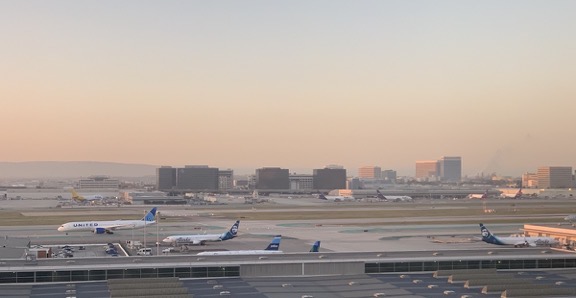
The last two nights were spent at the Los Angeles Airport Hilton on Century Boulevard. At $125 per night for a 12th floor room that overlooked runways 25L and 25R, I really enjoyed just sitting in my room in the morning and evening, watching the planes go by. (I even live-streamed the action for about 90 minutes.) This is one of the old, soundproofed hotels between the runways on Century, built in 1983. As one Trip Advisor reviewer said, “This is a Hilton, built when Hilton’s were top of the line.” If you stayed in Hiltons back in those days — as I did for my business travel in the late 1980s — you know exactly what he’s talking about. The Hilton name used to mean quality and this hotel is from that era, although it was renovated in 2013. Solid rooms with nice furniture. Giant mirrors for checking your image before going out to that business meeting or a show. Hell, even a lighted makeup mirror in the bathroom. It did lack a few of the amenities you’d find in a modern business hotel, such as additional outlets and USB ports. And it didn’t have the microwaves and fridges I’d had in the other two hotels I stayed in. But my room was large and there were enough towels for both nights of my stay.

I paid $10/night extra for a room facing the runways. Does that make me an #AvGeek?
What was weird, however, was the cold emptiness of the lobby, with minimal furniture — basically a handful of high-top bar tables and chairs — and no lingering people. The second floor, which probably gave access to the pool and hot tubs I could see from my room, was closed. One of the restaurants was closed; another had opened for the first time in a year that very day. Room service was not available. Even that notebook full of hotel information, menus, and area details was missing. Stickers on the elevator floor instructed you to stand in a corner if you were riding with someone else.
Yet the airport shuttle service was completely packed in the morning with so many people waiting that I actually walked a block away to the Marriott to get on their shuttle, which quickly filled up. I guess social distancing only applies when it’s convenient.
Eating Out
I fully expected to do all my dining outdoors or in my room. I had no desire to eat in an enclosed space — and yes, that includes tents erected in parking lots — with a bunch of maskless strangers. (Eating in contributed greatly to my in-room garbage collection.)
I went for a wine tasting in downtown McMinnville. It was outdoor seating and very pleasant. Afterwards, I found a restaurant with outdoor dining in little pods (for lack of a better name). They were small, individual tents, open on one end, with just a single table and four or six chairs in each. I felt pretty safe in there with my mask off, especially since I ate early in the day and may have been the first person in there since lunchtime.
I ate a ton of fast food before getting to Los Angeles. McDonald’s breakfast, Starbucks coffee with breakfast, KFC dinner. Okay, so maybe that’s not “a ton.” But it’s a lot more than I usually eat in a week.
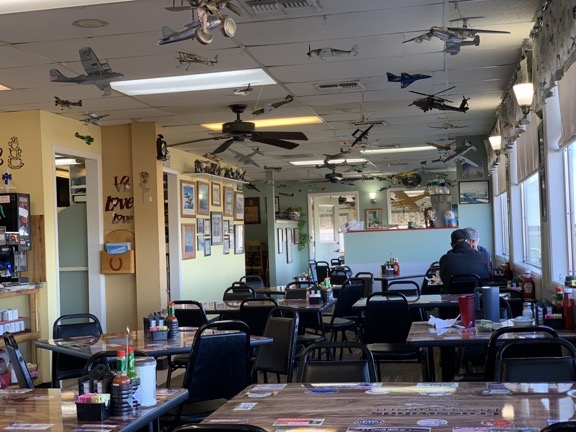
The only time we ate indoors was at the airport restaurant at South Lake Tahoe. We were two of only six customers when we arrived. The server wore a mask the whole time. We didn’t linger.
For dinner at the Hilton, I had to go to the restaurant in the lobby, order my meal to go from the limited menu I was permitted to look at, wait at one of those high top tables in the empty lobby, and take the food upstairs with me. I discovered that my food wasn’t as described on the menu, but it tasted okay. I wish it had been hotter and I was glad I had wine with me. I could have eaten in the restaurant — there were hardly any people in there — but why take a chance?
I had breakfast and lunch at the Los Angeles Farmer’s Market the next day. The last time I’d been there was in the late 1980s and I could not believe how much it had changed. Yes, the charming, closed in area of vendors still existed. What surprised me about the area is how they’d built an entire shopping center around the old Farmer’s Market. I had coffee and a french pastry for breakfast and later had empanadas and an Italian pastry for lunch. In all cases, I found a table off to itself, unmasked, ate, and masked back up. Everyone in Los Angeles was wearing masks inside and out. They apparently get it. (I admit that it took me a little while to get into the habit of wearing a mask outside.)

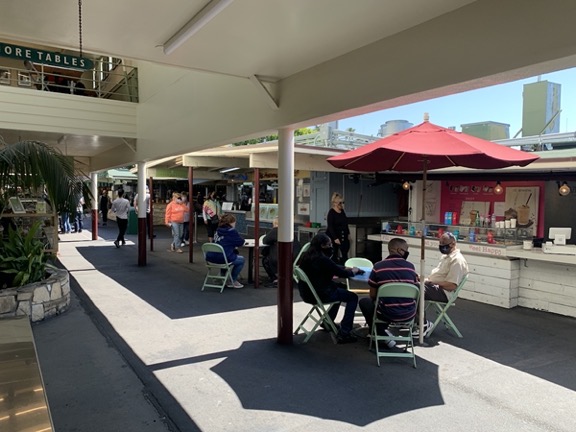
At the LA Farmer’s Market. This part is what I remembered from 30 years ago, but I remember it being a lot busier.
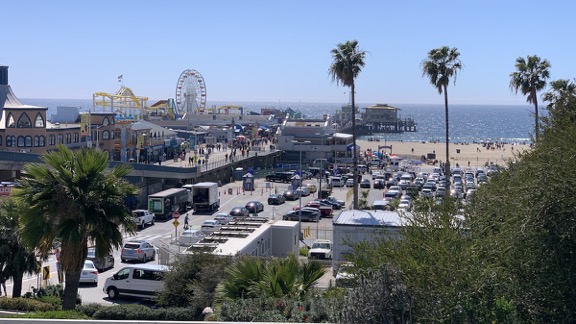
I had a snack later at the Santa Monica pier. Again, I ate outside. It was pleasant.

I killed some time at the Santa Monica pier on a gorgeous day.
By the way, I used Uber to get around Los Angeles. I had to agree to wear a mask before confirming my ride. All the drivers were masked and most windows were open. I didn’t share a ride with anyone.
(And seriously: how do Angelinos deal with all that freaking traffic?)
The Airports
I was at two kinds of airports during my trip: small general aviation and large commercial.
Mask use was hit or miss at the small airports, most of which were in rural areas where folks tend not to worry too much about the virus. But everyone I saw in Tahoe and Los Angeles was wearing a masks, inside and out.
At LAX, announcements warned that if you didn’t wear a mask in the terminal, they’d kick you out. I had to wait 15 minutes (at 6:30 AM) to get into the Alaska Air lounge — I think they were trying to discourage visitors by making us sign up and wait. When I got in, I was asked to stay masked unless I was eating or drinking and then to mask up afterwards. There was plenty of space between groups of guests. At one point, about half the people in there weren’t masked; they made an announcement and then followed it up with a person going table to table to remind people. This was my first visit to an Alaska Air lounge and I enjoyed it.
On the plane, it was the same thing: wear a mask or get kicked out. Of course, they couldn’t kick you out during the flight, but I can only assume that a troublesome passenger would be met by police on landing. I was flying in first class, which included a meal. (I could swear I ordered a sausage and egg wrap, but what I was given was an egg salad wrap. At 8:30 AM. At least it tasted good.) We were told to mask up as soon as we were finished eating or drinking.
I did notice that some of the first class services I’d come to expect were missing. There were no drinks before takeoff while the plane loaded. The flight attendant didn’t offer to hang up my jacket (although I wound up wearing it during the fight anyway.) There were no hot towels before the meal. There was no alcohol other than beer or wine — this seriously bummed me out because I really look forward to bloody marys with breakfast in first class. Besides, who drinks beer or wine in the morning?
Everyone wore masks at SeaTac and, again, there were regular announcements telling you to do so. It’s a federal law. (Thank you, President Biden.)
I had high expectations for the Alaska Lounge at SeaTac, which is, after all, Alaska Air’s hub. I was disappointed. I had the worst bloody mary I’d had in my life — seriously, bud, you only need a drop of Worcestershire — and the only food choices were apples, oranges, a salad, or tomato soup. Service was definitely lacking — I got the distinct impression that the staff simply didn’t care. (The LAX staff was worlds better.) Access to the lounge had come with my First Class (not upgraded) ticket, but I can only imagine how bummed out I’d be if I’d paid the $25 day fee for the privilege of getting that horrible bloody mary.
My flight from SeaTac to Wenatchee was the same as usual, but with masks. They used to offer a beverage service but had stopped long ago. Hell, it’s only a 20-minute flight. Is it really worth handing out cups of bottled water on a flight that short? I don’t. The only drawback is that Alaska had cut the flights to Wenatchee to just two a day and the other one arrives near midnight. This early afternoon flight was packed. I sure wish they’d add back a few flights.
Vacationing During COVID
I should remind readers that this was not a vacation for me. I made the trip for business. I would not have gone if I didn’t have to.
But it wasn’t like that for a lot of the folks on the airport shuttle from hotel to LAX. More than half of them were going on vacation with their kids in tow. At least one family was going to Hawaii.
The only thing I can say to that is WTF? After spending nearly a week sweating behind a mask every time I was in public — which was nearly all the time — I can’t imagine going on a vacation for more of the same. Why not wait until the pandemic is over or more people are vaccinated?
Are people absolutely nuts?
Anyway, I’m glad to be home with my pups and the projects that keep me busy here. I’ll venture down into town once or twice a week as necessary. I have no plans to travel again until May — when it’s time to bring my helicopter home.