I take in a few amazing museums.
(Continued from Part 2: The Farewell Tour)
Third Trip is the CharmThis was my third trip as a tourist to Washington DC and only my fifth trip ever. (Two trips were for work and I didn’t really get to see anything.) The first trip was when I was around 10 years old; it was a family vacation. I still remember parts of it: visiting the Mint and seeing stacks of uncut money and my dad surrendering his service weapon (he was a cop) at the White House after they searched my little purse. I also remember running into my third grade teacher on a street corner. (How weird is that?). The second visit was many years later with my future wasband and, oddly, I don’t remember much of that at all. This would be my first solo trip and my first opportunity to make all the decisions about where to go and what to do.
The next part of my trip started long before dawn. I was dead asleep when my brother woke me up at 3:30 AM. So was Penny, who reacted by jumping off the bed and barking her little brains out. Jolted to consciousness, I rushed from the bed to grab her so she wouldn’t wake my brother’s neighbors. That’s when I ran full speed into the footboard at the end of his bed. The bruise I got on my right thigh would haunt me for the next few days.
The Train Ride
A while later, he was dropping me and a small carryon bag off at Metropark Station in Iselin, NJ, which isn’t far from where he lives. I was catching a 5:12 AM Amtrak train to Washington DC. He was going to work and Penny would be starting five days as an apartment dweller.
It took me a few minutes to figure out where I had to go. I waited on the wrong side of the track for about three minutes, then got directions to the other platform. I walked down, through a tunnel under the tracks, and was honestly surprised that I didn’t smell urine. (New York has conditioned me to associate that smell with any tunnel near train tracks.) Then I was up on the other side, waiting with a handful of other people.

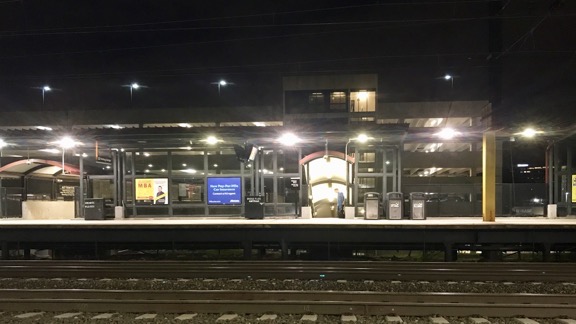
Iselin station, before dawn on a Monday morning.
A few commuter trains came through and stopped to pick up some of the folks waiting. Other folks arrived. Then my train pulled up and the doors opened. I stepped inside, then followed another passenger back through three cars to the Business Class car. I chose one of the few seats facing forward with a table between it and a rear-facing seat and settled in.
I’d bought a Business Class ticket because I’d always upgraded my rail fare when traveling by train to Washington. Back in my early freelance days, one of my clients sent me there occasionally. Since I flew on airliners so often for them, I decided that on short trips I’d take the train from Newark. (I lived in Northern New Jersey at the time.) They’d buy the ticket and I’d spend an extra $50 for the “club car” update. That was a very pleasant experience, with La-Z-Boy style swiveling recliners, small tables between seats, and waiter service with food and drinks. I thought that Business Class would be the same thing. I was wrong. (Silly me.) It’s just slightly nicer seating at the back of the train that’s less crowded because fewer people pay for the upgrade.

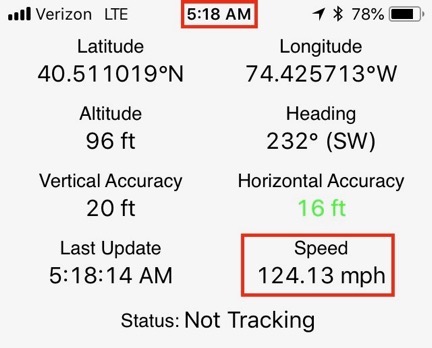
In just six minutes, the train reached a speed of 124 miles per hour. Eek.
I didn’t realize the train was the Acela until we started zipping southwest bound along the tracks. I thought we were going fast, but I didn’t realize how fast until I fired up one of my hiking apps for the current speed: 124 mph. Shit. It reminded me of riding on the Cyclone roller coaster at Coney Island. It isn’t the drops that scare you — it’s the ricketiness of the old wooden tracks and the constant through that they could break and send you careening off into oblivion at any moment.
Nighttime faded into a dreary day with occasionally rain. After crossing New Jersey in about 15 minutes, we took a more southerly route, making a few stops along the way. More people got into the Business Class car. A man sat in the seat opposite mine and unpacked some work on the table. I killed time by writing in a journal I’d started for the trip. Later, I walked up to the very disappointing dining car and got the free drink I was entitled to — an orange juice; it was too early for alcohol — and a microwaved sausage sandwich. I ate back at my seat.
There was some confusion as we neared Washington DC. Apparently a commuter train had some mechanical issues and we were taking on passengers waiting for that. Announcements made it sound as if the other cars were really jammed with passengers. When a woman tried to sit in our car, the conductor told her she needed a Business Class ticket and made her move.
Then we were at Union Station in Washington DC. Because another train was at the platform in front of us, we had to climb down train stairs and make a very long walk on the extended platform to the station. It was drizzling and rather depressing. It was also only around 8:30 AM — a lot earlier than I would have arrived if had I left my brother’s house at 4:45 to catch a plane.
As I left the station, I noted a Verizon Wireless store that was still closed.
The AirBnB
I’d be staying at an AirBnB studio apartment on 11th Street SE for the next few days. Although the host wanted to charge me an extra $45 to check in early, she did agree that I could store my bag on the floor in the “living room” — which was the only room — when I arrived in town. So I caught a shared Lyft — which is really so much cheaper than Uber — and headed over there right from the station.

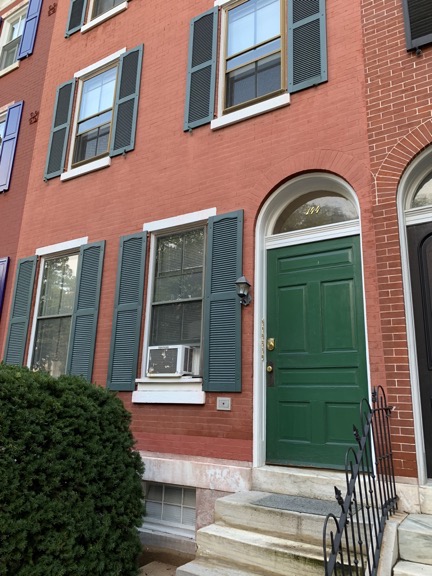
The house I stayed in in Washington DC during my visit.
The place was on a very nice tree-lined street, one of a row of attached houses with a few steps leading up to the front door. It wasn’t until I took this photo the next morning that a resident of the area told me that the homes were known as Philadelphia Row and had historic significance. (I’ll let you follow that link or Google for yourself to learn more.) All I cared about was stowing my bag so I wouldn’t have to carry it all day. I followed the access instructions, which required me to open two doors with two different key codes, peeked inside only long enough to make sure the place wasn’t a dump — it wasn’t; more on that later — and left my bag on the floor near the door. Then I locked up and headed out.
The Metro
I chose the Metro for transportation. It was supposed to be close to the AirBnB unit I was staying in. “Close,” however, is a relative term that depends on the person doing the walking and the weather she’s walking in. It was drizzling but warm. I’d donned my old motorcycle rain jacket, which fit over the fleece jacket I’d brought along on this trip, and was able to keep dry during the six-block walk. But the jacket had a rubber lining that made me sweat in the warm, humid weather. Ugh.
I descended underground at the Eastern Market Station. After figuring out how to buy a Metro pass and how much to put on it, I headed for the turnstiles. Soon I was on the platform, waiting for any train that would take me to Smithsonian Station.
It turned out to be a quick, pleasant ride. I got off at my station, climbed up to the surface, and blinked in the bright light of the gray day. It was still raining. I got my bearings and walked the rest of the way to my destination.
The Castle
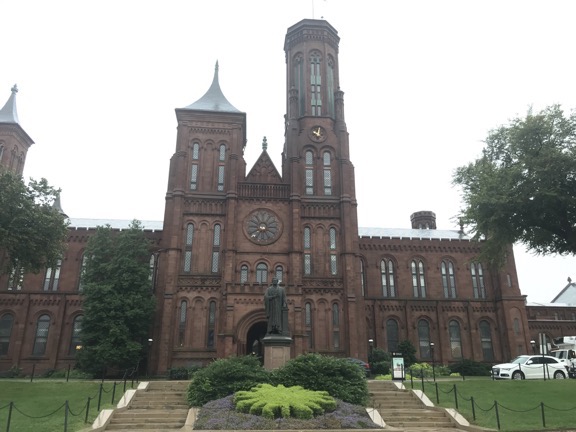
I had decided to start my visit at the Smithsonian Castle, which is the original Smithsonian Institution Building on the Mall. Although it once housed the museum’s treasures, it’s now an information center with Smithsonian offices. What also makes it a good place to start an early visit of the area museums is that it opens at 9 AM; the other museums open at 10. It was still before 10 AM; hard to believe I’d started in New Jersey just a few hours before.

The Smithsonian Castle is a great place to start any museum trip to Washington DC.
Follow the LinksI could make this blog post about 20 times longer than it already is by providing details about everything I saw, but do you really want to read that? I hope not because I don’t have the time to write it. Use the links I provided to get information about the highlights of my visit. And then do yourself a favor: schedule your own museum tour in Washington DC one day soon. Bring your kids or grandkids over age 8 if you have some. You won’t regret it.
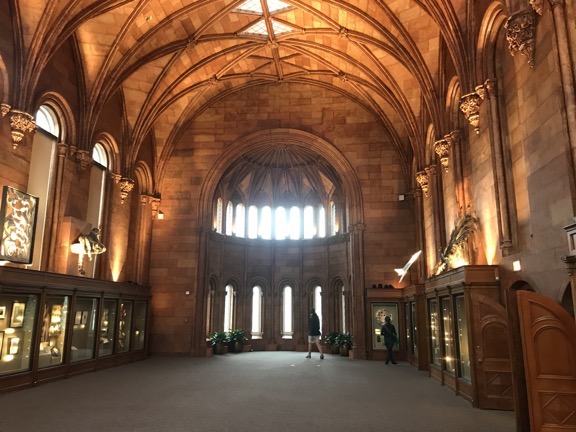
I spent about an hour there. I spoke to a woman at the information desk, got a brochure that listed all of the Smithsonian museums in the area, got a Metro map, and followed her suggestion to see the permanent exhibit in the West Wing called “The Smithsonian Institution: America’s Treasure Chest.” It included a sampling of items that could be found in the various other Smithsonian Museums. I couldn’t decide which was more impressive: the actual collection or the architecture of the room it was in.
The West Wing of the Smithsonian Castle houses a permanent exhibit of sample items from all Smithsonian Museums.
By the time I was ready to move on, I’d decided on my next two destinations: the National Museum of Natural History and the National Museum of American History, both of which were right across the Mall.
National Museum of Natural History
I visited the National Museum of Natural History first, primarily because it was the first one I came to when I crossed the mall. There was a slight moment of panic when I thought that a group of about 30 school kids would be coming in with me, but they realized, right before they reached security, that they were in the wrong museum and left. Phew.
Inside, the first thing I did was find a locker for my shoulder bag and rain jacket. I was toting around my Nikon with its medium lens and it was heavy. The only reason I brought it on my trip at all was because there was a tiny scratch in my iPhone 7’s camera lens and I wanted to make sure I could get good pictures my trip. But the iPhone photos weren’t that bad and I didn’t want to lug the heavy Nikon around.
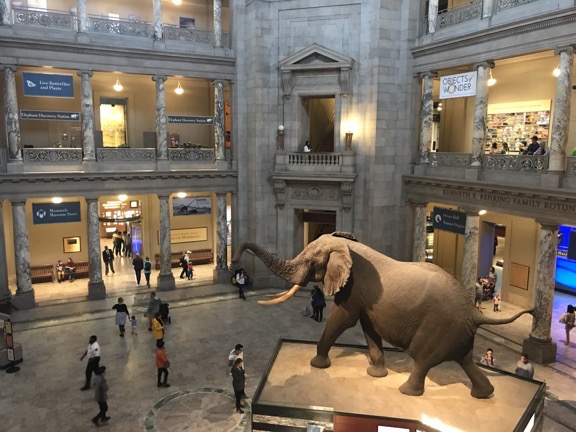
The Main Hall of the Natural History Museum. There were a lot of interpretive displays related to that big elephant, perhaps to make us feel a little less bad about killing and stuffing a big elephant.
Seeing Museums on my Own TermsAs I hinted in a sidebar near the beginning of this post, I really enjoyed being able to visit museums on my own terms. Not only could I decide which museums to visit, but I could decide which exhibits in each museum I wanted to visit and how much time I wanted to spend at any exhibit I wanted to see. There was no rush to finish up with things I cared about to see other things I didn’t care about. I made incredibly good use of my time and saw just about everything I wanted to see. After this trip, I can’t imagine visiting a museum any other way.
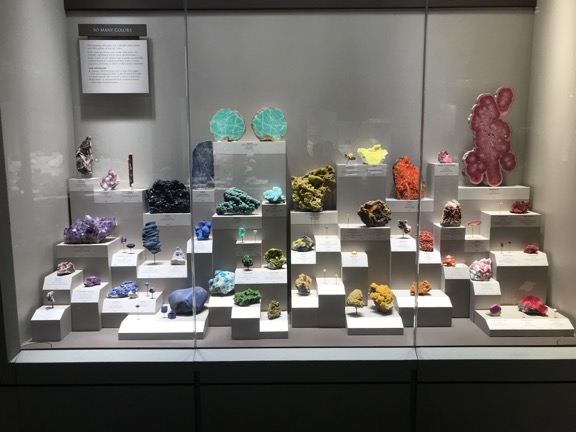
I was primarily interested in seeing the Gems and Minerals exhibit, which had been recommended to me by many friends who know about my interest in gemstones. Known officially as “The Janet Annenberg Hooker Hall of Geology, Gems, and Minerals,” it’s a permanent exhibit on the second floor. The Geology part was extensive and informative — I got a real kick out of seeing a display of columnar basalt just like the cliffs behind my home. Wandering on, there were exhibits about mines and mining and then, finally, the rocks I’d come to see: hundreds of specimens of beautiful gemstones from all over the world. I took numerous photos with my iPhone, sometimes setting it right up against the glass to eliminate glare. I wished they had book or website that cataloged every single one; it would be incredibly useful for identifying the specimens that I come across at rock shows.
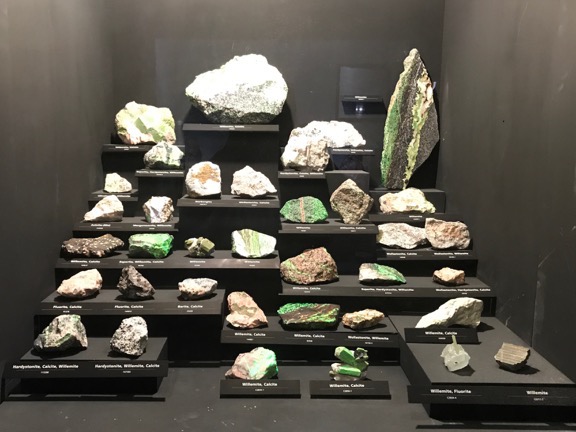
This display, called “So Many Colors,” arranged rock specimens by color. Every single specimen was identified.
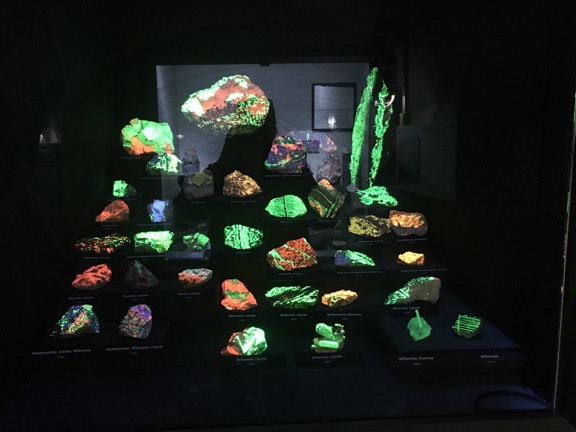
This display shows the features of rocks in regular and then black light. (Yes, that’s my reflection in the back of the display.)
More rocks.
I could share all my photos with you, but I won’t. If you like rocks, you really need to see this exhibit.
At the end of the exhibit hall were some famous gems, including the Hope Diamond, which was in its own rotating display with its own extra guard. Although a lot of folks had come to see just that, I really enjoyed the rest of the exhibit, which had taken me well over an hour to walk through.
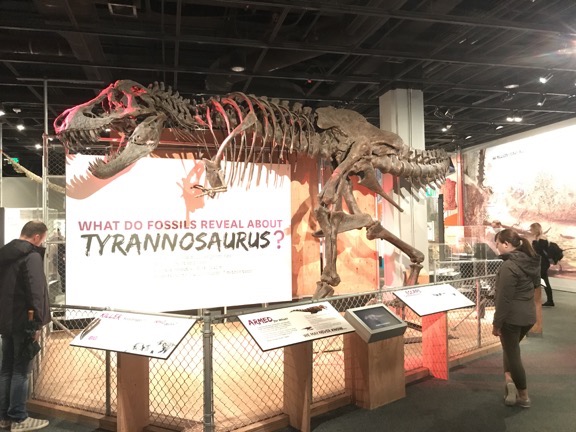
Afterward, I visited just one other exhibit, and I didn’t stay long: “The Last American Dinosaurs: Discovering a Lost World.” I didn’t stay long, mostly because the place was full of kids on a school field trip — different, younger kids than at the entrance — and I was developing a headache that I realized was likely due to caffeine withdrawal. I hadn’t had any coffee that morning.
The Tyrannosaurus was just one set of bones on display.
I did stop at the gift shop, where a saw a lot of rocks like the ones I collect for a lot more money than I usually pay. I also saw gemstone jewelry, most of which wasn’t nearly as nice as mine. Then I found my way down to the ground floor where there was food. I bought a small, remade sandwich wrap, a bottle of water, and something that really saved me: an Awake caffeinated chocolate bar. Holy cow. I ate half the bar right after my sandwich and my headache was gone 15 minutes later. Seriously: I need to buy these and take them with me when I travel.
The Museum of American History
It was nearly 1 PM when I left the museum and walked next door, to the The National Museum of American History. I followed the same drill with security and then stowing my stuff in a locker.
This museum is famous for housing Dorothy’s Ruby Slippers (from The Wizard of Oz) and Archie Bunker’s chair (from All in the Family), neither of which I saw. There’s way much more in its three floors. I didn’t really have anything specific I wanted to see, so I started at the bottom at the hall of Transportation and Technology, specifically, the exhibits about transportation by water and land, electricity, power machinery, and money. That alone took over an hour, with lots of stops to really look at the exhibits and the signs that explained them. I took a few pictures, but not many.

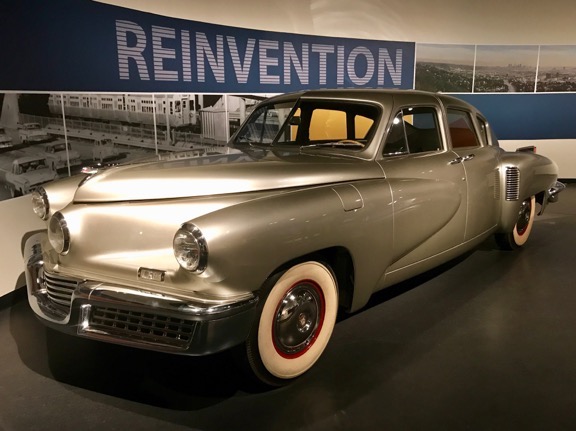
If you haven’t seen Tucker: The Man and His Dream from 1988, watch it. You’ll get an idea of how ahead of its time this car was.
The American Enterprise exhibit focused on American pioneers in business and industry. It seemed to me that they made a special effort to include as many women and people of color as they could. That’s a good thing — it introduced me to a lot of American businesspeople I’d never heard of.
I skipped the food exhibition and, therefore, missed Julia Child’s kitchen. Oh, well.
I did go to see the Star Spangled Banner, which used to hang behind a protective screen in the main hall. Now it’s in its own room, laid almost flat, behind a pane of glass. I raised my phone to take a picture and the guard said, “No photos!” I assured her my flash was off but she just repeated, “No photos.” I can’t quite understand why I can’t take a photo of this particular relic, especially if my flash it turned off. I’d share a photo from the museum website, but I can’t find one there, either.
I wandered around a handful of other exhibits but, by that time — late afternoon — I was tired. I decided to grab a Lyft to a restaurant near the AirBnB and call it a day.
Ambar
I wound up at Ambar Capital Hill, a Balkan restaurant. I had never had Balkan food and since it was walking distance from the AirBnB, eating there was a no-brainer for me.
I sat at the bar, as I often do when I’m traveling alone. They had a few happy hour specials of small plates and that’s what I went for. Veal soup, bread basket with traditional spreads, drunken mussels, and Balkan Kebab. All excellent. I tried the Sarajevo Old Fashioned (plum rake, bourbon, bitter, and cane syrup) and later tried an apricot rakia. It was an excellent meal and, as usual, I stuffed myself.
I needed that walk back to the AirBnB.
The AirBnB
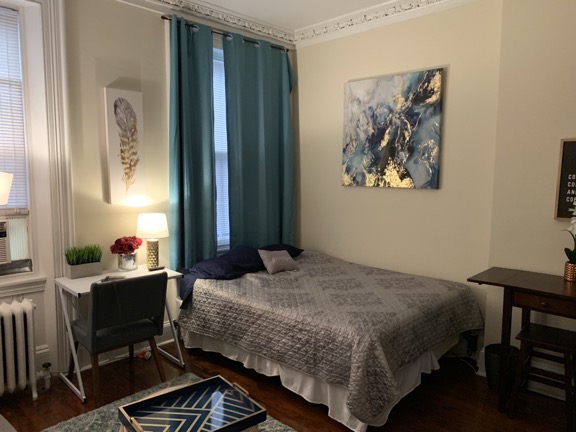
I made my way though the two locked doors and finally got a chance to really look at the AirBnB unit I was staying it. It was on the ground floor of the row house with two windows facing front. There was another window facing a back yard, but it was blocked by the full-sized refrigerator in the tiny kitchen.
It wasn’t a bad place, but it certainly wasn’t the “five star” accommodations the host kept reminding me it was. Although both front windows had blinds, only one of them had curtains and neither opened. The double (or maybe queen) bed was shoved up against the wall and had no headboard so the pillows kept falling into the space between the window and the bed. I actually made a list of all the things wrong with the place and sent it to the host at the end of my stay, mostly because every single time he/she sent me one of their long, canned messages it reminded me that the place deserved a 5-star review. That really bugged me. I gave them 4 stars but only because of the value for the money. I got what I paid for. All I did there was sleep, wash up, have coffee in the morning, and reheat some leftovers. It was clean enough and convenient enough. But the $95 cleaning fee really irked me when I found the previous guest’s hair in the shower. Ick.
You’re looking at more than half of the room I stayed in. I don’t see Five Stars here, do you? As I told my host in the private part of the review, it has all the charm of a freshman girl’s dorm room. You can see three of the six fake plants; not sure what purpose they served other than to increase tackiness.
My New Phone
In the morning, after coffee, I took another shared Lyft back to Union Station. I was the first customer at the Verizon store.
I wound up buying a new iPhone XS. The smaller screen one. I really liked what I’d seen about the camera. My iPhone 7 was nearly two years old and the camera lens had a tiny scratch. It didn’t make sense to spend $80 to replace the camera in a phone that old.
They had a 55 and older special going that gave me a second phone worth up to $900 for free, including free data, calls, texts, etc. All I had to pay was sales tax (which they didn’t tell me up front). So I also got a red iPhone 8 max. It’s still in its box. I don’t even know its phone number.
They sold me the insurance on both phones but I later canceled it. I figured that if I broke the new iPhone, I’d use the second one as a spare. Free insurance. Whatever.
On my way out of Union Station, I took my first pictures with the new phone. They came out okay.
The National Postal Museum
The National Postal Museum was right across the street from Union Station. I used to be a serious stamp collector. Now I just buy stamps I like and eventually use them. (I’d love to sell my old stamp collection if you know anyone who is interested in first day covers, commemorative blocks, and other mint stamps.) I walked over to the museum to take a look.

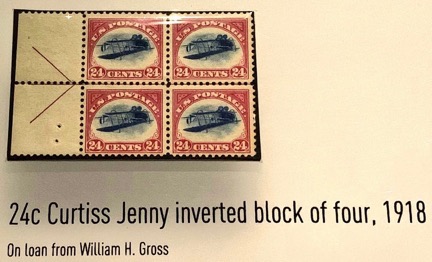
Safely displayed behind glass with a light that goes on only when someone is standing right in front of the display. This is one of the most valuable stamps in the world. The history of its release into the world is fascinating.
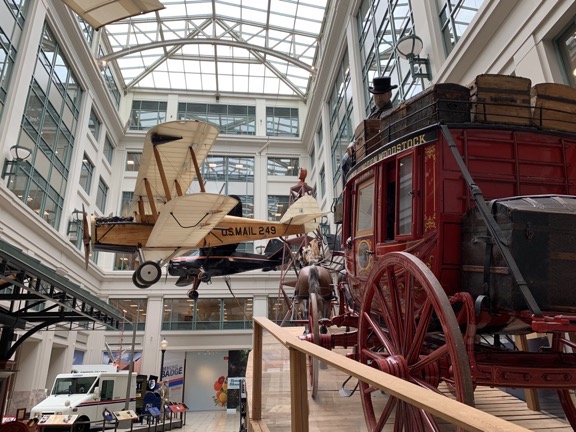
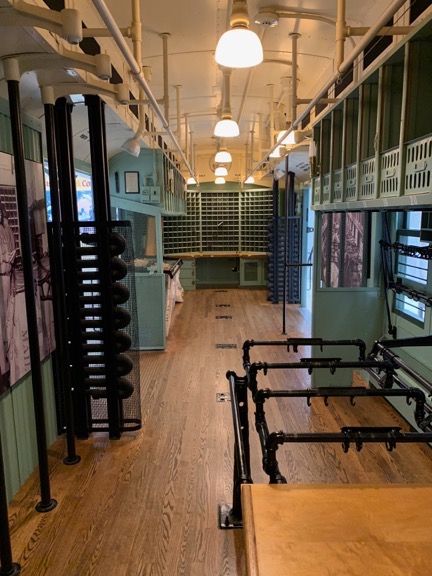
The museum has a good display of interesting/historic stamps — including a block of four Inverted Jennys behind glass that I was allowed to photograph — as well as larger displays downstairs for the various ways mail is transported. There were planes hanging from the ceiling and an entire mail car from a train.
The lower level atrium exhibits at the National Postal Museum.
Interpretive signs help visitors understand how mail was processed on-the-go inside train cars like this.
I spent a lot more time there than I expected to, really taking in the exhibits and learning a lot about all kinds of things related to the mail. It might sound dull to you, but I found it fascinating. But then again, I’m interested in a lot of weird things.
It was well after noon when I finished up with the Postal Museum. Before leaving, I stopped at the post office inside the building and bought a bunch of really neat stamps to use over the coming year. In the gift shop, I bought a refrigerator magnet of the Inverted Jenny.
Then I set out, on foot, to the next museum on my list.
The Newseum
The Newseum is the only non-Smithsonian Institution museum I visited on my trip to Washington. It was a must-see for me and my only regret is that I arrived there so late in the day.
I also arrived hungry, which is not a good thing. I decided to buy a ticket for the guided tour to get an overview of the museum’s highlights. While I waited for the tour to start, I went into the ground floor cafeteria, which Wolfgang Puck has put his name on, to have lunch. I had a very disappointing meal of fried catfish and sweet potato fries.
There was just me and an older couple on the tour. (I suspected that they were Trump supporters when they challenged the guide’s description of Fake News at a small exhibit dedicated to that topic.) The guide started us on the top floor and we worked our way down. There is a ton to see. The tour gave us some good highlights and insight, but it wasn’t enough for me and I wound up returning the next day to revisit many of the exhibits. My favorites:
- Today’s Front Pages are the front pages of newspapers from all over the country and world. Not only are they in a long, narrow exhibit on the top floor, but the exhibit is repeated outside every day so you don’t have to pay to see them. (You can actually view 700+ of these online on the Newseum’s website.)
- Pictures of the Year has award-winning news photography from the past 75 years.

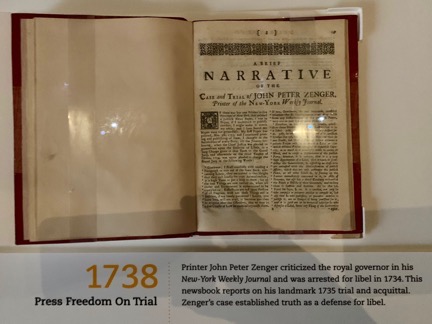
Here’s an example of a document from the News History Gallery.
News History Gallery shows 300 newspapers (and their predecessors) dating back to the Middle Ages, with interpretive signs that help you understand the significance of each.
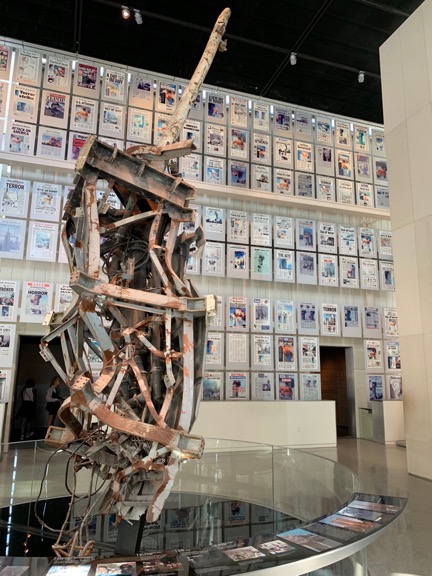
The 9/11 Gallery is very moving in an eerie sort of way.
9/11 Gallery includes the broadcast tower from the top of the World Trade Center, along with front pages from all over the world. It’s a pretty intense display, especially the section that shows the possessions of a journalist who went in with some firefighters and was killed when one of the towers fell.
- First Amendment Gallery has displays related to the five freedoms of the First Amendment.
- Internet, TV, and Radio Gallery traces the history of the spread of news information.
- First Dogs is an exhibit of photos of Presidents with their pets. It was a fun break from the reality of today’s news cycle.
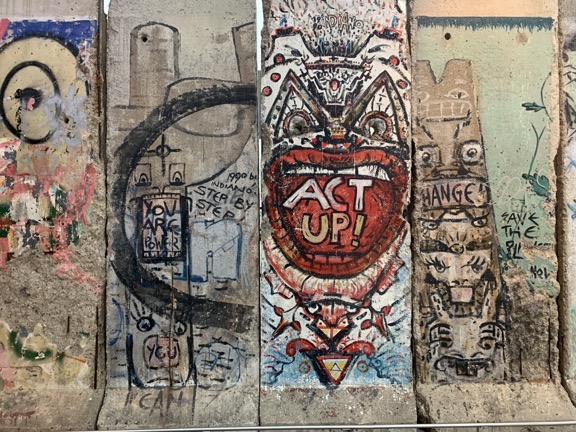
- The Berlin Wall is a two-story exhibit that the Newseum building was actually constructed around. It includes several panels from the Berlin Wall — more gathered in any single place outside Berlin — and most of a guard tower, as well as many exhibits explaining what the wall was all about and how it curbed the spread of information.
Sections of the Berlin Wall on display at the Newseum.
As I mentioned earlier, although I got a glimpse of many of these things during the guided tour, I actually came back the next day for a much better look. In between, I had dinner at the Carving Room, which a friend recommended. (The food wasn’t bad but the service sucked.) I wound up taking half my meal back to the place I was staying. I did a lot of walking that day, but when it came time to go back to the AirBnB, I used Lyft again. The shared ride service was incredibly cheap and a lot more convenient than the Metro.
The next morning, I returned to the Newseum to really focus on the exhibits that I wanted to see. Honestly, if you’re the kind of person who walks through a museum just looking at the exhibits without reading the signs that go with them, you’re missing half (at least) of the experience.
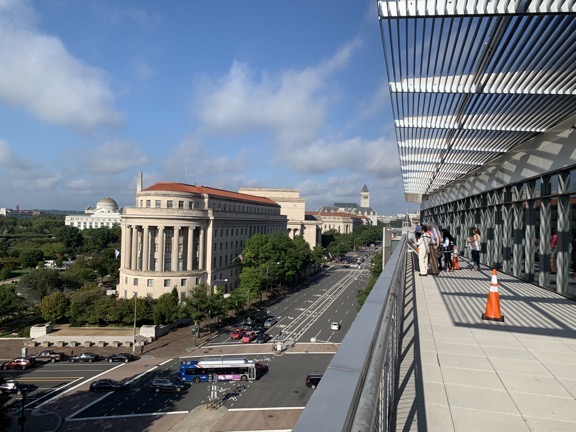
It was a really beautiful day — the first day of my visit with plenty of sun and bright blue skies. I started my visit to the Newseum with a trip up to the outdoor patio on the top floor. From there, I could look up and down Pennsylvania Avenue. I’d revisit that spot later in the day, before leaving to visit my next stop just to take in that view one more time.
The view up Pennsylvania Avenue on the Newseum patio.
A Quick Walk through the National Gallery of Art
My next intended destination was the Air and Space Museum, which was on the other side of the National Mall. I had two ways to get there: I could go the long way east on Pennsylvania Avenue to Fourth Street, walk south across the Mall, and then walk west up Jefferson Drive. Or I could cut pretty much straight through the National Gallery of Art and follow the walkway across the mall right to Air and Space. I took the shortcut.
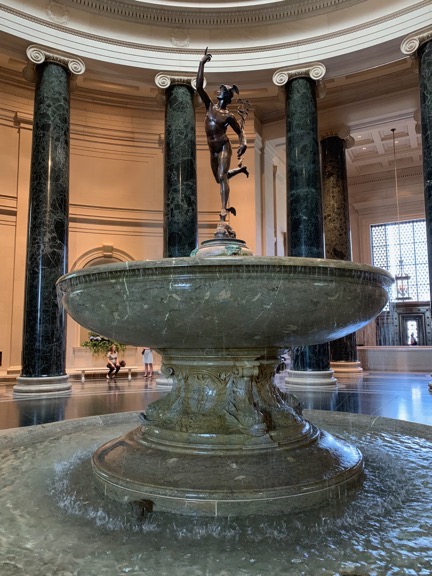
This fountain stands in the main entrance hall for the National Gallery of Art.
I really didn’t intend to spend any time looking at art, but the shortcut required me take a bit of a roundabout route through the building. Along the way was the gift shop, which I think I spent 30 minutes touring. I wound up buying a book and getting some ideas for a jewelry design. Then I made my way out to the south exit, stopping briefly to a few photos of the amazing architecture in the building.
The Smithsonian National Air and Space Museum
I’ll admit it: the main reason I came to Washington DC was to see the National Air and Space Museum. The first time I came to Washington, when I was a kid, it might not have even existed. The second time, when I was still a relatively young adult, I had limited interest in aviation. Now, with almost 20 years as a pilot under my belt and some experience with rebuilt or replica antique aircraft, I was very interested in aviation. I had been itching to visit Air and Space for years.
The National Air and Space Museum has two locations. The main location — the one most tourists visit — is the one in Washington DC. That’s the one I’d see that day. The other one is called the Steven F. Udvar-Hazy Center — named for its benefactor — is in Chantilly, VA. I’d see that the next day.
But first I needed lunch. Always eager to try different ethnic foods, I walked over to the National Museum of the American Indian next door. I’d heard very good things about its cafe. The museum itself looked interesting but I admit that it was not on my list of things to see, mostly because living in Arizona for 15 years, visiting various Native American museums (including the excellent Heard Museum in Phoenix and the National Museum of the American Indian in New York City), and spending an unusual amount of time on the Hopi and Navajo reservations had pretty much overdosed me on Native American culture. But the thought of trying some unusual native food enticed me into the building. The cafe was split into regional areas, each one serving up some native food. I had something from Central America — I can’t remember what — and it was good. Of all the museums I visited, this one definitely had the best food, although it was typical cafeteria style serving.
Next door, at the Air and Space Museum, I went through security and then checked my bag and jacket again and began exploring. I’d been wanting to see a planetarium show for a while and there was a planetarium on the premises. The only show on the schedule that looked interesting, Journey to the Stars, was showing just one more time that day in just a few minutes, so I bought a ticket and got on line. Soon I was seated near the wall in the round planetarium, eager to see that machine in the middle do its magic. I was disappointed. Instead of giving us a true planetarium show, they showed a specially formatted movie on the domed ceiling. It wasn’t terrible, but it wasn’t what I had come for.
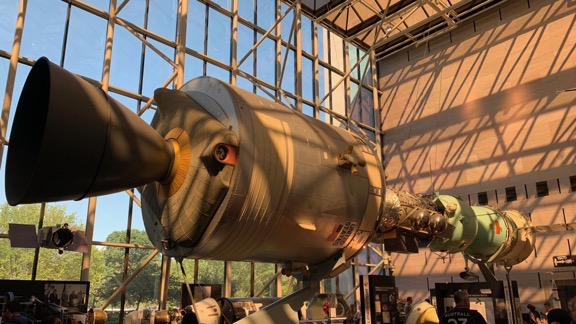
I think that set the tone for the rest of my visit. Don’t get me wrong — there were a lot of really great exhibits and displays. The Spirit of St. Louis hung from the ceiling. The real original Wright Flyer sat in its own exhibit room. There was an extremely informative exhibit about time and navigation. The Golden Age of Flight told the story, with plenty of aircraft on display, of the period between the two world wars, when aviation first began to thrive. Pioneers of Flight covered “firsts” for pilots and aircraft. Apollo to the Moon was an extremely informative display about the moon missions.

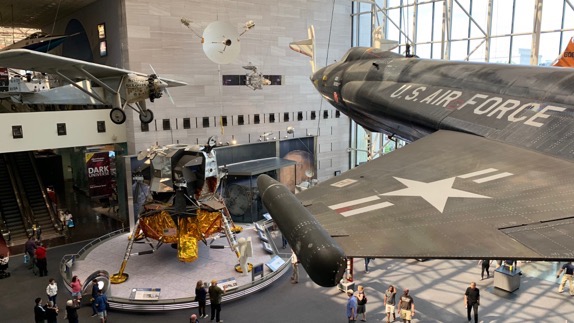
The Spirit of St. Louis is hanging from the ceiling at the Air and Space Museum in Washington DC — with a lunar lander right below it.

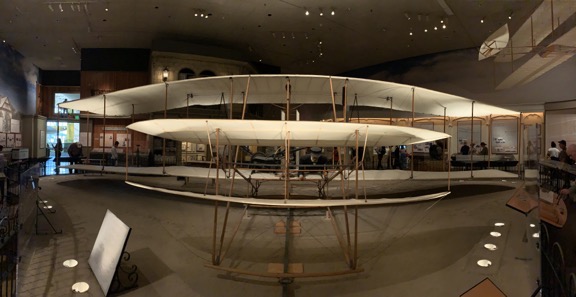
A panoramic image of the original Wright Flyer. This is the first aircraft that attained controllable, self-powered flight at Kitty Hawk in 1903.

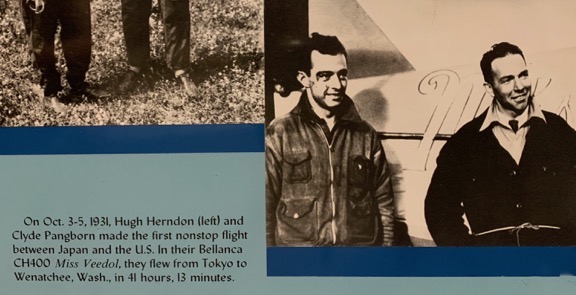
Herndon and Pangborn could be found on a plaque in one of the galleries. Wenatchee’s local airport is named for Pangborn. Did you know that it had such a place in aviation history? Only they didn’t land at the airport because it didn’t exist yet; they landed at Fancher Field, which is now a housing development called Fancher Heights.
I loved the lighting in the museum — natural light through huge windows. This is one of the last shots I took during my visit.
I wandered around and took a ton of photos. Along the way, I noticed what I thought was a disproportionately large percentage of displays designed for children. Explanations were over simplified — no, I didn’t use the phrase dumbed down, although it did come to mind — and questions were left unanswered. There was a lot of touch this, push this button, slide this drawer, compare this to something you know kind of stuff. There were entire galleries I didn’t bother going into because they looked as if they were for kids. Not having kids and not really enjoying their company — especially noisy school groups — I stayed clear. But it left me feeling somewhat disappointed. I didn’t know what was missing, but I felt as if the museum could have been a lot better.
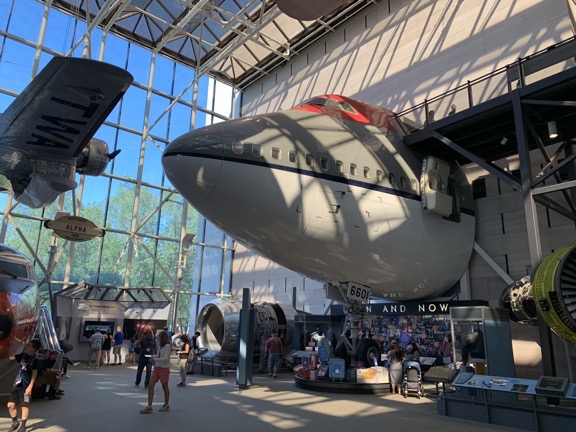
I think this is an example of one of the gee whiz dumbed down displays: a 747 nose poking out of a wall. Although I’m sure there was a plaque about it somewhere, I didn’t see it. The plane could not be accessed by visitors. It just hung there.
And then I was done. I’d seen everything that looked interesting to me and was ready to move on.
Scooting to Lincoln
I retrieved my things and stepped outside. It was still a nice day and it was definitely too early to go back to my AirBnB cubbyhole. It was also my last day in Washington DC so I wanted to make it count. I thought a trip up to the Washington Monument might be nice and thought I’d try walking. It wasn’t far — not even a mile — but it was hot out. The humidity, which I’m not used to at all, was killing me. (Not literally, but you know what I mean.)
My GoPedBack when I lived in Arizona many years ago and had more money than I knew what to do with, I bought myself a a gas powered scooter called a GoPed. The idea was to fold this thing up and take it with me in my helicopter so I’d have ground transportation when I arrived. And that’s what I did — but just once. You see, I took it to Sedona and climbed aboard to ride down from Airport Mesa into town. Along the way — fortunately, near the start of the ride, was a cattle guard. That’s when I learned that a scooters tiny wheels are not compatible with cattle guards. The scooter stopped short but I didn’t. I landed on my face and broke my nose — a fact that I’ve keep pretty much secret for the past 10 years. I’ve done a lot of dumb things in my life, but that was the dumbest. After that, I wasn’t very interested in riding the GoPed. I wound up giving it away to someone in exchange for him removing the surveillance cameras from my hangar before I moved to Washington.
And, in a weird twist of fate, surgery to fix my crooked nose was not necessary because within a year I had another accident: I tripped over the JetA hose at the airport while fueling a Lear jet. When I landed on my face again, the resulting broken nose actually fixed the first break. Truth is stranger than fiction. The way I see it, I was gypped out of the nose job that I’ve always needed.
So when I saw the row of five Skip rental scooters, I stopped for a closer look. I’d been seeing lots of people scooting around Washington DC on these electric vehicles. With just a long stretch of fine gravel “sidewalk” along the side of the mall and a few street crossings, it didn’t seem as if it would be a difficult ride. Why not give it a go?
After struggling a bit to make the app I downloaded work, I was heading west along the south side of the Mall, moving at a good clip. No, I didn’t have a helmet on. Although they say you have to wear one, there wasn’t one available with the scooter. But you can bet your ass that I was keeping a sharp lookout for potholes. (Cattle guards were unlikely.)
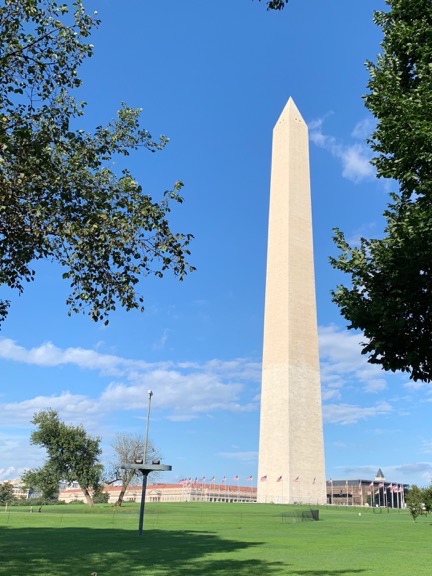
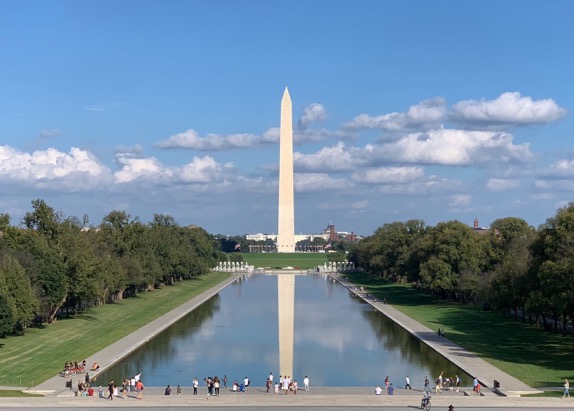
The Washington Monument was deserted that day because it was closed.
The ride was quick and very enjoyable. The breeze cooled me down and the humidity stopped bothering me so much. But I was disappointed when I got to the Washington Monument: it was closed to the public. Apparently, they’re upgrading the elevator and it won’t be open again until spring 2019.
So I kept going. The Lincoln Memorial wasn’t far beyond it and I was having fun. I scooted up there, stopping once to get a shot of the Monument framed by the trees along the path and a fountain I didn’t realize existed between it and the Lincoln Memorial.

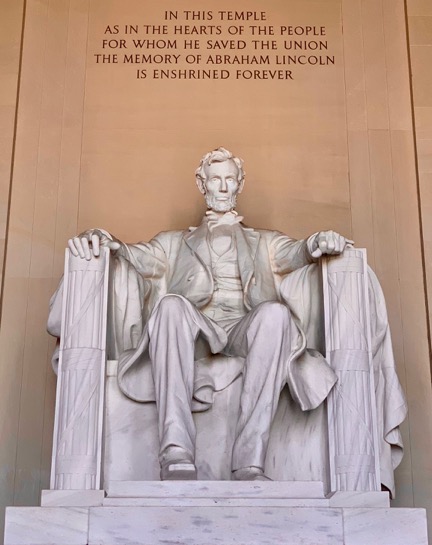
Although Republicans like to point out that Lincoln was a republican, I truly believe that today’s Republican Party would horrify and disgust him.
Once I reached the Lincoln Memorial — which was a lot more crowded on that Wednesday afternoon than I expected it to be — I found a place off the path near a bike rack filled with rental bikes to leave the scooter and tapped the appropriate buttons on my phone to “return” it. Then I walked up the steps, past dozens of people sitting in the shade, and visited the big statue of Mr. Lincoln. As I looked up at his wise old face I wondered what he would think of “the party of Lincoln” today, led by a barely literate, narcissistic conman who spreads hateful messages that divide the country he fought so hard to keep together 150 years ago.
I walked to the north wing of the building where Lincoln’s second inaugural address had been inscribed on the wall. (The Gettysburg Address is on the wall in the south wing.) Although it touches on many religious themes and quotes Jesus more than once, it finishes with words that I wish a real president would take to heart sometime soon:
With malice toward none, with charity for all, with firmness in the right as God gives us to see the right, let us strive on to finish the work we are in, to bind up the nation’s wounds, to care for him who shall have borne the battle and for his widow and his orphan, to do all which may achieve and cherish a just and lasting peace among ourselves and with all nations.
Lincoln was a wise man, but I can’t see anything he had in common with today’s Republicans.
Afterwards, I went outside and sat on the steps. The sun was setting on the other side of the building so the steps were in the shade. A lot of people were gathered, sitting around, chatting, resting. I saw the spot on one of the landings where Martin Luther King, Jr. had made his “I Have a Dream” speech in 1963; someone had splashed the letters engraved there with water.

In case you’re wondering, this is what Lincoln is looking out at.
Getting a Lyft from there back to the AirBnB took a long time with three scheduled drivers cancelling before one finally arrived. When I got back to the tiny apartment, I ate leftovers from the day before. I was asleep before 9.
Going to Virginia
I checked out of my AirBnB unit around 8 AM and headed toward the metro station on foot carrying my bags. Every time I take a small bag without wheels I swear I’ll use a wheelie bag next time but I still find myself using shoulder bags. That wouldn’t be so bad if I didn’t buy so many books along the way.
This was the best breakfast of my trip. The coffee cup was the size of a small soup bowl.
I stopped for breakfast at a cafe near the Eastern Market metro stop. They gave me a huge cup of coffee with my smoked salmon omelette.
Then I used the Metro card I’d bought on my first day to hop on a train bound for Virginia. I made sure I got on the right train so I wouldn’t have to change trains. It took at least 30 minutes to get to Wiehle-Reston East station. Once there, I called a Lyft and took that to the Steven F Udavar-Hazy Center, which is right near Dulles Airport.
At the National Air and Space Museum’s Udavar-Hazy Center
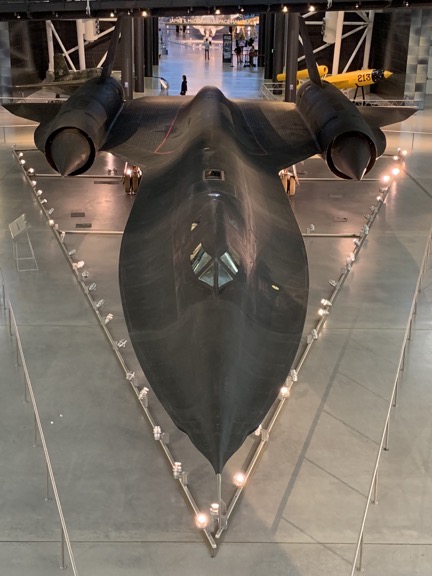
In your face: an SR-71 is the first thing you see when you arrive.
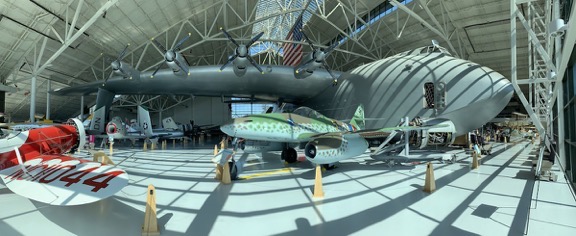
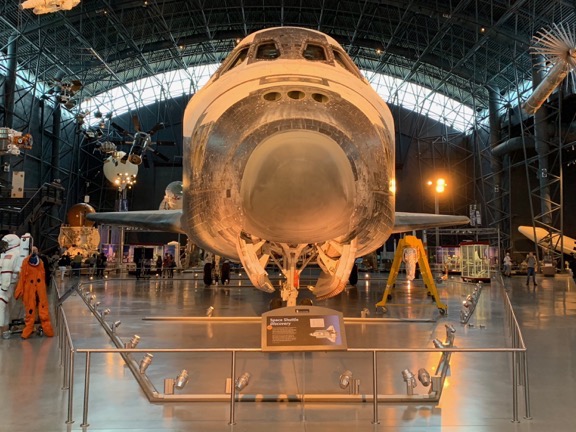
It was raining pretty hard when I arrived. I walked in, went through security, and checked all of my bags in a locker. Then I walked into the biggest hangar I’d ever been in and let my jaw drop. I mean, how could I not? I was standing on a platform overlooking the hangar floor with a SR-71 Blackbird right in front of me and a space shuttle in the room behind it. Parked on the floor and hanging from the ceiling on both sides of me were well over 100 aeronautically significant airplanes.
Completely overwhelmed by what I was seeing, I decided to take a free guided tour. I went down to the tour meet-up area where a bunch of people were already waiting. They split the group in two and I went with one guided by a retired aeronautical engineer. When he learned that I was from Washington State, he began stressing the world Boeing and looking pointedly at me every time he said it. (Boeing is based in Seattle. I don’t live anywhere near Seattle.)
He spent 90 minutes showing us around, mostly in the pre-1920 Aviation area and military aviation areas covering the period up to the end of World War II. It was the tip of the iceberg. When he let us loose, I walked the entire floor, reading plaques for anything that interested me, and taking dozens of photos.
The Discovery Space Shuttle is in a room surrounded space stuff. When I put a few photos on Twitter, a Twitter friend of mine asked if a computer unit he used to work on (The IDEX II Workstation) was still on display; I went back to this room, found it, and sent him a photo.
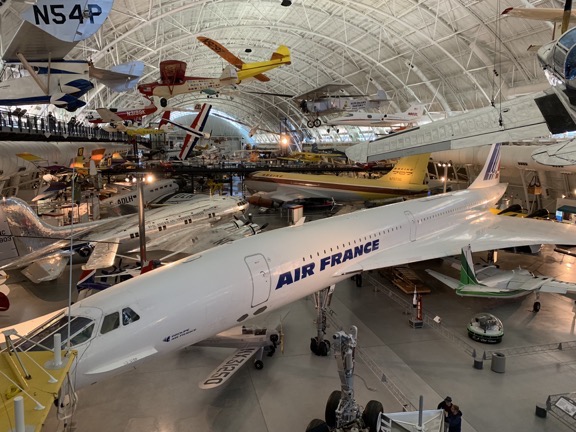
Planes, planes, and more planes. This is the commercial and general aviation side of the building, with a Concorde, Boeing 707 (367-80 or “Dash 80”), and I think a DC-3(?) with all kind of planes hanging around them. The Vertical Flight area was in the far corner of this room.
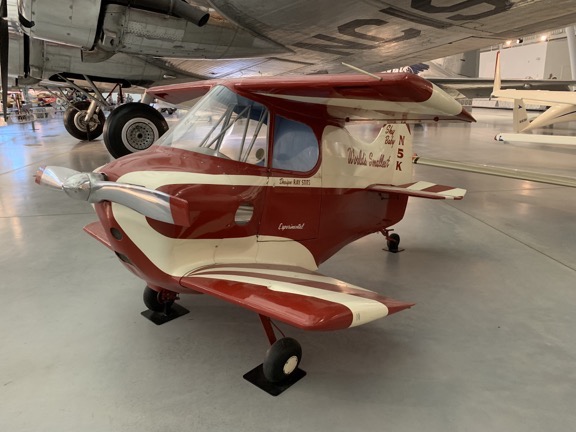
This plane was so small that it fit under the wing of another plane.
I won’t share all the photos. (Seriously: after reading this far you must be exhausted.) I will say this: if you have any interest whatsoever in aviation, you must go visit the Steven F. Udvar-Hazy Center in Chantilly, VA. Honestly — it will blow you away. This is an aviation museum designed for real aviation enthusiasts. Kids would likely get bored within an hour, but if you are fascinated by aviation and want to see and learn about all kinds of aircraft, this is the place to visit.
I spent nearly the whole day there. By 3 PM, I was hungry and very disappointed to see that the only food available was at the McDonald’s inside the museum. (Really? Is that the best they can do?) I bought some sort of chicken thing that actually contained chicken, some fries, and one of their cheap hot-fudge sundaes.
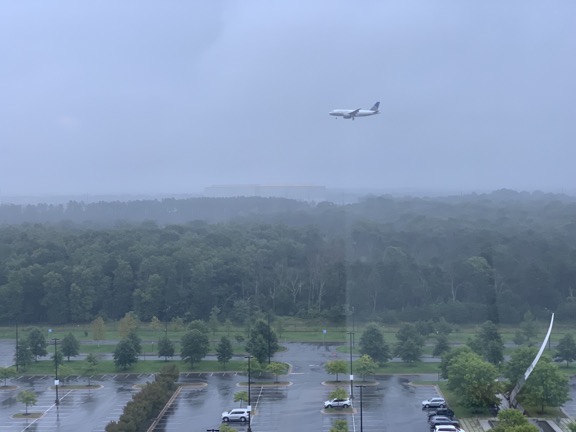
After my late lunch, I made my way up to the observation tower to watch the planes coming in for landing at Dulles. It was a perfectly miserable day with low ceilings and heavy rain. The jets came out of the clouds not far from the tower, which has 360° views of the surrounding area. There was an aviation radio tuned into the approach (but sadly not tower) frequency. I stayed for about 20 minutes; while I was there a group of high school students came up with sketch books and sketched various part of the tower’s inside.
What a miserable day, eh?
Winding Down and Heading Out
By about 4:30, I was ready to go. I called the Fairfield Inn, where I’d booked a room, and arranged for a shuttle. Soon I was in a very comfortable business style hotel room that looked out over the hotel’s front entrance. I settled in to watch a movie on HBO. I was exhausted.
Later, I found a Chinese restaurant online that delivered and ordered enough food to meet their delivery minimums. I was surprised when the delivery guy brought it right to my room. It was really good but there was a ton leftover. I stowed it in the room’s little fridge.
In the morning, I woke early, as I usually do. I washed all of my dirty clothes in the laundry room on the premises. While I was waiting for it to finish, I checked out the free breakfast. I was absolutely appalled by the mess left by other guests and not tended to by any hotel staff. I’m talking about food on the floor and countertops, abandoned meals, lack of forks and napkins, empty coffee urns. And that was less than an hour after breakfast opened! It was a real shame; the hotel was nice and very comfortable, but they completely dropped the ball on the breakfast.
By 10:30, I was heading out in the hotel shuttle. Rather than go all the way back into the city for a return train ride, I’d booked a flight on American Airlines to Newark. I could carry on my bag. By some miracle, I got TSA Pre√ so security went quickly. The flight was short and I tracked our progress on ForeFlight along the way, seeing a lot of familiar territory from the air.
My brother met me at the airport and we went back to his place where Penny was very happy to see me.
We ate that leftover Chinese food for dinner.
(Continued in Part 4: Killing Time in New Jersey)