I start to think long and hard about my involvement in social media and whether it’s worth the time I spend on it. Maybe you should, too.
Back in the mid 2000s, I was at the height of my writing career. Churning out at least five books a year with two of them guaranteed bestsellers — well, “bestsellers” by tech book standards, anyway; I wasn’t arguing with my royalty checks — I was on the leading edge of so much end user level stuff. It seemed natural that I should dive into social media, which was so new at the time. I may have had an account on MySpace, but it was Twitter, which I joined in 2007, that really attracted me.
Twitter
Back then, it was possible to view the entire system timeline just by going to Twittr.com. (Yes, in the very early days, there was no E. That was a popular naming trend back then. Drop the E in front of the R. Tumblr is another example.) You’d just go to that home page, read the tweets of people all over the world, and pick out the accounts you wanted to follow. I still follow the first person I followed on Twitter — although I follow him on Mastodon now. (More on that in a moment.)
Twitter became an important part of my lifestyle. It was my “office watercooler,” so to speak. I worked alone at a home office, working long, 12-hour days while on a book project and then taking time off to recharge before the next one. My future wasband either worked from his home office or back on the East Coast or, later, from an office down in the Phoenix area. (In the end, it got to be a sort of “job of the month club” for him, bouncing from one job to another. At the very end, it was hard to keep track.) Since my work was mostly solitary, each time I came up from a highly focused writing session for a brief rest before diving back in, I looked for someone to talk to. If my future wasband was busy or not around, I turned to my Twitter friends.
I started to build real-life friendships with some of these people. I met a surprising number of them in person. In those days, I was still traveling a bit for work and would make a point of meeting up with ones who lived at my work destination. Coffee. Lunch. Whatever. These people were folks I could chat with online during the day, cutting a bit of the loneliness out of my workday. We chatted about all kinds of things, from the weather and photography to travel and cooking. Just about anything. (That’s one of the benefits of being a polymath: you can find something to talk about with almost anyone.)
Also, pretty early on, when I was still producing video content for Lynda.com (not LinkedIn Learning), I wrote the very first video courses — or training material at all — about using Twitter. I think I revised that course two times before they pulled it away from me and handed it to in-house authors they didn’t have to pay royalties to. (And that wasn’t the only successful course they snatched away from me to bring in-house. They also took my WordPress course, which was a real money-maker for me for several years. I guess you can see why I won’t develop courses for them anymore.)
Facebook
I also hopped onto Facebook around the same time, although my use of that service didn’t pick up until around 2010. I didn’t like it quite as much. It seemed juvenile. People posting sometimes idiotic, sometimes misleading memes created by others. There are only so many cat pictures a person can look at in a day. Not many original thoughts being shared. Actually, not much of anything that could be considered a “thought.” It also upset me to learn that several real-world friends and family members appeared to have Nazi leanings. Do I really need to know that? Sometimes ignorance really is bliss.
And then there was the time my sister, a life-long Republican, posted a pro-Democrat sentiment on her Facebook wall. My mother, in her infinite wisdom, had the nerve to lecture my sister, right there on Facebook for everyone to see. My sister deleted my mother’s comment and stopped talking to her for a while. I just blocked my mother. Who needs to worry about shit like that?
LinkedIn
I might have hopped on LinkedIn before Facebook. In the beginning, LinkedIn looked like a serious social networking website where I might actually make connections to people who could move my careers forward. (Yes, back then I had two active careers: writing and flying helicopters.) But I never had any success making solid professional contacts there and couldn’t see any reason to duplicate personal content I was already sharing on other social media. And then the spam began; it got to the point that every time I connected to LinkedIn, the only new content directed to me was spam from people claiming to know someone I barely knew or had heard of, trying to sell me on their services.
In fact, sometime between 2010 and 2014, I started to realize that actively participating in three social media sites — Twitter, Facebook, and LinkedIn — was taking a lot of time and effort. More than I wanted to give. LinkedIn was mostly abandoned; I killed the account completely when the spam started arriving in my email inbox and I couldn’t seem to shut it off.
Instagram, TikTok, others
Fortunately, I never got sucked into Instagram, like so many other folks have, although I think I did set up at least once account. Again, I felt my hands were already full with the social media I “had” to be on. I did not want to lose more hours of my day building a presence somewhere else.
Ditto for TikTok — most of the content I’ve seen there is amateurish, juvenile, or both. I think TikTok is the perfect platform for today’s vapid population of low attention span, gullible people. I do believe China is (or will be) using it to sway popular opinion. It won’t surprise me at all if it works. Anyone willing to waste hours of their day on the kind of crap the algorithm serves them — no matter how “good” that algorithm is at predicting what people like — is already being led around by a leash.
Social Media and the Publishing World
Anyway, my publishers were thrilled that I had a social media presence. That presence was enhanced quite a bit when I earned a “verified” checkmark on my Twitter account. (Back in the day, verified meant that they’d checked your identity and you were who they said you were. Twitter only performed this service for people with a certain level of fame, which I’d achieved at the time through my writing. Heck, for a while I even had a Wikipedia page.)
Keep in mind, this is still before the word influencer began being used. Authors at my level weren’t influencers yet — and I don’t think I ever was one. But readers — potential and otherwise — could find us online and be “friends” with us. We could post about our work and people who followed us could learn about it. All without costing the publishers a single cent of their advertising budgets. All the work fell to the authors and it sometimes was quite a bit of work.
And this is how things remain today in the publishing world. Part of the author evaluation process is an examination of the author’s social media reach and content. It’s crazy because it forces authors to build an online presence that takes them away from their actual work. It also limits what an author can say on social media — one unpopular tweet can land an author in seriously hot water. (And I’m sure I could find at least six good examples of this, but since I’m writing this in the middle of the California desert with no cell signal, I can’t look now.)
2015 to 2022
Let’s fast-forward to the mid 2010s. By this point, I was pretty much addicted to participation in social media, including Twitter and Facebook. (I’d mostly given up on LinkedIn by then.)
My writing career had wound down — who buys computer how-to books these days? — and my flying career had taken off (no pun intended). I was happily divorced, living in a home I had built to my specifications on 10 acres of view property in Washington state. I was exploring new hobbies like beekeeping and, later, silversmithing. I had a great garden. I had a little jet boat I’d take out on the Columbia River. I had real-life friends who lived nearby in addition to my social media friends.
The need to keep my publishers happy by maintaining a social media presence had pretty much faded away. But still, I was spending hours every day with my nose in my phone or iPad, scrolling through Twitter and Facebook, clicking Like buttons and Retweet buttons and replying to posts I had something to say about.
It was around then that I started to realize that Facebook wasn’t showing me all of the posts by all of the people I followed. It was showing me a selection of them. If I went to the person’s wall — do they still call it that? — I would see what they’d posted, but I had no patience to do that for everyone I wanted to keep up with.
The posts that seemed to come up the most were political memes. Holy crap! How many hateful, usually misleading memes are out there? Are people so freaking stupid that they can’t comprehend a thought unless it’s 25 words or less in big type on a picture?
And then there were the ads. They never seemed to stop. But when they started showing me ads related to things I’d searched for on Google, I completely wigged out. Facebook was tracking my activity across the Internet and using that info to display advertisements for things it thought I might like. This had to stop.
In the meantime, Twitter grew exponentially and became the platform of choice for the news media to quote. Not a day went by when a television newscast didn’t include at least one tweet.
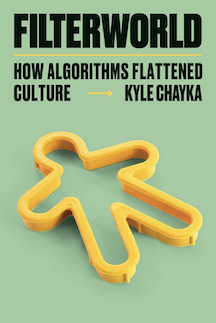
Understanding the AlgorithmIf you’re curious about how the algorithm used by social media companies affects what you see and how you feel about it, you really ought to check out Filterworld: How Algorithms Flattened Culture by Kyle Chayka. This book takes an extremely detailed look at how algorithms are used to addict us to social media and then manipulate us when we’re there. It’s full of real-life stories as examples.
I “read” it in audiobook format on a long drive and was really struck by a lot of things it covered, mostly because I’ve already seen examples in my own life and social media use. It has made me glad I’ve gotten off of algorithm-based social media platforms but has also made me think hard about the time I spend online.
And then I noticed that tweets weren’t appearing in the reverse chronological order I loved. And that tweets were missing. Twitter, like Facebook, was employing an algorithm that determined what it would show me and what order that content would appear in. Among ads. I found myself repeatedly going into settings to revert back to the chronological timeline of all the tweets by people I followed.
In the perfectly coined word by Cory Doctorow, social media — all social media — was becoming enshittified. After getting us addicted to their platforms, they were adding crappy “features” no one wanted to display advertising, change opinions, and collect information about us that they could sell to third parties. You know what they say: nothing is free. If you’re using a free service, maybe you’re the product they’re selling to someone else.
I knew what was going on and I didn’t want to be part of it. Something had to give.
After staying off Facebook for a whole year, I decided to delete my account. The hardest part about it was not losing touch with the few real friends I had there. It was knowing that the hours I’d spent participating on the service, giving them content that they might or might not show to the people who followed me, was time ultimately wasted. All that content would be deleted. Gone for good. (At least I hope so.)
I was down to just one social media account: Twitter.
2022 and Beyond
My love affair — fueled, in part by addiction — for Twitter soured considerably when the Space Karen, Elon Musk, bought it. It didn’t take long for him to try to monetize it by allowing people to pay for a “verified” check mark and trying to force those of us who already had one to pay up to keep it. I elected not to pay and found myself suddenly unverified. I was no longer who I said I was?

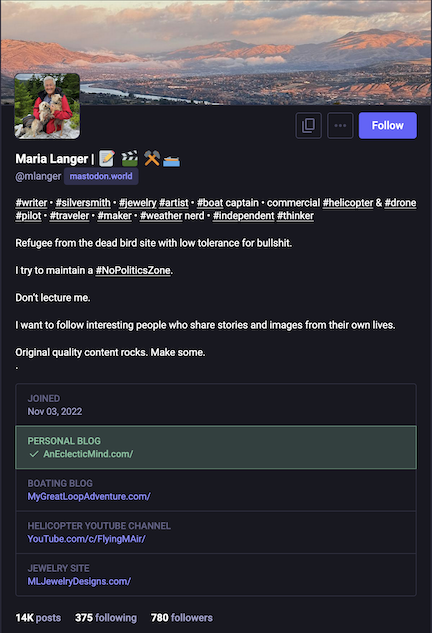
My current profile on Mastodon.
I saw the way things were going — although I admit I never expected it to get as bad as it did. I set up an account on Mastodon, an open source platform that networks servers around the world, very much like the old Fidonet network my BBS was part of in the mid 1990s. Over time, I weaned myself off of Twitter and onto Mastodon. I fully expected it to meet my “watercooler” needs, bringing me a handful of friends I could chat with online no matter where I was.
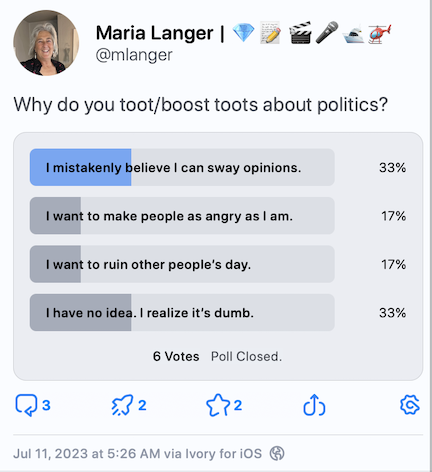
Mastodon reminded me of Twitter when I first joined. No algorithm. Posts appear in reverse chronological order. I see every toot by everyone I follow — unless, of course, I blocked certain words or phrases with filters. I currently use filters extensively on Mastodon to block out as much political content as possible. I don’t need to follow politics on social media, where memes and desperate pleas attached to article links fill our minds with so much oversimplified crap.
When I learned my Twitter content was being used to feed AI systems, I wanted my 150,000+ tweets off Twitter. I paid TweetDeleter to do the job for me. Due to constraints on the Twitter platform, it took two months.
I set up Mastodon to automatically delete toots after a year. I had realized that nothing I shared online was so important that it needed to be kept forever. Life is fleeting, social media life is even more fleeting.
And this is where I am now:
- I still have my Twitter account. I have to hold onto the user name so no one else gets it and tries to impersonate me. (Yes, it has happened before.) But I rarely look at it and, if you looked at it now, it would tell you to find me on Mastodon.
- I participate throughout the day every day on Mastodon. Am I addicted? Sadly, I believe so.
My Current State of Dissatisfaction
And that brings me to the point of this post.
You see, even though I believe that Mastodon is my best option for participating in social media — keeping in mind that my solitary lifestyle gives me a need for the always attended “watercooler” for chatting with others — I’m finding myself less and less satisfied with it. Simply said, I don’t think it’s meeting my real need, which is thoughtful or amusing conversation.
If I wanted a distraction, I’d look at YouTube or do a crossword puzzle. Or, for Pete’s sake, work on one of my hobbies. (Did I mention that I recently started linocut and bookbinding? It never ends.)
But it’s not just distraction I want. I want meaningful conversation with intelligent people who don’t get bent out of shape if you don’t fully agree with everything they toot. People who aren’t sucked into current events so deeply that all they can do is whine about the current political landscape and share idiotic memes. People who can share a joke or provide insight about something I mentioned or share their own interesting experiences. People who aren’t so focused on the illusion of being a better human that all they can do is toot about the latest catastrophe or outrage that should make us sad or angry or frustrated and boost the toots of every out-of-luck user begging for money. People who don’t hate.
Am I getting that on Mastodon? Yes, to a certain extent. I fine-tune the accounts I follow daily, cutting out the ones who toot things I don’t want to see and turning off boosts for the ones who share everything they like, regardless of its more universal appeal. (The theory these people cling to is that they’re doing the original posters a favor by sharing instead of liking since there’s no algorithm to give them exposure. What they don’t realize is that they become one of thousands of algorithms, and that by sharing nearly everything, they’re filling our feeds with too much stuff.
I can count on two hands the accounts I interact with — keeping in mind that the only thing I want from social media is interaction. The rest is a steady stream of photographs that may or may not have been taken by the person who originally posted it. (I recently blocked the Pixelfed instance and that really cut back on the flood of photos. Enough remain.) And don’t get me started on the holier-than-thou mavens who find it necessary to tell us all how to toot and include alt text and use hashtags. I tell people how to mute and block people like that. ;-)
In general, however, social media is not serving me what I want to be served. It’s not filling the socialization gap in my life that’s inherent with living or traveling alone in a relatively remote area. And that’s got me wondering why I waste so much time on it.
The Solution
The solution is easy:
- Cut back on social media use. I’ve tried before but will try again to limit my access to social media to 7 PM to 7 AM. In other words, no scrolling during the day. I’m also going to try to limit all access to less than one hour a day.
- Continue to fine-tune the list of people I follow to dump the ones who share stuff I don’t care about and don’t interact with me and replace them with more interesting people. (I’ve been doing that a lot lately.)
- Turn off boosts (like a retweet or share) for the people who share a lot of crap I don’t want to see.
- Continue to fine-tune my filters to block out content I don’t want to see. These days, it’s pretty much anything to do with politics, war, gender and race issues, gaming, and programming. I figure that I already see just a fraction of what the people I follow post because of my extensive filtering. That’s fine with me.
While I don’t think any of these things will make my participation in social media more satisfying, I do believe that it’ll help break my addiction (because of less access) and help keep it from getting any more disappointing than it actually is.
The next step, of course, is dropping out of this last social media platform and staying off social media completely. But I don’t think I’m quite ready for that yet.
In the meantime, what do you think about your participation in social media? Is it giving you everything you want to need? Are you satisfied? Do you feel as if you’re using your social media time productively or wasting it?