In my possession for 12 years before last week’s sale, it played a part in the theater of my crazy divorce.

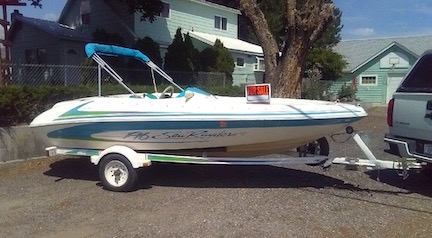
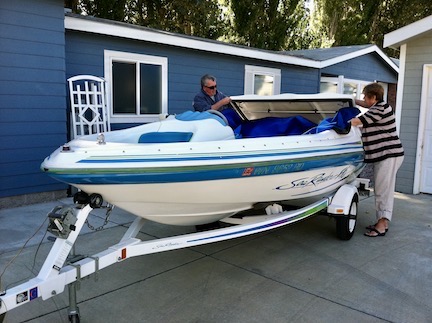
Here’s my little jet boat parked in front of Bob’s house on the corner. He also sold my Yamaha motorcycle for me. Now if only I can get him to take my truck camper…
Last week, I sold my little jet boat.
Or my friend Bob did. He lives on a main road and had a caller within 30 minutes of putting the For Sale sign on the boat where it was parked on the corner at his house. The next day, after a launch and engine run, he had cash in hand and the new owner was driving away.
About the Boat
The boat was 28 years old when I sold it. That is not a typo.

My friend Pete and the boat’s previous owner open the engine lid for a look inside. It was immaculate.
I bought it in late summer 2011 from the original owner, a couple who lived at Crescent Bar in Quincy, WA. I’m pretty sure my future wasband told me not to buy it — he didn’t like me buying anything anymore, even though I always bought with money I’d earned and not our joint funds.
It was a fun little boat. At the age of 16 years old — when I bought it — it was in amazing condition, having been stored indoors for most of its life. The one season the original owners had left it in the water on a mooring ball at Crescent Bar, the upholstery had taken a beating and they’d replaced it. It looked great. It started right up. It was easy to tow, easy to launch by myself, easy to drive, and easy to get back on the trailer by myself.
Because it was a jet boat, it seemed to steer from somewhere about 1/3 down the boat — instead of from the back. It was a weird sensation, especially at high speed. Virtually no body roll. It would just seemingly slide into a turn.
It had a 120 horsepower jet boat engine which, considering the boat’s diminutive size — it was only about 17 feet long — seems like a lot. But it didn’t have enough power to pull a skier — I was told that by the owner when I bought it. That was fine with me. All I wanted was a way to get out on the water and have some fun. The price of admission — just $1,500 — made it a no-brainer to buy.
Winter 2011/2012
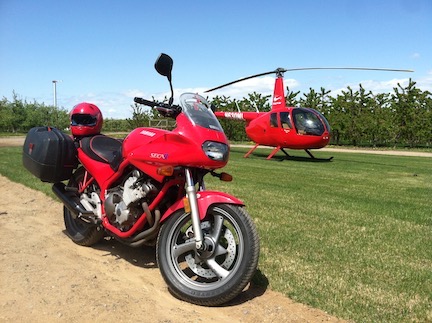
I had one of my two motorcycles shipped up to Washington because I was spending every summer there and wanted something to get around on other than my wasband’s truck. Here it is with my old helicopter parked at my friend Pete’s winery/orchard. Both of these are gone now; more life subchapters closed.
I couldn’t bring it home with me to where I was still living in Arizona because I had to drag home the fifth wheel I spent my summer working months in. Instead, I made arrangements to have it and my old Yamaha Seca II motorcycle, which I’d had shipped to Washington earlier that year, stored indoors for the winter.
I went home and had a miserable winter with my future wasband, trying to keep our marriage together by living with him during the week in his Phoenix condo and coming home with him on weekends. If anything, living in the cave-like condo he’d bought (for reasons I still don’t understand) made matters worse.
In the spring of 2012, I went back to Washington for my fifth consecutive season of cherry drying. I was growing my business there and had hired another pilot to help me during the busiest part of the season. I was also working on a Mac OS book revision — I was still writing computer books back then — and picking up flying work by taking people to wineries with the helicopter. It was summer 2012 and my flying business was really looking up.
When I wasn’t writing or flying and there wasn’t rain in the forecast, I was able to take my little jet boat out on the river from Crescent Bar and ride my motorcycle. My summer job was looking more and more like a paid summer vacation every year.

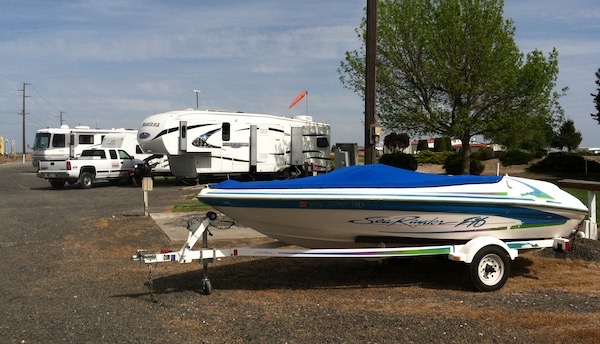
Here’s the boat parked at the Colokum Ridge Golf Course campground, where I started each summer. You can see my old Montana fifth wheel and my wasband’s white Chevy truck in the background.
The Divorce Bullshit Begins
The idiot I was was dumb enough to marry called on my birthday to tell me he wanted a divorce. (Can you believe that shit?) A lot of weird stuff followed and if you look hard enough in this blog under early posts tagged divorce you should find plenty of that.
Meanwhile, I was stuck in Washington for work and I wasn’t sulking around. I was doing what I always did when I was there: hanging out with friends, flying for work and pleasure, writing, and doing fun things like day trips with the boat or my motorcycle or my wasband’s truck, which is what’d used to take that big fifth wheel up to Washington again.
When he didn’t actually file for divorce and swore that there was no other woman, a friend of mine told me that he wasn’t serious about the divorce and was probably just blowing steam. I emailed him to tell him I’d be home in September with the boat so we could use it on Lake Pleasant. But then I found out about the old woman he was already shacking up with and my plans changed.
At the end of cherry season, I stored the boat and the fifth wheel and went home. More weirdness followed. Then the nitty gritty of divorce bullshit. He dragged that out for months, certain for some reason that I was in a hurry to get back to Washington and would give him anything he wanted to finish things up quickly.
For a man who’d lived with me for 29 years, he certainly didn’t know me very well. I had no reason to go back to Washington before cherry season and I only had one home. So other than taking a few trips to visit friends and family members, I just stayed home and packed. I’d already decided that when the divorce dust settled, I’d buy 10 acres of land in Malaga that some friends were selling and build a new home on it.
The boat never crossed my mind, although, in hindsight, it would have been a lot of fun on Lake Pleasant and the Salt River lakes while I waited for him to get a clue.
The Boat as a Divorce Pawn
The boat was included in my list of personal property. Because I had purchased it while we were married, it was technically part of our community property, despite the fact that only my name was on the title. I don’t remember if I listed it for its purchase price of $1500 or something a little lower, perhaps $1200. I was honest about the value — which is more than I can say for the way he tried to undervalue his Mercedes by neglecting to mention its AMG upgrade. Although we tried mediation to split the personal property and other things before our court date in May 2013, the old woman he’d replaced me with — who was apparently managing the divorce for him — told him not to agree to anything. So that’s how the boat wound up in court.

I lost 45 pounds while I was away in Washington during the summer of 2012. I’m surprissed my future wasband didn’t have a heart attack when he first saw me on my return. I looked and felt like the new woman I was about to become.
And this is where the farce began. I think it was our second day in court. Before things got started, his lawyer told my lawyer that my future wasband wanted the boat and was willing to pay half its value. He offered me $1000 for my share.
Now this was, in no way I knew of, half the boat’s value. The boat, in my mind, wasn’t worth a penny more than I’d paid nearly two years before: $1500. For some reason, he was claiming it was worth $2000.
But I knew what was really going on. They — my future wasband and his “advisor” (or mommy; call her what you will) — thought the boat was worth a lot more. Remember, he’d never actually seen more than photos. They figured that if they lowballed me and I refused, they’d somehow be able to prove it was worth more than I said. (For what purpose at this very late stage in the game, who knows?)
But I knew what the boat was worth: $1500 max. So he was offering me $250 more than half the value.
I’m not a complete idiot. I took the offer.
While all this was going on, my future wasband was squirming in his seat. It was pretty clear to me — after all, I’d lived with him for 29 years, too, and I’d been actually paying attention — that he didn’t want the damn boat. This was a ploy his mommy and lawyer had agreed to play in court as the judge was settling into his seat for the day and I don’t think he was happy about it. When I mentioned that the boat was in Washington and I would not be storing it for him, he started to see the reality of the situation: having to not only pay for a boat he didn’t want, but drive 1200 miles to Quincy, WA to retrieve it and another 1200 miles to bring it home. I relished the thought of him doing that for an 18-year-old boat he’d overpaid for.
So he told his lawyer he didn’t want it and it went back into the property pool.
Oddly enough, when the judge made his decision, he let me keep everything I’d bought over the years, even if I’d bought it since we were married. That included the fifth wheel, a hangar in Page, AZ (which was actually an exchange for like property purchased before we married), and the boat.
So I got to keep the boat and didn’t have to pay him a dime for it.
The Boat in My New Life

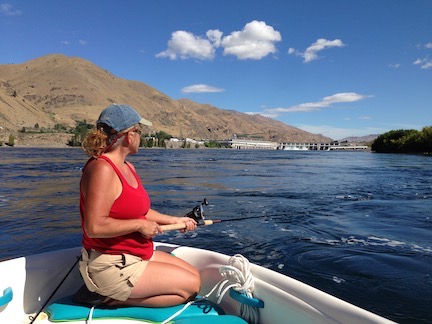
My friend Janet spent a week with me in late summer 2013. We took the boat out and she did some fishing. A typical trip would be to drive at full throttle up to the nearest dam, kill the engine, and drift back downriver, listening to music, snacking, and talking with whoever had come along for the ride.
When I moved up to Washington “full-time” to reboot my life closer to work, the boat became part of that life. My garage was big enough to store it and although I didn’t use it as much as I wanted to, it was great to be able to just hook it up to my Jeep and drag it down to the Columbia River on a hot summer day with friends. I even dragged it to Arizona behind my truck camper years later, long after that fifth wheel had been sold so I could go boating on the Colorado River, Lake Havasu, and Lake Pleasant.

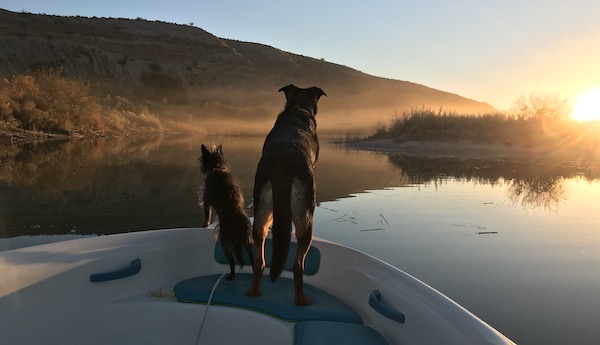
Although I didn’t use the boat as much as I liked when I took it back to Arizona, it was good for a few outings on the Colorado River, Lake Pleasant, and Lake Havasu. Here’s my old dog Penny with Janet’s dog Dually on the bow when we headed out to the Colorado River late one afternoon.
But time marches on. I wanted to do more serious boating. Cruising in something I can live aboard while covering long distances. Like maybe the 6,000 mile Great Loop. After a series of unexpected positive events, I wound up buying the 2019 Ranger Tug R29 CB I named Do It Now. I’ve spent a total of 179 days on board since September 5, 2022 and I’ll be going back for more at the end of this September.
I didn’t need that little jet boat any more. I knew that, despite the fact that I really liked it and how easy it was to just go out on the river for a day of fun. It was taking up space in the garage, space I’d hoped to store other stuff in. Like maybe a trailer for that bigger boat.
Selling the Boat
So after a lot of soul searching, I put it up for sale last week.
I suspected, at this point, that it was worth more than I’d paid. Everything these days is worth more. (My truck camper is worth at least $7K more than I’d paid for it 6 years ago.) So I originally priced it at $2200, hoping to settle on $2,000.

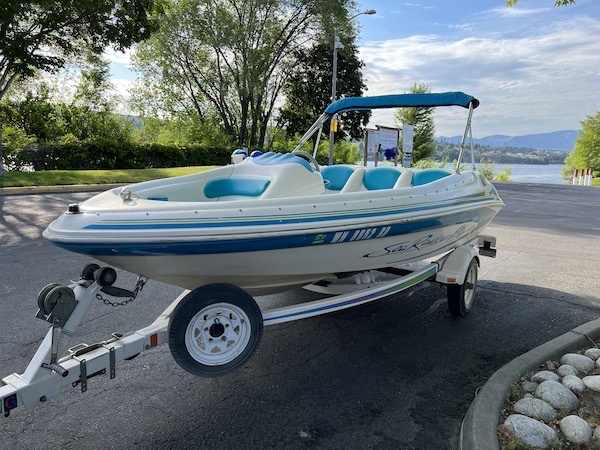
Here’s the boat on the last day I owned it. I’d taken it down to the river for one last ride with the neighbors who were interested in buying it. I almost changed my mind — as I almost had on my last motorcycle ride — but stayed firm.
The neighbors who wanted to buy it — well, she did and he didn’t and he won — said it was worth more. So when I dropped it off at Bob’s house where it would get a lot more exposure, I suggested $2500. He thought that was high, but it was worth a try.
It sold in less than 24 hours for the full asking price of $2500. I paid Bob a commission and pocketed $2250.
Did I lie about the boat’s value back in 2013? No. I think inflation and the fact that the 28 year old boat was in mint condition — due to being garaged for its entire life — worked in my favor.
And thus ends another subchapter of my life: my small boating days.



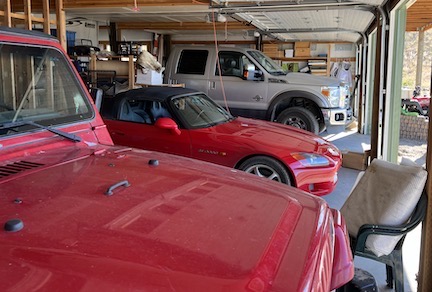
 This might be the only photo I have of my Honda and Toyota parked side by side. For years, the Toyota lived at whatever airport I flew my helicopter to most often: Prescott, Scottsdale, and, in this photo, at Phoenix Deer Valley.