Dear Census Bureau

Does anyone there know how to think?

Census LetterMarch 11, 2010

Robert M. Groves
Director, U.S. Census Bureau
United States Department of Commerce
Washington, DC 20233

Dear Mr. Groves,

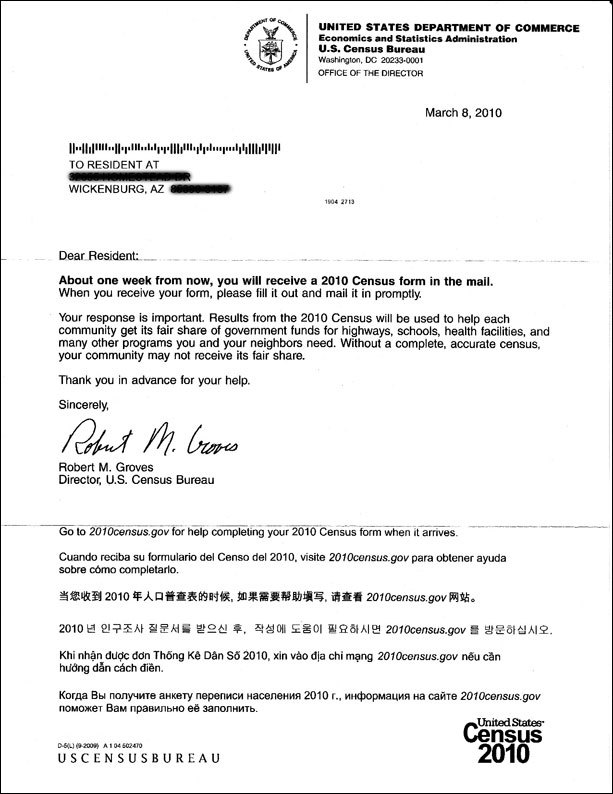
Thanks so much for your letter of March 8, 2010. It’s interesting to see that the U.S. Government can spend our tax dollars to send mail to millions of people just to let them know that it’s sending them more mail.

While I’m sure this two-punch mass mail campaign will help replenish the ailing U.S. Postal Service’s coffers, have you considered the impact on the ailing U.S. Government’s coffers? Our country currently has a record deficit, yet your office has elected to waste millions of taxpayer dollars on printing, labor, and postage — just to let us know that we’ll receive another costly mailing in a week.

Tell me, will you follow that up with yet a third mailing to make sure we got the second one? Or can we expect a personal visit from a Census Bureau employee to follow up?

Sincerely,
Resident

Some Concerns about Home-Schooling

Is it an excuse to teach religion instead of science?

I’ve always been concerned about the quality of education kids get these days. Underpaid teachers, peer pressure that rewards bad behavior, high drop-out rates. As I reported back in November 2008, kids are graduating the local high school without knowing how to tell time on an analog clock. It’s impossible to have an intelligent conversation with most teens; they seem absolutely clueless about anything that isn’t on television or the Internet — and I’m not talking about PBS or Wikipedia here. They can’t spell because they have spelling checkers that do that for them. They can’t do math without a calculator. While I’m obviously not talking about all young people here — there would be absolutely no hope for America’s future if the problem affected every kid — it’s certainly more than half of the ones I come in contact with.

And “No Child Left Behind” just made the situation worse. It forced teachers and schools to teach just so kids would pass exams. Teaching by rote rather than ensuring that kids understand what they’re being taught is not doing the next generation any good.

These days, concerned parents are taking an active role in their kids’ education. While I personally believe that working together at the end of the day on homework and even just discussing what was learned in school each day is enough, many parents are going the extra step: they’re home-schooling their kids.

I’ll admit that I don’t know much about home-schooling. I don’t have kids; I decided early in life not to take that path. I don’t regret it. I sometimes wonder how my kids would have turned out — whether they’d be smart or lazy or interesting or dull. I’d like to think that they’d know how to tell time by the age of 18 and aspire to something more substantial than stocking shelves at the local supermarket.

I do know that if my kids weren’t getting the education they needed at school and I couldn’t help them by being part of their nightly homework routine, I’d likely consider home-schooling. After all, if you want something done right, sometimes you have to do it yourself.

My neighbor home-schools her kids. She has four of them ranging in age from about 5 to 12. She and her husband are either Evangelical or Born-Again Christians. I don’t know which and I don’t care. The last thing I want to do is have a discussion about religion with people who scratched religious slogans into the wet concrete of their driveway.

And this brings up my concerns about home-schooling. While browsing the news with the Associated Press (AP) mobile application on my BlackBerry (while waiting for a notary public at the bank), I stumbled upon an article titled, “Top home-school texts dismiss Darwin, evolution.” It reported:

“The majority of home-schoolers self-identify as evangelical Christians,” said Ian Slatter, a spokesman for the Home School Legal Defense Association. “Most home-schoolers will definitely have a sort of creationist component to their home-school program.”

It went on to say that, “Two of the best-selling biology textbooks stack the deck against evolution,” according to educators who reviewed the books.

And this is the root of my concerns. I believe that science textbooks and science lessons should be about science. Evolution is a widely accepted component of the science of biology. The alternative — creationism or its disguised alter-ego, “intelligent design” — is not. There is a wealth of scientific evidence to back up evolution; there is no evidence to back up creationism.

Clearly, the failure to teach accepted science as that — accepted science — is a serious shortcoming in the home-schooling textbooks that shoot down evolution. The children being taught that evolution is “only a theory” are being given an inadequate education — one that could put them at a serious disadvantage if they go on to college or attempt to pursue careers in science or medicine.

One of the books doesn’t hide its intent:

“Those who do not believe that the Bible is the inspired, inerrant Word of God will find many points in this book puzzling,” says the introduction to “Biology: Third Edition” from Bob Jones University Press. “This book was not written for them.”

The textbook delivers a religious ultimatum to young readers and parents, warning in its “History of Life” chapter that a “Christian worldview … is the only correct view of reality; anyone who rejects it will not only fail to reach heaven but also fail to see the world as it truly is.”

The Christian worldview is the only correct view of reality? In whose world? I don’t think the millions of Jews, Muslims, or Hindus in the world would agree with that statement. I know the atheists wouldn’t. Does that mean that Christian children should be taught a different version of reality than the rest of the world? To what benefit? Certainly not the benefit of the children.

And what of the home-schooling parents that don’t want religion to be part of their children’s curriculum? The AP article discusses their struggle to find appropriate science textbooks.

Evolution Book(Might I suggest starting with Daniel Loxton’s excellent book, Evolution: How We and All Living Things Came to Be? It’s not a textbook, but it’s a great introduction to evolution for kids and parents.)

So here’s my question: if a school board has to approve textbooks that are used in public school classrooms and home-schooled students have to take and pass standardized exams, who is approving the textbooks used in home-school “classrooms”?

And then I recall this, a piece of “Hate Mail” that was sent to Bobby Henderson of the Church of the Flying Spaghetti Monster. You can find it here, but to save effort for the folks too lazy to click, I’ll repeat it here in all its glory, as an example of home-schooling gone terribly wrong:

wow you people are crazy i pray to my LORD jesus christ that you people wake up God created man in his own image and im sorry but if you look like noodles with meatballs growin out your BUTT you need to go back to SPACE or get back in the pan where you’ll be somebodys dinner!

people will believe anything!!

i am verryyy happy i was well homeschooled becuase i would be in jail for punching a teacher in the face when she tried to tell me about this so called spagetti monsterr!

i hate to be the breaker of bad news but when you look around when u die u wont be with your master meatball you’ll be burning in the pits of HELL and i am a REAL christian and that hurts to know that so many people are gonna be in hell! over a random guy that started a joke and has nothing better to do besides make up some god for fun then see how many people are loving this idea.

God bless you wacked out meatball loving freaks!

-christy

(I recommend Bobby’s site if you’re interested in seeing where reason and faith collide.)

Christy is right about one thing: People will believe anything. But is it right to teach it to their kids?

The Window of Opportunity

Sometimes you just get lucky.

This is a follow-up to the post that appeared here on Friday, “The Tour Operator’s Fly or Don’t Fly Decision.” In that post, I explained why I wasn’t going to take a party of three passengers on a 3+ hour scenic flight in northern Arizona in Thursday’s high winds.

It was a very good decision. We flew on Friday instead. What a difference a day makes! The skies were completely clear and winds seldom topped 10 MPH anywhere on our route.

We had a smooth flight up the Verde River before climbing over the Mogollon Rim west of Payson to Meteor Crater. We passed a herd of buffalo just southwest of the crater and I was able to do a low-level circle around them for the benefit of my passengers.

Here’s a quick video of the Meteor Crater overflight, taken from a camera mounted inside my helicopter’s bubble. Narration was added afterward.

It was a bit bumpy from there to the Grand Falls of the Little Colorado River, which were flowing but not exactly “grand” that day. (We need more snow melt to really get them going.)

This video shows the no-so-grand Grand Falls of the Little Colorado River. Look closely and you’ll see a truck parked along the right rim of the canyon; gives you an idea of scale.

Then south of Flagstaff Airport to Oak Creek Canyon and into Sedona. My passengers had lunch at the airport restaurant while I arranged for fuel and chatted with the folks at the terminal. On the way back, we did a quick flyby of Montezuma’s Castle, climbed up the mountains southwest of Camp Verde, and followed the Agua Fria River to Lake Pleasant. I showed them the ruins atop Indian Mesa and one of my passengers spotted some wild burros, so I swung around to give them all a good look. From there, we returned to our starting point at Scottsdale Airport.

I logged 3.4 hours of flight time in the nicest of conditions. My passengers — and I! — really enjoyed the flight. And it was nice to put a little cash in Flying M Air’s coffers.

On Saturday, the wind kicked up again, although not as bad as it was on Thursday. Then storms moved in. It rained almost all day in the Phoenix area (and Wickenburg) and snowed up north. There were low clouds all day Sunday and even now, as I write this around dawn on Monday, I can see low clouds out my window. (Oddly, I got a call from a Phoenix area concierge asking if I could do a nighttime tour of Phoenix last night; what kind of scenic tour did they expect when you can’t see more than a mile or two in mist? Sheesh.)

Of course, all this rain is very unusual for Arizona. We’ve had more rain in the first two months of this year than we did all 12 months of last year.

In general, I consider myself (and my passengers) lucky to have slipped into that narrow window of opportunity for such a long flight. It worked out great for all of us.

The Tour Operator's Fly or Don't Fly Decision

It should be about client experience, shouldn’t it?

Yesterday, like all other days I’m scheduled to fly, I faced a pilot’s usual weather-related fly/don’t fly decision. While the weather in Arizona is usually so good that flying is possible just about every day of the year, yesterday’s weather forecast was different. It required me to make a real decision.

SDL to Meteor Crater

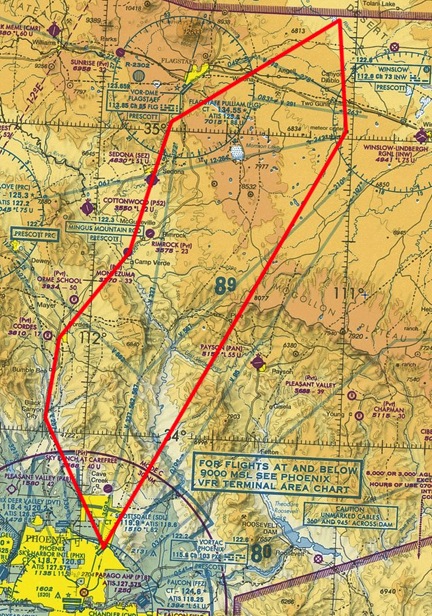
As this marked-up WAC shows, the most direct route I’d take for this flight has us spending extended periods of time at high elevation over mountains.

I was scheduled to do a custom tour of Meteor Crater and the Grand Falls of the Little Colorado River in northern Arizona with a lunch stop on the return trip in Sedona. The total flight time would be about three hours, with much of it conducted over mountainous or high altitude (or both) terrain.

The Weather

I’d been watching the weather forecasts for Winslow (east of the Crater), Flagstaff (between the Grand Falls and Sedona), and Sedona for a few days. Earlier in the week, there had been a 10% chance of snow in the Flagstaff area. That wasn’t worrying me much. What did worry me was the wind forecast: 20 mph plus gusts. That would make for an uncomfortable and possibly very unpleasant flight.

On the morning of the flight, the weather forecast had taken a turn for the worse. According to NOAA what I was looking at for the places we’d fly over:

Phoenix: Sunny, with a high near 64. Breezy, with a south southwest wind between 7 and 17 mph, with gusts as high as 28 mph.

Sedona: A 10 percent chance of showers after 11am. Partly cloudy, with a high near 58. South wind 6 to 9 mph increasing to between 18 and 21 mph. Winds could gust as high as 33 mph.

Flagstaff: A 30 percent chance of snow showers after 11am. Partly cloudy, with a high near 43. Breezy, with a southwest wind 8 to 11 mph increasing to between 20 and 23 mph. Winds could gust as high as 37 mph. Total daytime snow accumulation of less than a half inch possible.

Winslow: Sunny, with a high near 58. Breezy, with a south wind 8 to 11 mph increasing to between 25 and 28 mph. Winds could gust as high as 44 mph.

To be fair, we weren’t actually flying to Winslow. But we’d be about 20 miles to the west, on the same big, flat, windswept plateau.

But if that wasn’t bad enough, there was also a Hazardous Weather Outlook for entire area:

A VIGOROUS PACIFIC LOW WILL BRUSH NORTHERN ARIZONA BRINGING SOUTHWEST WINDS OF 15 TO 25 MPH WITH LOCAL GUST TO NEAR 40 MPH AND COOLER TEMPERATURES. IN ADDITION…PARTLY TO MOSTLY CLOUDY SKIES WILL SPREAD ACROSS THE AREA WITH SCATTERED SHOWERS DEVELOPING FROM ABOUT FLAGSTAFF NORTHWARD TO THE ARIZONA…UTAH BORDER. THE SNOW LEVEL WILL RANGE FROM 4000 TO 5000 FEET BY THIS AFTERNOON

Flagstaff is at 7000 feet.

I know from 2,300 hours experience flying helicopters all over the southwest that when the winds get above 20 mph and you’re flying over mountainous terrain, you’re in for a rough ride. A 15 mph gust spread in the mountains can make you feel as if you’re riding a bull at a rodeo.

And a 10% to 30% chance of rain or show showers didn’t make the situation any better. I’ve been in snow showers in the Sedona area that cut visibility to less than a mile in localized areas. Not very scenic.

The Decision

There are three ways I could make the decision:

  • Do I have to go? The simple truth is that if I had to make the flight — for example, if it were a matter of life and death — I could. I’ve flown in high winds before and although it caused white knuckles and a lot of in-flight stress, it was doable. But this was not a “must go” situation.
  • If paying passengers weren’t involved, would I go? The answer to this one was no, I wouldn’t. If this were a personal pleasure flight, I simply wouldn’t make the trip that day. I don’t take much pleasure in a rodeo ride 500-1000 feet off the ground.
  • Would passengers enjoy the trip? I’d guess the answer would be no. I fact, I’d expect the passengers to actually experience fear at least once during the flight. Turbulence are scary, especially when you seldom experience them — or have never experienced them in a small aircraft.

So the decision was actually quite simple: I would call the client and advise that we not make the trip that day. I could offer a tour of Phoenix (relatively flat, a shorter flight, much lighter winds) or the same trip the next day when the weather was expected to be much better.

I’m Selling an Experience

This is what separates me from the tour operator I worked for at the Grand Canyon back in 2004. In the spring, we routinely flew in winds up to 50 miles per hour, with fights that were so bumpy that even I, as the pilot, was starting to get sick. (Puking passengers was a daily occurrence.) Keeping in mind that we did “scenic” flights, near the end of the season, we occasionally flew in conditions with minimal visibility due to thunderstorm activity and smoke from forest fires (planned and unplanned). After one flight, when the visibility was so bad that I had trouble finding my way back to the airport, I asked the Chief Pilot why we were flying. After all, the passengers couldn’t see any more than I could. His response was, “If they’re willing to pay, we’re willing to fly.”

I don’t have this same attitude. My passengers are paying me for a pleasant, scenic tour. While I can’t control the weather, I can control when we fly. If I suspect that the weather will make the trip significantly unpleasant — or possibly scare the bejesus out of them — how can I, in good conscience, sell them the flight?

I’m not saying that I won’t fly in less than perfect conditions, but if the conditions are downright horrible for flight, why should I subject my passengers — or myself — to those conditions?

I called the passenger and explained the situation. He consulted his wife. They agreed to do the flight the next day. He seemed happy that I’d called and given him the choice.

I’m sure we’ll all have a great time.

Blogging the FARs: Avoid the Flow of Fixed Wing Traffic

What it means — and doesn’t mean.

I was at Wickenburg Airport for a short time yesterday and was dismayed to see another helicopter pilot practicing autorotations using a left traffic pattern for the taxiway parallel to Runway 23. In Wickenburg, it’s right traffic for Runway 23, keeping the airplanes on the northwest side of the runway. There are fewer houses out that way; a left traffic pattern would have you overflying dozens of homes.

Someone else at the airport told me that the owners of the homes southeast of the runway had asked this pilot several times not to overfly their homes. They were bothered by the noise of his buzzing aircraft just 500 feet over their houses over and over again. He replied that he was supposed to “avoid the flow of fixed wing traffic.” When one of the nicest guys on the airport suggested he fly on the other side, this pilot’s response was, “Fuck you.” Whoa. Seems like someone has an attitude problem.

But is he right? Should he be doing left traffic patterns if the airplanes would be doing right patterns?

The Rules

FAR Part 91.126, “Operating on or in the vicinity of an airport in Class G airspace,” says, in part:

(a) General. Unless otherwise authorized or required, each person operating an aircraft on or in the vicinity of an airport in a Class G airspace area must comply with the requirements of this section.

(b) Direction of turns. When approaching to land at an airport without an operating control tower in Class G airspace —

(1) Each pilot of an airplane must make all turns of that airplane to the left unless the airport displays approved light signals or visual markings indicating that turns should be made to the right, in which case the pilot must make all turns to the right; and

(2) Each pilot of a helicopter or a powered parachute must avoid the flow of fixed-wing aircraft.

To some, it might appear that Part 91.126(b)(2) gives helicopter pilots permission to fly wherever they want in Class G airspace, as long as it’s not anywhere near an airplane. Maybe that’s what our attitude-challenged helicopter pilot at Wickenburg thinks. But I’d argue that it’s simply not true.

Why Avoid the Flow? Why Not Join It?

Wickeburg Airport

Wickenburg Airport, from the approach end of Runway 05.

Helicopters are advised to avoid the flow of fixed-wing traffic mostly because of the significant differences in the way they operate. Helicopters are usually slower than airplanes, they tend to operate at lower altitudes, and they don’t need a runway to land or take off. Putting airplanes and helicopters together in a traffic pattern is like mixing oil and water: they just won’t blend.

But does avoiding the flow of fixed wing traffic mean creating a completely separate traffic pattern? Sometimes, it does.

Does it mean making yourself a noisy nuisance over a residential neighborhood on the side of the airport that normally doesn’t have aircraft flying over it? I say it doesn’t.

And what if there aren’t any airplanes in the traffic pattern? I’ll argue that there’s nothing to avoid so why not use their established, community-preferred traffic pattern?

And that was the problem yesterday: the bad attitude pilot was the only aircraft in the traffic pattern for the entire time he was flying yesterday. There was no fixed-wing traffic to avoid.

There was no reason to overfly those homes.

Fly Neighborly

Although I’m not a big fan of Helicopter Association International (HAI), I do want to commend them on their attempts (although usually feeble) to share information that’s useful to the helicopter community. Among that information is “The Fly Neighborly Guide” they offer as a PDF download from their site. Here’s a blurb about the program from their site:

The Fly Neighborly Program addresses noise abatement and public acceptance objectives with programs in the following areas: 

  • Pilot and operator awareness
  • Pilot training and indoctrination
  • Flight operations planning
  • Public acceptance and safety
  • Sensitivity to the concerns of the community

The point is, lots of people hate helicopters because they’re noisy. (In reality, they’re not all that much more noisy than an airplane. But because they usually fly lower, they seem louder.) By using techniques that help us fly more quietly and avoiding noise-sensitive areas, we’ll blend in with the environmental impact of aircraft traffic much better.

What does that mean to me? Well, here are some of the things I try to do:

  • Maintain speed above 80 knots in my R44 to avoid “rotor slap.”
  • Not fly low over homes, schools, or businesses.
  • Vary the flight path I use to approach or depart the airport.
  • When flying traffic patterns, choose a pattern that does not repeatedly overfly the same noise-sensitive areas. (Yes, the other day when I was practicing autorotations at Wickenburg, I shared the same standard traffic pattern with three airplanes.)

I do need to point out here that anyone who buys a home within 3 miles of an airport should expect some level of noise. If you don’t like aircraft noise, don’t buy a home near an airport. Period.

Why I Care

Why should I care that a bad attitude pilot is thumbing his nose (and perhaps making other hand gestures) at people who complain about his inconsiderate flying?

AFD for E25

The Airport/Facilities Directory entry for Wickenburg.

Well, it’s like this. Right now, at Wickenburg, there is no published noise abatement procedure. Look in the Airport/Facilities Directory and see for yourself. (Try not to notice that the diagram is inaccurate on so many levels.) That means pilots have the freedom to make their own decisions about approaching and departing the airport. We’re not forced to follow some idiotic plan set forth by an ignorant non-flyer in response to noise complaints.

But if Mr. Bad Attitude keeps ignoring the complaints and overflying the same homes again and again, the complaints will get escalated. I’m not too worried about the town doing anything — they’re extremely ineffective when it comes to solving airport-related problems. But eventually, it’ll get up to the FAA. Enough people know it’s not me — a bright red Robinson R44 looks nothing like a little white Schweitzer 300 — so I won’t get in trouble. But the FAA might actually do something to make the complaints go away. Since Mr. Bad Attitude isn’t technically doing anything wrong, the only way to fix the problem is a noise abatement program. The FAA will push the town to make one and we’ll be stuck with it.

What’s also bad is that his continued inconsiderate behavior makes everyone in the helicopter community look bad — including me and the two other helicopter owners based in town. It could cause problems in Wickenburg or other communities for helicopter pilots and operators. It could affect businesses like mine or emergency services. (Come to think of it, one of the reasons our hospital lost its helicopter medevac base was noise complaints. So if you have a heart attack in Wickenburg, you’ll just have to wait an extra 20-30 minutes for help to come.)

And all this is why I care.

In Summary

When helicopter pilots are advised to “avoid the flow of fixed-wing traffic,” that doesn’t mean we should avoid flying in empty airplane traffic patterns. It means we should avoid flying with airplanes.

It also doesn’t mean we should use FAR 91.126(b)(2) as an excuse to become a nuisance by repeatedly overflying noise-sensitive areas.

If there’s no conflicting aircraft, common sense should prevail.